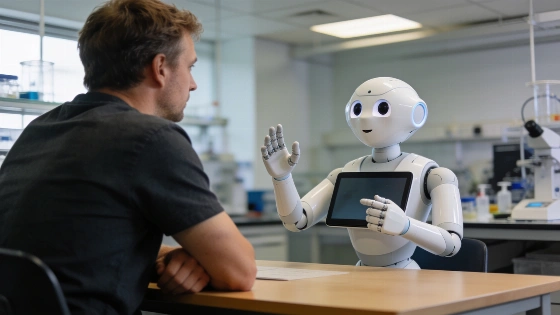
A Drexel University study found that people quickly trust expressive humanoid robots, but even minor conversational mistakes can cause trust to collapse, raising new challenges for social robot design in healthcare, education, and homes
Researchers at Drexel University have conducted a controlled study examining how adults build and lose trust in humanoid robots during face-to-face interaction. The team evaluated the social robot Pepper in two configurations: one version displayed human-like behaviors such as eye contact, head nods, and hand gestures, while the other remained motionless and delivered identical scripted dialogue without nonverbal cues. The study is notable for its multimodal approach, simultaneously measuring participants' brain activity, oxytocin levels, behavioral choices, and self-reported trust during extended conversations with the robot.
Fifty adult participants each completed three interaction sessions with Pepper. The first two sessions were designed to be error-free, establishing a baseline of trust. In the third session, the robot deliberately introduced conversational errors-such as irrelevant responses, interruptions, and illogical statements-rather than mechanical failures. This allowed the researchers to isolate the effects of social mistakes on user trust and engagement.
Measuring Trust and Engagement
Participants interacting with the expressive version of Pepper initially showed higher engagement, paid more attention to the robot's responses, and were more likely to follow its recommendations during collaborative tasks. However, when the expressive robot began making conversational errors, trust declined sharply. Brain recordings revealed increased activity in the dorsolateral and medial prefrontal cortex-regions associated with social reasoning and expectation violation-suggesting that users interpreted the robot's mistakes as breaches of social norms rather than technical faults.
In contrast, the motionless robot's errors were processed differently. Participants appeared to treat its mistakes as isolated system failures, resulting in weaker neural responses and a less dramatic drop in trust. Behavioral data confirmed that the expressive robot's influence on decision-making fell by more than half after errors were introduced, while both robot versions experienced a measurable decline in user trust.
Physiological and Behavioral Findings
The study also reported an unexpected physiological response: participants' oxytocin levels increased after the robots made mistakes, even as trust decreased. The researchers interpret this as a possible vigilance response, where oxytocin heightens attention to unreliable social behavior rather than signaling emotional attachment. This finding complicates the common assumption that oxytocin always reflects positive social bonding in human-robot interaction.
These results highlight a key engineering challenge for social robots intended for healthcare, education, and domestic use. While expressive behaviors can enhance engagement, they also raise user expectations for reliability. When those expectations are violated, trust collapses more rapidly than with less expressive systems. Designers must therefore balance social expressiveness with robust error handling and dependable performance to avoid undermining user confidence.
Design Implications and Related Research
The Drexel study underscores the importance of integrating psychological and neurobiological insights into social robot design, rather than focusing solely on likeability or engagement metrics. As humanoid robots are increasingly deployed in sensitive environments, even minor conversational failures can have outsized effects on user trust and willingness to collaborate. This challenge is not unique to conversational robots: related research on collaborative robots, such as the ergoCub system for shared lifting tasks, has also shown that human expectations and trust dynamics are central to successful deployment.
While the Drexel study provides new evidence on the fragility of trust in expressive robots, it also raises questions about how best to measure and manage user expectations in real-world settings. The findings suggest that social cues, while valuable for engagement, must be matched by technical reliability and transparent error recovery to maintain user confidence over time.
Understanding trust in human-robot interaction requires attention to both psychological and physiological responses. In this context, automation bias-the tendency for people to over-rely on automated systems-can be amplified or disrupted by a robot's social behaviors. When a robot simulates human-like cues, users may unconsciously apply social expectations, making them more sensitive to errors that would be tolerated in less expressive machines. Effective social robot design must therefore account for these biases, ensuring that engagement features do not inadvertently undermine trust when failures occur.