Archaeologists have uncovered a pre-Inca Huaylas settlement in Peru's Cordillera Negra, revealing evidence of urban planning, specialized craft production, and later Inca occupation through pottery, architecture, and workshop remains
Archaeological investigations in Peru's Cordillera Negra Mountains have brought to light a pre-Inca settlement attributed to the Huaylas, a group known primarily for camelid herding. According to a report from Andina News Agency, the site, located in the Ancash region of western Peru, preserves architectural and material evidence dating to approximately 1200 CE. The research team, led by Ilder Cruz Mostacero of Peru's National University Santiago Antunez de Mayolo, has documented a range of features that suggest a complex and organized community structure prior to Inca expansion in the region.
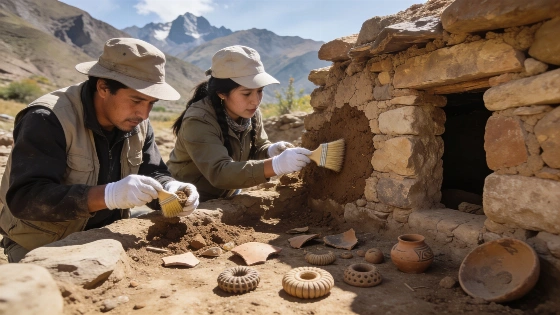
Excavations have revealed domestic and funerary architecture, including stone-built houses and burial structures, as well as monolithic elements. Among the most notable finds are pottery vessels, spindle whorls, and grinding stones, which indicate both daily domestic activities and specialized craft production. The presence of metalworking workshops, complete with furnaces and tools for processing raw materials, points to a degree of technological sophistication and economic specialization within the settlement.
Settlement Organization
One of the key findings at the site is the evidence for planned infrastructure. Archaeologists identified drainage systems and pathways that connect various buildings, suggesting that the Huaylas community engaged in deliberate urban planning. The spatial organization of the settlement, with designated areas for craft production and domestic life, reflects a level of social coordination not always documented in highland Andean sites of this period.
Material evidence for textile production is particularly strong. Numerous spindle whorls and spaces dedicated to processing camelid wool were recovered, supporting the interpretation that textile manufacture was a significant activity. Camelids, such as llamas and alpacas, would have provided both raw material for textiles and a means of transport, facilitating trade with neighboring groups. The integration of animal husbandry, craft production, and trade networks is consistent with broader patterns observed in pre-Inca Andean societies.
Chronology and Later Occupation
Based on ceramic typology and stratigraphic context, the main occupation of the site is dated to around 1200 CE, prior to the region's incorporation into the Inca Empire. The site's later layers show evidence of Inca presence, including architectural modifications and material culture associated with imperial administration. However, the settlement appears to have been abandoned in the early colonial period, likely as a result of broader social and political changes following Spanish conquest.
Quantitative data from the excavation include the recovery of dozens of pottery fragments, multiple spindle whorls, and several metalworking furnaces. The architectural remains span an area of several hundred square meters, with at least two distinct phases of construction identified in the stratigraphy. The preservation of organic materials is limited, but the stone architecture and ceramic assemblage provide a robust basis for interpretation.
Interpreting the Evidence
While the archaeological context supports the interpretation of a planned settlement with specialized production, several uncertainties remain. The precise scale of the community, the extent of its trade connections, and the social organization of its inhabitants require further investigation. The absence of written records from the Huaylas period means that much of the interpretation relies on material evidence and comparative analysis with other Andean sites. The transition from Huaylas to Inca control is visible in the archaeological record, but the nature of this process-whether gradual integration or abrupt conquest-remains a subject for ongoing research.
Understanding the development of early Andean settlements depends on careful analysis of both architectural and artifact evidence. In this case, the combination of domestic, funerary, and workshop remains provides a window into the daily life and economic strategies of a pre-Inca community. The findings contribute to a growing body of evidence that Andean societies engaged in complex forms of urban planning and craft specialization well before the rise of the Inca Empire.
Archaeological dating at sites like this often relies on a combination of ceramic typology and stratigraphic analysis. Ceramic typology involves comparing pottery styles and manufacturing techniques to established regional sequences, allowing archaeologists to estimate the relative age of occupation layers. Stratigraphy, the study of soil and deposit layers, helps establish the sequence of construction and use at a site. While these methods provide a framework for dating, they are subject to limitations such as disturbance from later activity or incomplete preservation. Direct radiocarbon dating of organic remains, when available, can refine these estimates, but in many Andean highland sites, organic preservation is poor, making ceramic and architectural evidence especially important for reconstructing settlement chronology.