Computer simulations suggest turbulent water rising through Europa's ice would freeze its pathways shut, making shallow surface pools poor indicators of the moon's buried ocean
NASA's Europa Clipper is traveling toward Jupiter to investigate whether Europa has conditions that could support life. The spacecraft is scheduled to begin its close study of the icy moon after arriving in April 2030, but a new modeling study suggests that one of the mission's most tempting targets-shallow water near the surface-may not be directly connected to Europa's global ocean.
Ice as a barrier
Europa's ocean lies beneath a frozen shell that may be several kilometers thick. Evidence from the Voyager and Galileo missions indicates that the moon contains a global body of liquid water, with more than twice the volume of water in all of Earth's oceans combined. Because the ocean is hidden, scientists have considered fractures, water plumes and warm surface regions as possible routes for material from below to reach spacecraft in orbit.
Research led by planetary scientist Lujendra Ojha of Rutgers University challenges the assumption that ocean water can travel upward through the ice as a relatively stable stream. The study describes the shell as a much more effective thermal barrier than some earlier simplified models allowed. Water moving through a crack would interact chaotically with its extremely cold walls, losing heat as it rises.
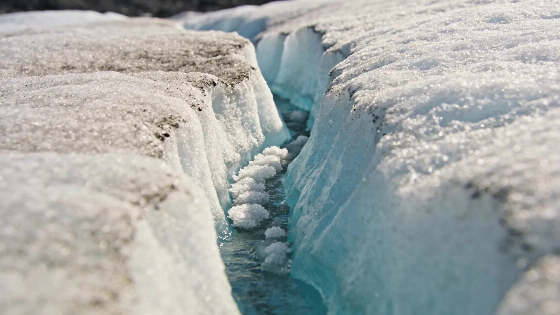
That process matters because a fracture is not simply an insulated pipe. Turbulent flow can move water back and forth across the channel, increasing contact with the surrounding ice. According to the study's calculations, the liquid could cool rapidly enough for the crack to seal, in some cases within hours, before the water reached shallow depths.
What the simulations tested
Ojha's team used computer simulations to examine how liquid water would behave as it moved through fractures in Europa's ice shell. Earlier approaches often treated the flow as smooth and orderly. The new calculations instead included turbulent motion and the associated loss of heat, producing a less favorable route from the deep ocean to the surface.
As the water cools, it can remain liquid below its usual freezing temperature, a state known as supercooling. That unstable condition allows tiny ice crystals to form. These crystals, called frazil ice, can accumulate into a slushy blockage that restricts or stops the flow. The result is not a direct observation of Europa's interior; it is a physical inference from a model of fluid motion, heat transfer and ice formation.
The researchers found that wider fractures might carry more water, but avoiding complete blockage would require channels that are unrealistically long or present in very large numbers. This does not rule out water movement within the ice shell. It does, however, reduce the likelihood that a shallow reservoir would routinely be replenished by liquid rising directly from the ocean.
Implications for flybys
NASA's Europa Clipper is planned to make 49 close flybys of Europa. Its instruments will study the moon's surface, interior structure and surrounding environment, searching for evidence relevant to habitability. A plume or a shallow liquid deposit would be scientifically valuable because material near the surface is easier to examine remotely than water buried beneath kilometers of ice.
The new study suggests that such a feature should not automatically be treated as a sample of the deep ocean. If Clipper detects shallow liquid or related surface anomalies, a more likely explanation may be localized melting within the ice shell. That distinction will affect how scientists interpret chemistry measured by remote-sensing instruments and how confidently they connect surface features to the ocean below.
The same caution will apply to the European Space Agency's Jupiter Icy Moons Explorer (JUICE) mission, scheduled to arrive at Jupiter in July 2031. JUICE will study Jupiter and three ocean-bearing moons-Europa, Ganymede and Callisto. Neither mission's detection of a surface feature, by itself, would establish that the feature is supplied by the deep ocean or that Europa hosts life.
What remains uncertain
The modeling result changes the interpretation of possible observations rather than eliminating the possibility of exchange between Europa's ocean and its surface. Water could still move through unusually favorable fractures, and other mechanisms could transport heat or material through the shell. The study instead indicates that sustained direct upwelling through ordinary cracks is physically difficult under the conditions represented in the simulations.
That limitation is important for astrobiology. Europa may remain a potentially habitable ocean world, but habitability is not evidence of biology. Even a plume, salt deposit or shallow pool would need to be characterized in detail, with competing geological and chemical explanations tested before it could be linked to the ocean's composition.
The research was published July 23 in Nature Astronomy. Its practical value is prospective: it gives mission scientists a framework for distinguishing local melting from deep-ocean transport when Europa Clipper and JUICE return data. The spacecraft will provide observations that can test how well this model describes the real moon, but the simulations alone do not show whether Europa's ocean has ever reached the surface.
Supercooling occurs when liquid remains below its normal freezing point without immediately becoming solid. In a narrow fracture, small disturbances can trigger ice formation, producing frazil ice-loose crystals that behave more like slush than a solid sheet. Because turbulent flow increases contact between the water and the cold fracture walls, it can accelerate both cooling and blockage. This is why a water pathway that appears geometrically possible may still fail as a long-lived route from Europa's ocean to its surface.