A highly active sunspot has produced an M6.9-class solar flare and launched a coronal mass ejection toward Earth, raising the possibility of geomagnetic disturbances and enhanced auroral activity later this week
An active region on the sun, designated sunspot 4513, has produced a significant M6.9-class solar flare while facing Earth, accompanied by a coronal mass ejection (CME) that may interact with Earth's magnetosphere in the coming days. The event has drawn attention from space weather researchers due to its potential to trigger geomagnetic activity and visible auroras at higher latitudes.
Solar Flare and CME Details
The M6.9 flare was recorded on August 25, peaking at 10:00 UTC, according to data from solar monitoring networks. Sunspot 4513 has exhibited heightened activity over the past 24 hours, producing multiple M-class flares-each an order of magnitude more energetic than C-class events. M-class flares are considered moderate but can still disrupt radio communications and impact satellite operations.
During the flare, a moderate (R2) radio blackout was observed across the sunlit side of Earth, temporarily affecting high-frequency radio signals over regions including Africa, Europe, and the Arctic. The associated CME was detected leaving the solar surface shortly after the flare, with early modeling suggesting a glancing impact on Earth's magnetosphere is possible.
Predicted Arrival and Geomagnetic Impact
Initial simulations from NASA's WSA-ENLIL+Cone model indicate that the CME could reach Earth around 10:00-11:00 UTC on August 28, with an uncertainty window of approximately seven hours. The CME is described as relatively slow-moving, which typically reduces the likelihood of severe geomagnetic storms. However, the precise impact will depend on the CME's magnetic field orientation upon arrival.
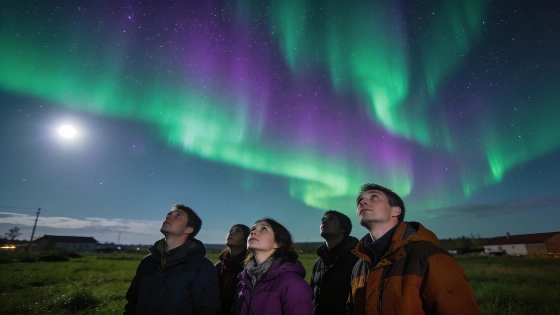
In addition to the CME, the Solar Influences Data Analysis Center (SIDC) forecasts that a high-speed stream of solar wind from a positive-polarity coronal hole will begin influencing Earth's space environment from August 27. The combination of the CME and the fast solar wind stream could increase geomagnetic activity, potentially raising the chances of auroral displays at mid to high latitudes.
Uncertainty and Observational Limits
Whether the CME will produce significant geomagnetic effects remains uncertain. The most important factor is the orientation of the CME's embedded magnetic field. If the field is strongly southward when it reaches Earth, it can couple more efficiently with Earth's own magnetic field, enhancing geomagnetic disturbances. If the field is oriented northward, the impact is likely to be minimal.
Space weather forecasters are monitoring the situation closely, with updated model runs expected as the CME approaches. The event follows a period of increased solar activity, and the potential for visible auroras will depend on the timing and interaction of the CME and solar wind stream. For those interested in observing the night sky, recent events such as the partial solar eclipse and Perseid meteor shower earlier this month, covered in our recent report on coordinated solar and meteor observations, highlight the dynamic nature of space weather phenomena.
Key Measurements and Scientific Context
The M6.9 flare from sunspot 4513 was one of several M-class events recorded within a 24-hour period, with the flare peaking at 10:00 UTC on August 25. The associated CME is predicted to arrive at Earth between 10:00 and 11:00 UTC on August 28, with a model uncertainty of ±7 hours. The radio blackout caused by the flare was classified as R2 on the NOAA scale, affecting high-frequency communications across sunlit regions. The high-speed solar wind stream is expected to begin influencing Earth's magnetosphere from August 27, with unsettled to active geomagnetic conditions forecast and a chance of minor storm levels if the CME and solar wind stream interact constructively.
Solar flares and CMEs are monitored using a combination of ground-based observatories and space-based instruments, including solar telescopes, coronagraphs, and magnetometers. These tools allow researchers to track solar activity, model CME trajectories, and forecast potential impacts on Earth's space environment. The current event underscores the importance of continuous solar monitoring as the sun approaches the peak of its 11-year activity cycle.
Solar flares are sudden releases of energy from the sun's atmosphere, often associated with active sunspot regions. When a flare is accompanied by a CME, large quantities of charged particles and magnetic fields are ejected into space. If these reach Earth, they can interact with the planet's magnetosphere, producing geomagnetic storms and auroras. The severity of the impact depends on the speed, density, and magnetic orientation of the CME, as well as the state of Earth's own magnetic field at the time of arrival.