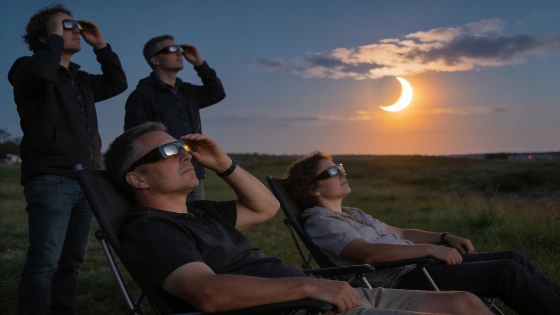
On August 12, observers across North America and Europe will witness a partial solar eclipse by day and the Perseid meteor shower by night, with optimal viewing conditions expected due to the new moon and clear skies in many regions
August 12 brings a rare opportunity for skywatchers as a partial solar eclipse coincides with the peak of the Perseid meteor shower. This alignment offers a unique chance to observe two major astronomical events within a single 24-hour period, with both phenomena visible from different regions and under favorable conditions for much of the Northern Hemisphere.
Daytime Eclipse Visibility
During daylight hours, a partial solar eclipse will be visible across large parts of North America, including Alaska, eastern Canada, and the northeastern United States. Observers in these regions will see the Moon partially obscure the Sun, with the degree of coverage varying by location. In Europe, a total solar eclipse will be observable from eastern Greenland, western Iceland, and northern Spain, where the Moon will fully block the Sun for several minutes. Safe viewing requires certified solar eclipse glasses throughout the event, as even partial phases can cause eye damage.
For those unable to access the path of totality, space agencies such as NASA and the European Space Agency are providing live streams of the eclipse, particularly from Spain, beginning at 13:00 EDT. The eclipse's path and timing have been mapped in detail, and the event is expected to draw significant attention from both amateur and professional astronomers. As previously discussed in our coverage of the coordinated timing of these events, the overlap between the eclipse and meteor shower is an uncommon occurrence (see our earlier analysis of the August 12 alignment).
Perseid Meteor Shower Peak
After sunset, the Perseid meteor shower will reach its maximum activity, with the best viewing hours between midnight and 2 a.m. local time. The Perseids are known for producing bright, fast-moving meteors, and this year's new moon ensures minimal interference from moonlight. Under dark-sky conditions, observers may see between 50 and 75 meteors per hour, according to estimates from The Planetary Society. The shower is caused by Earth passing through debris left by Comet Swift-Tuttle, with meteors appearing to radiate from the constellation Perseus.
In addition to meteors, the absence of moonlight will make it easier to observe the Milky Way and several planets that will be visible before dawn. The combination of a solar eclipse and a major meteor shower in a single night is rare, and many astronomy enthusiasts are planning special activities, including group observations and travel to optimal viewing sites.
Public Engagement and Observing Plans
A recent poll of over 240 readers found that 51% plan to observe both the eclipse and the meteor shower, while 21% are interested only in the Perseids. About 20% reported that they are outside the eclipse viewing area and will rely on online streams. A small minority indicated no plans to participate. Some observers are organizing unique experiences, such as traveling to Spain to combine eclipse viewing with surfing, highlighting the event's appeal beyond the astronomy community.
For those preparing to observe, recommended equipment includes certified eclipse glasses for daytime viewing and, for nighttime, a reclining chair and patience under dark skies. Weather conditions and local light pollution will affect visibility, but the new moon and the timing of the shower's peak offer favorable circumstances for much of the Northern Hemisphere.
Numerical Context and Observational Limits
The partial solar eclipse will be visible to millions across North America, with the maximum obscuration occurring in the northeastern United States and eastern Canada. The total eclipse path, stretching from eastern Greenland through Iceland to northern Spain, will last several minutes at maximum. The Perseid meteor shower, peaking overnight on August 12-13, is expected to produce 50-75 meteors per hour in dark-sky locations, with the best rates observed after midnight. The new moon phase ensures that faint meteors will be easier to detect, but local weather and light pollution remain limiting factors.
While the overlap of these two events is notable, the ability to observe both depends on geographic location and sky conditions. Not all regions will experience both phenomena, and the eclipse's partial phases require strict eye protection. The meteor shower's visibility is also sensitive to cloud cover and artificial lighting, underscoring the importance of preparation and site selection for optimal results.
Understanding the mechanics of a solar eclipse and a meteor shower requires familiarity with orbital dynamics and observational astronomy. A solar eclipse occurs when the Moon passes directly between Earth and the Sun, casting a shadow on Earth's surface and temporarily blocking sunlight. The degree of obscuration depends on the observer's location relative to the path of totality. Meteor showers, such as the Perseids, result from Earth intersecting the debris trail of a comet, with particles entering the atmosphere and producing visible streaks of light. Both phenomena are predictable but require careful planning and appropriate equipment to observe safely and effectively.