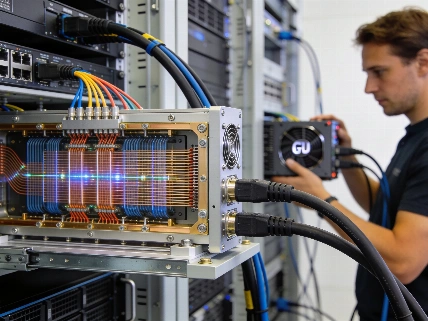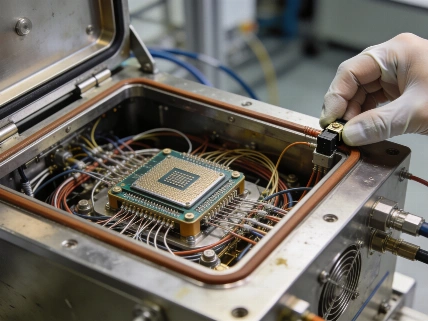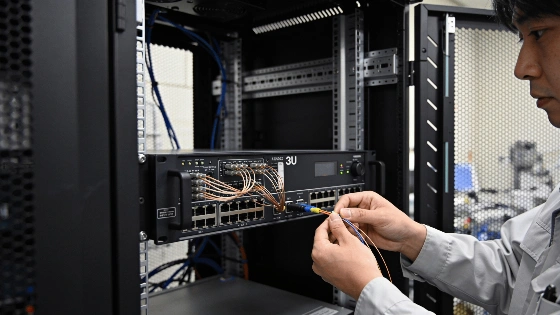
The three-year program assigns shared engineering targets to Dutch research groups and companies, including sub-10 ns feed-forward control and 0.1 dB coupling loss per fiber facet
A photon lost at a chip boundary can carry away quantum information before it reaches a processor's core. QuiX Quantum is leading a Dutch program to address that and other linked engineering constraints as it lays the groundwork for a universal photonic processor with more than 100 qubits.
A shared architecture
The initiative sits within Phase II of the PhotonDelta National Growth Fund Integrated Photonics Programme. Titled "Delivery of a 100+ Qubit Universal Quantum Computer," the mission is scheduled to run from January 2026 through December 2028. The Quantum Insider's report describes twelve technical deliverables spanning the photonic-computing supply chain. The announcement describes a research and manufacturing mission, not a completed 100+ qubit machine or a demonstrated fault-tolerant processor.
Eight academic and industrial partners are coordinating work across the twelve system deliverables. QuiX Quantum leads system integration, shared KPI verification and development of a multi-wafer manufacturing strategy. The programme is intended to coordinate components against shared performance indicators and a common technology-readiness framework, rather than assess each part in isolation. Its scope covers photonic chips, photon sources, detectors, control electronics, packaging and manufacturing.
imec is responsible for silicon nitride photonic circuits designed for very low loss, alongside high-speed electro-optic modulators. The work is intended to align the components against a common error budget. Optical loss can accumulate as photons pass through waveguides, interferometers, packaging interfaces and detectors, making coordinated performance across the system a central engineering concern.
Loss at the interface
Fiber-to-chip packaging is one of the program's specific targets. PHIX and MicroAlign are tasked with automated optical alignment and packaging aimed at coupling losses of 0.1 dB per facet. That figure is an engineering target, not a reported measurement from a completed system.
Photon loss matters because each missing photon can reduce the information available to a photonic computation. The team's other source-related work includes quasi-deterministic single-photon emitters led by the University of Twente and Eindhoven University of Technology. The programme also includes resource-state production, with the goal of generating states below fault-tolerant thresholds.
Manufacturing coordination is a challenge across quantum hardware platforms. A separate Science Report account of Q-Block's Ottawa base describes a link between prototype design and fabrication in Alberta, a different route to connecting development with production.
Detection and feed-forward
Leiden University and Eindhoven University of Technology are assigned waveguide-integrated photon-number-resolving detectors and single-photon avalanche diode arrays. These devices address the measurement stage: a processor needs to register photons reliably to use their outcomes in subsequent operations.
Feed-forward electronics must act quickly enough to change the optical circuit while photons are still travelling through it. Bruco-IC is developing flip-chip application-specific integrated circuits with a target active feed-forward latency below 10 ns, against a stated baseline of 150 ns. The goal is to let control logic reconfigure phase shifters and optical switches before photons reach later interferometric stages.
From wafers to systems
Eindhoven University of Technology is also assigned inverse-design algorithms and post-fabrication optical trimming to mitigate variation between wafer runs. Those methods address whether components can be brought closer to their intended performance after fabrication; the mission includes process-tolerance work intended to support repeatable manufacturing across wafer runs.
The coordinated programs are also intended to inform QuiX Quantum's loss-tolerant Dedalo architecture, which targets logical-qubit demonstrations between 2028 and 2030. The national mission itself runs through December 2028, with a manufacturing strategy for systems exceeding 100 qubits as its stated endpoint.
QuiX Quantum CEO Stefan Hengesbach described the award as "a strong vote of confidence in the Dutch photonics ecosystem and in our roadmap," as reported by Quantum Zeitgeist.