Dirac Labs has secured $1.8 million in pre-seed funding to develop and test diamond-based quantum sensors designed for navigation in environments where GPS is unavailable, using nitrogen-vacancy centers and AI-driven signal processing
Dirac Labs Inc., a spinout from the University of Wisconsin-Madison, has announced $1.8 million in pre-seed investment to advance its diamond-based quantum navigation sensors. The company aims to address the persistent challenge of reliable positioning in environments where satellite-based GPS signals are blocked or degraded, such as underwater, underground, or in areas subject to deliberate interference.
Diamond NV Centers for Sensing
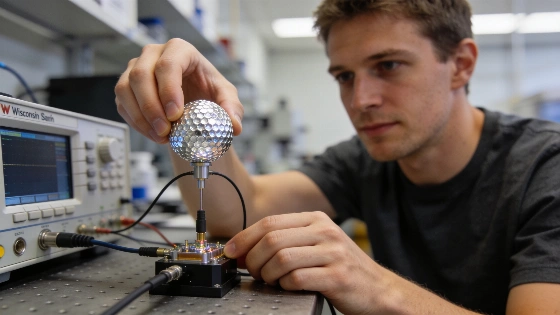
The core of Dirac Labs' approach is the use of nitrogen-vacancy (NV) centers in diamond as highly sensitive magnetometers. These quantum defects allow the measurement of minute variations in the Earth's geomagnetic field, which can serve as a reference for navigation when GPS is unavailable. The company's NVD-4 sensor, described as roughly the size of a golf ball, is engineered to detect local magnetic signatures with high spatial resolution. According to the company, this enables positioning in settings where conventional radio-frequency navigation is impractical or vulnerable to jamming and spoofing.
AI Signal Processing and Sensor Fusion
To extract reliable position information from weak and noisy geomagnetic signals, Dirac Labs integrates real-time artificial intelligence models for signal processing and sensor fusion. These algorithms are designed to filter environmental noise and compensate for platform vibration, aiming to deliver accurate location fixes in dynamic and cluttered environments. The sensors are built for plug-and-play compatibility with standard GPS device ports, targeting deployment on aircraft, submarines, autonomous underwater vehicles, and industrial equipment.
Manufacturing and Engineering Constraints
Dirac Labs reports that its sensors are fabricated using standard CMOS semiconductor foundry processes, which could reduce manufacturing costs and support higher production volumes if the technology matures. However, the practical deployment of diamond NV-center sensors at scale remains subject to engineering challenges, including device yield, calibration stability, and integration with existing navigation systems. The company's funding round was led by TitletownTech, with participation from Automotive Ventures, Riceberg Ventures, quantumEDGE Ventures, gradCapital, and angel investors. Additional non-dilutive support has come from public grant programs, including the National Oceanic and Atmospheric Administration and the Indo-U.S. Science and Technology Forum.
Context in Quantum Sensing
Quantum sensors based on solid-state defects, such as NV centers in diamond, have attracted interest for their potential to outperform classical magnetometers in sensitivity and spatial resolution. While laboratory demonstrations have established the fundamental capabilities of NV-based magnetometry, translating these results into robust, field-deployable navigation systems remains an open engineering problem. Recent efforts in the quantum sensing sector, including initiatives to integrate quantum devices with standard semiconductor fabrication, reflect a broader trend toward manufacturable quantum hardware. For comparison, other startups have focused on silicon spin qubits and superconducting quantum processors, as seen in developments like Quantum Motion's expansion into U.S. semiconductor hubs.
Dirac Labs' announcement does not include independently verified performance data or peer-reviewed publications detailing the sensitivity, accuracy, or operational reliability of its NVD-4 sensors in real-world navigation tasks. As with many early-stage quantum hardware ventures, the transition from laboratory prototype to practical deployment will depend on reproducible device performance, integration with existing infrastructure, and the ability to withstand environmental noise and operational variability outside controlled settings.
Quantum navigation using diamond NV centers relies on the quantum properties of point defects in the diamond lattice, where a nitrogen atom replaces a carbon atom adjacent to a vacancy. These centers can be optically initialized and read out, allowing the measurement of local magnetic fields with high sensitivity. The quantum coherence of the NV center's electronic spin state determines the sensor's performance, but this coherence can be degraded by temperature fluctuations, strain, and magnetic noise. Achieving reliable navigation requires not only sensitive quantum measurement but also robust signal processing and careful calibration to distinguish geomagnetic features from environmental interference. The promise of quantum-enhanced navigation is contingent on overcoming these technical barriers in real-world conditions.