DEWALT says its DALE drilling robot has completed more than 385000 concrete holes with over 99 percent accuracy; company-reported deployments include more than 300 weeks saved across 44 data-center construction phases, while August Robotics separately reported 190 weeks saved across 26 major projects.
More than 385000 concrete holes have already been drilled by DEWALT's DALE(TM) robot, according to the company, which reports accuracy above 99 percent across deployments at data-center construction sites. The result puts a mundane but consequential task at the center of industrial robotics: not spectacular movement, but repeatable positioning, drilling, dust control and verification across large work areas.
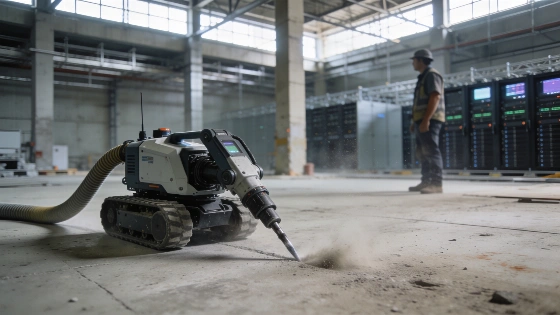
That distinction matters. DALE is not presented as a general-purpose construction machine, and the available evidence does not establish that it can handle every site condition without assistance. Developed with mobile robotics company August Robotics, the system is designed for the repeated downward drilling needed to install server racks and mechanical, electrical and plumbing systems.
DEWALT says the robot can drill at up to 10 times the speed of conventional methods. Its later company-reported deployments saved more than 300 weeks across 44 data-center construction phases, a result that indicates where the machine is intended to earn its value: by clearing a drilling workload before subsequent installation crews arrive. This figure should not be merged with an earlier July 2026 August Robotics report of 190 weeks saved across 26 major projects; the two statements refer to different reporting scopes and should be treated as separate operational metrics.
The robot moves through a work area, positions itself against a required layout and drills at specified points. Remote monitoring allows operators to oversee the work without standing beside the machine for every hole. Fast-swap batteries reduce interruptions, automatic dust extraction operates during drilling, and an AI-based quality-assurance system checks completed work. These layers resemble the instrumentation logic used in other precision-engineering fields, where a result is only useful when positioning, execution and verification are measured together.
Those features describe layered automation rather than an unsupervised replacement for a construction team. The machine performs a defined physical task, while people remain responsible for monitoring its operation and managing the wider site. The available material does not provide a breakdown of human interventions, failed holes, operating conditions, confidence intervals or independent verification of the reported accuracy. Consequently, the 99 percent figure is best understood as a company-reported performance claim, not as a peer-reviewed estimate with a published sampling protocol or p-value.
Fleet operation is the more important engineering proposition. DALE is positioned as the first fleet-capable downward-drilling robot, allowing several machines to work on the same project under the coordination of August Robotics' autonomous platform. A large data center can have several active work fronts, and a fleet of mobile drilling machines could increase capacity without assigning additional workers to the same repetitive activity.
August Robotics describes its platform as modular rather than limited to one drilling tool. Its broader offering includes autonomous robotic solutions, leasing and service infrastructure for construction, exhibition and industrial applications. For a contractor, that architecture could matter as much as the drill itself: a shared control layer may simplify task assignment, fleet supervision and maintenance across different deployments, although the available reporting does not disclose the platform's navigation error rates, uptime or communications-redundancy design.
That fleet model also makes reliability more important than a single impressive demonstration. A contractor would need machines to navigate work areas, maintain positioning, manage batteries, control dust and identify errors consistently across changing phases. The reported results show that DALE has completed substantial work, but they do not establish performance across every concrete surface, layout or construction environment. As in autonomous systems research associated with MIT and NASA, repeatability across environments is a separate engineering question from success under a defined operating envelope.
The operational argument is straightforward: faster verified drilling can make space for MEP installation and other work that follows it. Bill Beck, president of Tools & Outdoor at Stanley Black & Decker, framed the development around faster work without sacrificing consistency, safety or control. The claim is commercially relevant, but it remains a statement from the company rather than an independently published evaluation.
The idea belongs to a wider construction-robotics pattern in which machines are assigned narrow, measurable jobs rather than asked to imitate an entire human workforce. That is different from the coordinated construction teams explored in earlier construction research: DALE's value is concentrated in one repetitive operation and its integration into an active commercial site. The distinction parallels the way CERN engineering projects separate a tightly specified instrument function from the larger human-managed system around it.
DALE has also received external industry recognition. In October 2026, DEWALT reported that the system had moved beyond the pilot stage and was being presented as a market solution for data-center construction. Fast Company named it a winner in the 2026 Next Big Things in Tech Awards in the "Enduring Impact" category for companies with more than 15 years in business. DEWALT was the only tool manufacturer represented in the program, which drew more than 1000 applicants across more than 30 categories. The robot made its public debut at World of Concrete before the company brought the system into the market. The award and commercial transition are documented in a Fast Company report.
Fast Company characterizes the DEWALT-August Robotics collaboration as a human-machine partnership: robots take on physically demanding operations while people retain responsibility for organizing and controlling the process. That framing is consistent with the practical boundary between task autonomy and organizational authority. It also reflects a recurring concern in engineering literature, including work published in Nature, that system-level reliability depends not only on the machine's local control loop but also on supervision, procedures and the surrounding work environment.
For construction, the significance is practical rather than futuristic. DEWALT's figures suggest that a specialized robot can remove substantial repetition from data-center work, but they do not prove universal autonomy or eliminate the need for skilled oversight. In robotics, automation means that a machine executes a defined procedure; autonomy concerns how much decision-making it performs without intervention. DALE's reported achievement is strong evidence for the first claim, while the available information is not enough to make the second one.