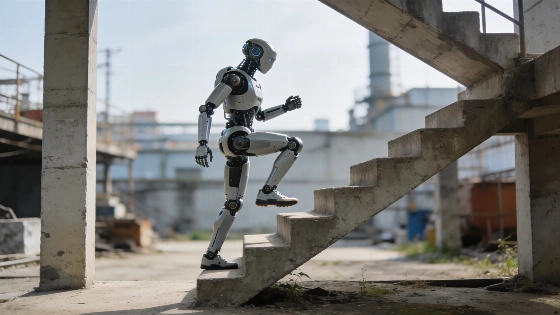
Deep Robotics has released new video of its DR02 humanoid robot climbing outdoor concrete stairs, providing evidence of its mobility on uneven terrain as the company seeks to commercialize the platform for industrial and hazardous environments
Deep Robotics has published new footage of its DR02 humanoid robot climbing outdoor concrete stairs, offering a public demonstration of the machine's ability to navigate uneven, real-world surfaces. The video, released as the Hangzhou-based company advances its commercialization efforts, shows the DR02 maintaining balance and forward motion while ascending a set of concrete steps in an uncontrolled outdoor environment. This demonstration is intended to support claims that the robot can operate beyond laboratory conditions, a key requirement for industrial and hazardous-environment deployment.
The DR02 is a 175-centimeter-tall humanoid robot designed for outdoor and factory use, with a reported weight of 65 kilograms including its battery. The robot features 31 degrees of freedom-six per leg, seven per arm, and three at the waist-and can be equipped with an optional dexterous hand. According to Deep Robotics, the DR02 achieves a typical walking speed of 1.5 meters per second, with a laboratory-tested maximum of 4 meters per second. The robot is rated to climb stairs up to 25 centimeters high and slopes up to 20 degrees, and can carry a dual-arm payload of up to 10 kilograms. Its IP66 dust and water resistance rating allows operation in temperatures from -20°C to 55°C, and its perception system combines LiDAR, depth cameras, and a wide-angle camera for environmental awareness.
The company reports that the DR02's computing is handled by an onboard 64-bit octa-core processor with 16GB of memory and 128GB of storage, supplemented by an AI processor capable of up to 275 trillion operations per second (TOPS). Power is supplied by a 20Ah, 1,440Wh swappable battery. The robot's modular design allows for rapid replacement of major components, including arms and legs, which is intended to reduce downtime in industrial settings. Recent demonstrations have shown the DR02 running on grass, jumping over obstacles, and carrying a fire extinguisher while operating near high-voltage electrical infrastructure, suggesting a focus on emergency response and inspection tasks.
Deep Robotics' latest demonstration comes as the company seeks to raise approximately $367 million through an initial public offering on Shanghai's STAR Market, following its first reported net profit in 2025. The timing of the DR02's public field tests appears intended to address investor and industry skepticism about the reliability of humanoid robots outside controlled environments. As competition intensifies among Chinese robotics firms, there is increasing scrutiny of whether such systems can perform unscripted tasks in unpredictable conditions, rather than relying on carefully staged demonstrations. For context, other companies have also showcased humanoid robots navigating complex terrain, such as DOBOT's LUMO, which was recently profiled for its ability to adapt to varied environments and user interactions (see coverage of DOBOT's LUMO platform).
While the DR02's outdoor stair-climbing demonstration provides evidence of progress in dynamic mobility, the company has not disclosed detailed success rates, number of trials, or the extent of human supervision during the test. It remains unclear how the robot performs under adverse weather, unexpected obstacles, or extended operation without intervention. As with most current-generation humanoid robots, the distinction between automated and fully autonomous operation is significant: the DR02's ability to recover from failure, handle unstructured environments, and operate safely around people and equipment will require further independent evaluation before routine deployment in industrial or hazardous settings can be established.
Robot perception is a critical capability for machines operating in unstructured environments. Perception systems typically combine multiple sensors-such as LiDAR, depth cameras, and wide-angle cameras-to build a real-time model of the robot's surroundings. This sensor fusion enables the robot to estimate distances, detect obstacles, and plan safe foot placement. However, perception remains vulnerable to environmental factors like lighting changes, reflective surfaces, and sensor noise. Reliable operation in the field depends not only on the quality of the sensors but also on the robustness of the underlying software and the ability to recover from errors or unexpected events.