A soft robotic gripper using a latex membrane and coffee grounds has demonstrated the ability to securely grasp fragile and irregular objects without cameras or complex sensors, offering a low-cost alternative for robotic manipulation tasks
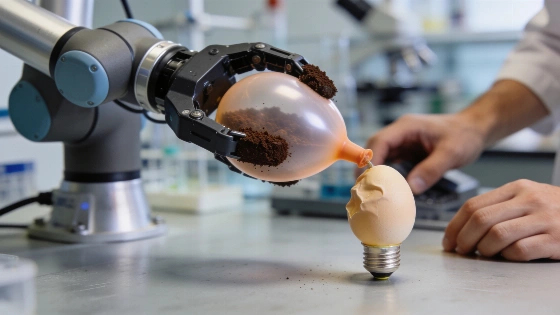
A research team has demonstrated a soft robotic gripper constructed from a latex balloon filled with ordinary coffee grounds, offering a low-cost approach to handling objects of varied shapes and fragility. Unlike conventional robotic hands that rely on cameras, force sensors, or advanced software, this system achieves secure grasping by pressing the flexible membrane onto an object and extracting air with a vacuum pump. The removal of air causes the coffee grounds to jam together, conforming to the object's surface and creating a stable grip. This method, first introduced in 2010 by researchers at Cornell University, the University of Chicago, and iRobot, continues to attract attention for its simplicity and versatility in robotic manipulation.
The gripper's effectiveness is rooted in the physical properties of coffee grounds. When loose, the grounds behave like a fluid, flowing around and filling gaps in the target object. Applying a vacuum compacts the particles, forming a rigid structure that distributes force across a broad contact area. Researchers report that even a contraction of less than 0.5% in the membrane's volume is sufficient to transform the soft bag into a solid, object-conforming grip. This approach reduces the risk of damaging delicate items, as the force is not concentrated at rigid fingertips but spread over a larger surface.
Material Selection and Performance
Experimental results indicate that coffee grounds outperform alternative fillers such as glass beads or sand. The irregular shapes and particle sizes of coffee grounds interlock more efficiently, producing a stronger jamming effect without excessive weight. In laboratory tests, the coffee-filled gripper was able to lift objects several times heavier than its own mass and release them instantly when the vacuum was deactivated. The design has successfully handled a wide range of items-including scissors, light bulbs, raw eggs, tape rolls, springs, and foam earplugs-without requiring custom programming or object-specific adaptation.
One notable limitation is the gripper's reduced effectiveness with extremely smooth or flat objects, which may not provide enough surface texture for the grounds to interlock securely. However, for many irregular or fragile items, the system offers a broader range of reliable grasping than traditional rigid robotic hands. The absence of complex sensors or feedback mechanisms simplifies both hardware and software, reducing cost and potential points of failure. Industrial versions of the technology have already been deployed on conveyor lines where product shapes and sizes vary significantly.
Deployment and Broader Context
The coffee-ground gripper operates with minimal human intervention: the robot arm presses the membrane onto the object and activates a vacuum valve. Feedback sensors are largely optional, as the gripping mechanism is based on physical jamming rather than precise force control. This simplicity improves reliability and lowers system complexity, making the approach attractive for industrial automation where cost and robustness are critical. Researchers are now investigating new soft materials and multi-bag configurations to extend the technology's capabilities for larger or more complex manipulation tasks.
This development fits within a broader trend in robotics toward soft, adaptable grippers that can handle unpredictable real-world objects. For comparison, recent advances in robot locomotion, such as the Georgia Tech framework enabling humanoid robots to walk on uneven terrain with less training, highlight the ongoing effort to reduce complexity and cost in robotic systems. Readers interested in related progress can find further details in Science Report's coverage of humanoid robots learning to walk on real terrain with reduced training requirements.
In one set of laboratory trials, the coffee-filled gripper was able to lift and release more than a dozen distinct objects, ranging from fragile raw eggs to heavy metal tools, with a success rate exceeding 90% for irregularly shaped items. The system's total weight was typically less than 200 grams, and the vacuum pump required only a brief activation-often under two seconds-to achieve a secure grip. These figures reflect controlled laboratory conditions; real-world performance may vary depending on object material, surface texture, and environmental factors.
Understanding the principle of granular jamming is central to this technology. Granular jamming occurs when loose particles, such as coffee grounds, transition from a fluid-like state to a rigid, interlocked mass under compression or vacuum. This physical transformation enables soft robotic grippers to conform to a wide variety of shapes and then lock in place, providing a secure hold without the need for precise sensing or complex control algorithms. The approach is part of a broader movement in robotics to exploit material properties for adaptable, reliable manipulation in unstructured environments.