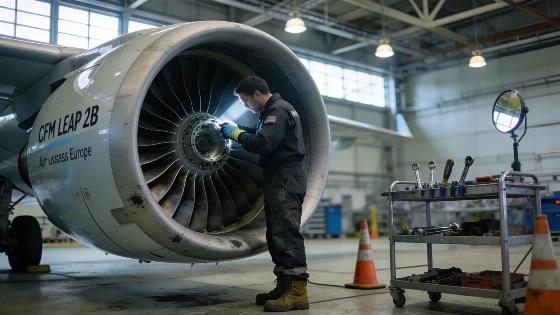
CFM International has received regulatory certification for new LEAP-1B engine upgrades, including a high-pressure turbine durability kit and a reverse bleed cooling system, both designed to extend operational time and reduce maintenance in challenging climates
CFM International has secured certification from both the US Federal Aviation Administration (FAA) and the European Union Aviation Safety Agency (EASA) for two significant upgrades to its LEAP-1B aircraft engine: a high-pressure turbine (HPT) durability kit and a reverse bleed system (RBS) for improved cooling. These developments are intended to address persistent maintenance challenges faced by operators in regions with high temperatures and airborne particulates, such as the Middle East and India, where engine wear and maintenance frequency have historically been elevated.
The HPT durability kit is engineered to extend the engine's operational period between major overhauls, a metric known as "time on wing." According to CFM International, the kit is designed to double this interval under demanding conditions, though independent field data on long-term performance is not yet available. The company has begun scaling up production of the new hardware, with a full transition to large-scale manufacturing targeted for early 2027. The upgrade will be rolled out across the LEAP-1B fleet as production ramps up, but the pace of adoption will depend on operator demand and logistical factors.
Cooling System and Maintenance Impact
The reverse bleed system (RBS) represents a new approach to engine cooling, aiming to reduce the frequency of on-wing fuel nozzle replacements-a maintenance task that can disrupt airline schedules and increase operational costs. By improving thermal management, the RBS is intended to bring LEAP-1B maintenance intervals closer to those of the older CFM56 engine family, which is widely regarded for its reliability and long service intervals. Initial engine-level certification for the RBS has been granted, but comprehensive operational data from diverse airline environments remains limited at this stage.
CFM International reports that 70% of LEAP-1A engines are now operating with the RBS, while 40% of the LEAP-1B fleet has been equipped with the HPT durability kit. These figures reflect ongoing retrofitting and production integration, but do not yet represent universal adoption across all deployed engines. The company states that the upgrades are expected to reduce maintenance demands for operators in harsh environments, but the extent of these benefits will depend on real-world usage patterns and environmental factors not fully captured in certification testing.
Deployment Scale and Reliability Context
The certification of these upgrades coincides with a major operational milestone for CFM International: the LEAP engine family has now surpassed 100 million engine flight hours since the LEAP-1A entered commercial service in August 2016. More than 10,000 LEAP engines have been delivered worldwide, according to company figures. For comparison, it took 17 years to deliver 10,000 units of the previous-generation CFM56 engine, while the LEAP program reached the same figure in just 10 years. This rapid deployment underscores strong market demand, but also increases the importance of robust maintenance and support systems as the global fleet expands.
While the company positions these upgrades as a response to operator needs in challenging climates, independent verification of long-term durability and maintenance reduction claims will require several years of operational data. Certification by the FAA and EASA establishes regulatory compliance for the new hardware, but does not guarantee performance under all real-world conditions. Operators will need to monitor engine health and maintenance outcomes closely as the upgrades are adopted at scale.
Certification, Oversight, and Remaining Questions
Both the HPT durability kit and the RBS cooling system have passed regulatory review for safety and compliance, but the certification process does not substitute for independent, longitudinal evaluation of reliability and cost-effectiveness. The upgrades are not autonomous systems; they are hardware modifications and cooling enhancements that operate within the established control architecture of the LEAP-1B engine. Human oversight remains central to engine operation, maintenance scheduling, and safety monitoring.
As with all complex aviation systems, the effectiveness of these upgrades will depend on a combination of engineering design, environmental exposure, maintenance practices, and regulatory oversight. The company's reported figures for adoption and operational hours provide a sense of scale, but do not resolve open questions about performance variability across different airlines, climates, and usage patterns. Ongoing data collection and transparent reporting will be necessary to assess whether the upgrades deliver the promised reductions in maintenance and improvements in operational efficiency.
Understanding the distinction between certification and demonstrated reliability is essential in aviation technology. Certification by authorities such as the FAA and EASA confirms that a system meets defined safety and performance standards under controlled test conditions. However, real-world reliability depends on how the system performs across diverse operational environments, maintenance regimes, and usage profiles. For hardware upgrades like the HPT durability kit and RBS, long-term evidence from field deployment will be critical to establishing their true impact on maintenance intervals and engine availability.