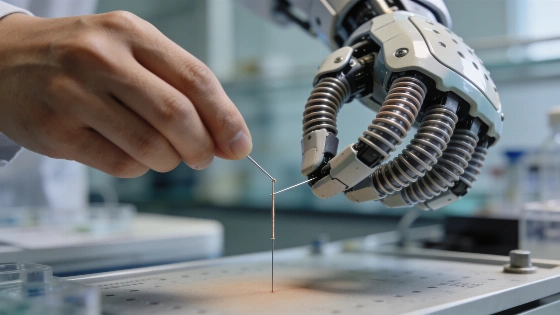
Researchers in China have built BioflexBot, a robotic hand that uses compressed air and a coiled spring to perform precise manipulations such as threading needles and opening bottle caps, aiming to reduce hardware complexity and cost
Researchers in China have introduced BioflexBot, a prototype robotic hand designed to perform dexterous manipulation using a minimalist hardware approach. Unlike conventional robotic hands that mimic the complex anatomy of human fingers, joints, and tendons, BioflexBot relies on a coiled spring, a flexible shell, and two pneumatic (compressed air) inputs to achieve a range of precise movements. The system was developed to lower the cost and control complexity typically associated with advanced robotic manipulation, while still enabling tasks that require fine motor skills.
BioflexBot was evaluated in a series of laboratory demonstrations. The robot successfully threaded an acupuncture needle, operated a laboratory pipette, and twisted a bottle cap to an angle nearly four times greater than the maximum rotation of a human hand. In further tests, the hand was able to hook and carry objects such as goggles and a toolbox, and securely grasp items of varying sizes-including objects up to 13 times larger than those handled by comparable robotic systems, according to the published study. The device demonstrated an extension and contraction range 3.5 times greater than a human hand, suggesting potential for retrieving distant or irregularly shaped objects in confined spaces.
BioflexBot's design is based on identifying the essential movements required for manipulation, rather than replicating the full structure of a human hand. By supplying compressed air through two inputs, the mechanism can bend, extend, contract, or rotate as needed for the task. This approach reduces the number of actuators and control channels, which are major sources of cost and complexity in traditional robotic hands. The research team reported that the prototype could perform cross-scale grasping and complex manipulations with only basic pneumatic control, without the need for advanced sensors or high-precision motors.
Potential applications for BioflexBot include laboratory automation, aircraft inspection, integration with humanoid robots, and operation in environments where space is limited or human access is restricted. In demonstration scenarios, the robot was used to inspect aeroengine blades, perform routine activities on a humanoid platform, and conduct a chemistry experiment involving delicate equipment. Its ability to manipulate a wide range of objects with minimal control inputs may simplify integration with existing robotic systems and reduce the engineering burden for new deployments. The approach contrasts with other recent advances in humanoid robotics, such as the LUMO robot, which combines computer vision and motion control for all-terrain mobility and interaction, as seen in this related demonstration.
Despite these promising results, BioflexBot remains an early-stage prototype. The current system operates under controlled laboratory conditions and does not yet function autonomously in unstructured environments. The developers acknowledge that further work is needed to add sensing capabilities, environmental awareness, and higher-level control, so that the robot can select appropriate movements and complete complex tasks without continuous human supervision. The research was published in the peer-reviewed journal Advanced Science, but independent replication and real-world deployment have not yet been reported.
Robotic manipulation is a longstanding challenge in engineering, requiring the integration of mechanical design, sensing, and control algorithms. Many advanced hands use multiple actuators, force sensors, and vision systems to approximate human dexterity, but this often leads to high cost and maintenance requirements. Pneumatic actuation, as used in BioflexBot, offers a route to simpler and potentially more robust designs, but typically trades off some precision and feedback. The balance between simplicity, capability, and autonomy remains a central question for the field, especially as robots are considered for use in sensitive or hazardous environments.