Ørsted and Skyports Drone Services completed a four-week cargo-drone trial at Hornsea 2, moving 55-65 kg maintenance kits between a service vessel and offshore turbines. The test included automated pickup and return, but published results do not quantify savings, emissions reductions or comparative safety.
A drone carried maintenance kits to offshore turbines and brought them back after technicians finished their work during a four-week trial at Ørsted's Hornsea 2 wind farm. The test puts cargo drones forward as a possible substitute for some routine vessel trips, but it does not establish that they are cheaper or safer in regular service. Ørsted has not announced a timeline for moving from the trial to permanent commercial operations.
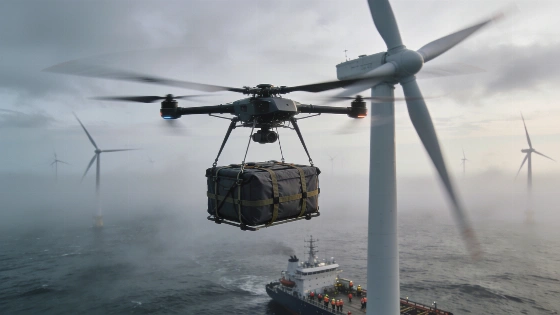
The trial included Ørsted's first reported cargo delivery within an operating offshore wind farm beyond visual line of sight (BVLOS). The drone flew about 4 km between a supply vessel and individual turbines. BVLOS describes an operating condition: the remote pilot does not have to maintain direct visual contact with the aircraft. It does not, by itself, specify how much of the flight is automated or what decisions a human operator retains. Trial flight details describe the route and cargo-handling system.
The kits weighed 55-65 kg and contained tools, spare parts and other materials for specific maintenance tasks. A hook system fitted to the drone's winch enabled automatic pickup and release, avoiding the need to connect or detach the cargo bag manually at each operation. This automated handling did not mean the aircraft operated without human supervision.
Drones delivered kits to turbines before technicians arrived, then collected used kits and returned them to a service operations vessel (SOV). Testing both delivery and retrieval matters operationally: the system was not limited to one-way cargo drops. The approach may avoid parts of the conventional sequence of transporting a kit by vessel and hoisting it onto a turbine, which the companies describe as time-consuming and potentially hazardous; the trial did not publish a measured comparison of those workflows.
Flights were planned, coordinated and monitored from a dedicated service vessel. The trial took place under the UK Civil Aviation Authority's regulatory framework, with the CAA helping coordinate airspace. Four weeks of operations involved drone operators, aviation and safety teams, technicians and the regulator. The trial included both planned work and ad-hoc equipment requests, according to trial coverage.
Ørsted says drone deliveries could help technicians start work sooner and reduce vessel movements, emissions and operating costs. However, published trial materials provide no measurements of actual savings, emissions reductions or comparative safety outcomes against conventional vessel trips. A rigorous future assessment would need to define those outcomes, record comparable missions and account for weather, payload and operational constraints. As a general principle in engineering research-from work at MIT to papers published in Nature-a successful feasibility demonstration is not, by itself, evidence of comparative performance.
This was not Ørsted's first heavy-lift drone experiment at an offshore wind farm. The distinguishing feature here was the combination of BVLOS delivery, automated cargo handling and return of used equipment in operating conditions. Skyports Drone Services CEO Alex Brown argued that drones could reduce the time, coordination, risk and cost associated with vessel or helicopter logistics. Those remain potential advantages, not outcomes quantified by the trial.
The practical question is whether a drone can reliably move the right equipment when turbine work is planned or urgent, without adding delays or safety risks. Ørsted's account describes a field trial, not an independently verified comparison with vessel logistics or evidence of routine fleet deployment. As in industrial maintenance automation, operational value depends on how well a tool fits real service work, not simply on a successful demonstration. The result is a credible logistics test, not yet a case for replacing offshore vessel trips wholesale.