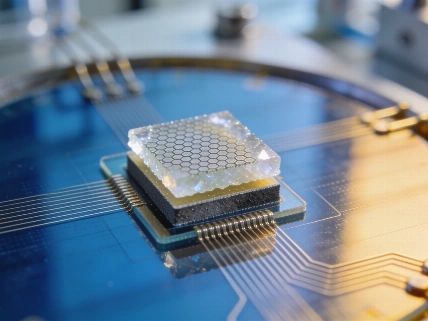
A nanoscale heat map of boron arsenide shows phonons travelling along preferred directions at room temperature, offering researchers a way to study the effect without specialist cryogenic equipment
For decades, observing directional paths taken by heat-carrying vibrations meant cooling a crystal enough to limit scattering. UCLA researchers have now detected the pattern in boron arsenide at room temperature, using a nanoscale map of heat spread rather than specialist cryogenic detectors.
Mapping Heat
Phonons are quasiparticles: discrete packets of vibrational energy that emerge from interacting atoms in a crystal lattice. They carry heat and have wave-like behaviour, but scattering at higher temperatures usually disrupts the long-range propagation needed to observe that behaviour. Phonon focusing occurs when crystal anisotropy concentrates heat-carrying vibrations along preferred directions instead of producing a simple, circular diffusion profile.
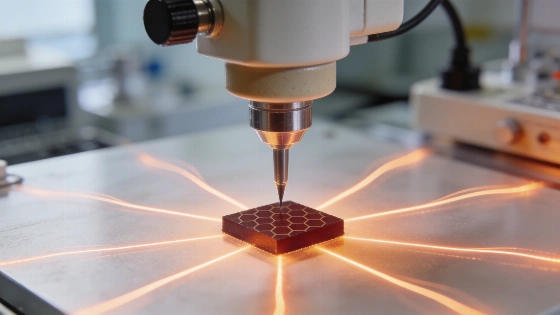
The new method tracks where heat travels across a boron arsenide sample. Researchers coated it with a molecular monolayer that begins to detach as temperature rises. The resulting desorption pattern maps the heat distribution at the nanoscale. A nanoscale tip heats the sample, and the coating's response records the local temperature field rather than detecting individual phonons directly.
Six Preferred Paths
With the sample heated by a nanoscale tip, an isotropic material would typically produce a circular heat profile as energy diffuses in all directions. Boron arsenide showed a different pattern: a central hexagonal region with six ray-like features extending outward. These features indicate heat flux concentrated along preferred directions.
The team also observed different focusing patterns when the boron arsenide crystal was oriented differently. That variation shows how the crystal's underlying symmetry shapes the directions in which phonons propagate. The findings do not mean heat travels only along those paths; they reveal a directional component in its spread.
Explaining the Pattern
Calculations based on microscopic phonon physics reproduced the observed profiles and allowed the researchers to predict temperature patterns. The agreement between experiment and first-principles theory supports the proposed explanation of the focusing effect.
Boron arsenide provided a useful test material because of its exceptionally high thermal conductivity. On 10 August 2018, Joon Sang Kang, Man Li, Huan Wu, Huuduy Nguyen and Yongjie Hu published experimental measurements in Science, reporting conductivity of about 1,000 watts per metre-kelvin. Three independent research groups synthesized crystals with values near that level; later technical references cite approximately 1,300 watts per metre-kelvin for especially high-quality single crystals at room temperature. The 2018 findings were reported in Science.
Those conductivity figures describe bulk heat transport, not the shape of the nanoscale heat map. Boron arsenide is a cubic crystal with a zinc-blende structure, and its conductivity depends on crystal quality, defects, isotopic composition and phonon-scattering processes. The 2018 work established the material as an emerging subject in thermal-transport research; later work has demonstrated potential uses in cooling high-power GaN devices and as an advanced thermal interface material.
From Observation to Control
The distinction between heat-carrying phonons and information-bearing quantum devices matters across physics: hybrid qubit architectures concern processor designs, while this experiment examines how vibrations carry energy through a crystal.
The room-temperature observation offers a route to studying directional phonon transport without cryogenic equipment. The UCLA group hopes to move from observing the effect to engineering phonon trajectories. That remains a research goal; the reported experiment demonstrates focusing, not active control or a working cooling system.
If researchers can eventually direct heat along designed paths, the approach could inform thermal management for high-power computer chips, where power density and localized hotspots are challenges. The current result establishes a way to investigate the phenomenon under room-temperature conditions.