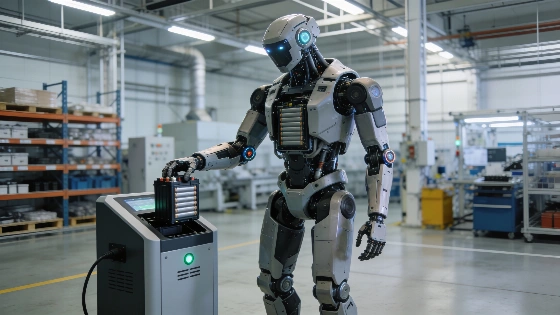
Boston Dynamics has shown its Atlas humanoid robot autonomously swapping its own battery in under three minutes, aiming to reduce downtime and extend operational shifts in industrial settings
Boston Dynamics has demonstrated that its Atlas humanoid robot can autonomously replace its own battery in less than three minutes, according to company technical documentation. The system is designed to identify when its battery is depleted, navigate to a designated charging station, perform the battery swap without human intervention, and resume its assigned task. This capability is intended to address a persistent limitation for industrial robots: the need for frequent recharging or manual battery changes, which can interrupt multi-shift operations and reduce productivity.
The production version of Atlas stands approximately 1.88 meters tall and weighs 90 kilograms. According to Boston Dynamics, Atlas can operate for about four hours under typical conditions and for roughly two hours when performing sustained heavy lifting. The robot is rated to handle continuous payloads up to 30 kilograms and can briefly lift objects weighing as much as 50 kilograms. A conventional recharge cycle takes around 90 minutes, so the ability to autonomously swap batteries in under three minutes could offer a significant operational advantage in environments where robots are expected to work across multiple shifts with minimal downtime.
Industrial Deployment and Technical Design
Atlas is equipped with tactile sensors in its hands and a 360-degree camera system for environmental perception. The robot uses electric actuators and AI-based control software to adapt its movements to changing conditions, rather than relying solely on preprogrammed routines. Boston Dynamics reports that Atlas can independently recognize low battery status, return to a battery station, and complete the swap process before resuming its assigned tasks. The company has not disclosed the full details of the battery-swapping mechanism or the frequency of successful autonomous swaps in uncontrolled environments.
Recent advances in reinforcement learning and large-scale simulation have enabled Atlas to acquire new manipulation skills, including adaptive lifting, carrying, and balancing. According to the company, simulation environments can accelerate robot training by running the equivalent of millions of hours of practice in a single day. These learned behaviors are then transferred to the physical robot, with the company claiming that the sim-to-real gap has been reduced through hardware simplification and symmetrical limb design. Atlas uses only two actuator types across its body, and its joints are designed to allow continuous rotation without exposed cables, which may reduce maintenance requirements.
Evaluation and Limitations
Boston Dynamics has not released independent evaluation data or peer-reviewed studies verifying the reliability of Atlas's autonomous battery swapping in real-world industrial settings. The company's demonstration videos and technical reports indicate that the robot can complete the battery swap process in under three minutes under controlled conditions. However, it remains unclear how the system performs in environments with unexpected obstacles, variable lighting, or unstructured layouts. Human oversight is still required for system monitoring, maintenance, and intervention in the event of hardware or software failure.
During internal testing, Atlas was able to move a refrigerator weighing over 45 kilograms after training with lighter objects, suggesting that the robot's manipulation skills can generalize to heavier loads. These tasks require coordinated whole-body control, visual perception, and force estimation. Dynamic movements such as kicking, handstands, and backflips have been used to develop balance and agility, but their relevance to routine industrial work remains to be established. For comparison, other research teams have explored humanoid robots for collaborative lifting and ergonomic support, as seen in the ergoCub project focused on reducing human strain during shared lifting tasks.
Context and Open Questions
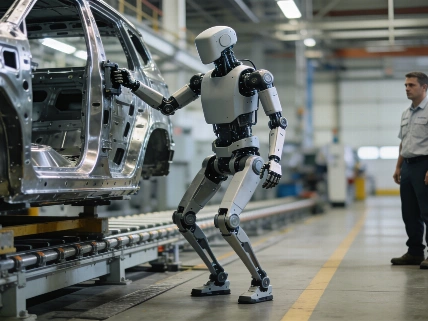
Atlas is positioned as a production-ready humanoid robot for industrial material handling, but the extent of its deployment outside laboratory or demonstration settings is not yet clear. The company's claims of reduced downtime and extended shift operation depend on the reliability of autonomous battery swapping and the robot's ability to operate safely in complex, dynamic environments. Regulatory approval, safety certification, and integration with existing workflows remain open challenges for widespread adoption. As with other advanced robots, the transition from controlled demonstration to routine industrial use will require further evidence of reliability, safety, and cost-effectiveness.
Reinforcement learning is a machine learning technique in which an agent-such as a robot-learns to perform tasks by receiving feedback in the form of rewards or penalties. In robotics, reinforcement learning is often combined with large-scale simulation to accelerate skill acquisition, allowing robots to practice millions of scenarios virtually before transferring learned behaviors to physical hardware. The process of moving from simulation to real-world deployment, known as sim-to-real transfer, presents challenges due to differences in physical dynamics, sensor noise, and environmental unpredictability. Hardware simplification and improved simulation fidelity can help reduce this gap, but real-world reliability must still be demonstrated through systematic testing and independent evaluation.