Boston Dynamics says its prototype team can build an Atlas in about a day and is targeting roughly an hour next year. The figure describes a robot-building process rather than factory output.
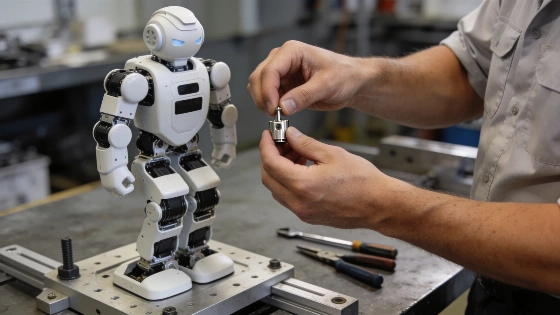
The pace at Boston Dynamics' Waltham, Massachusetts, prototype floor has quickened: the team now assembles an Atlas in about a day and aims to cut that to roughly an hour in 2027. Newly machined parts can reach assembly the same day or the next, bringing revised hardware to engineers sooner. The company's Katie Conner, a senior technical program manager, described the effort to accelerate individual robot builds in a company video.
The nearly six-minute film shows a facility where teams make components and assemble robots, with repair work also part of the operation. Its capabilities include precision machining for tight tolerances, as well as specialized gear cutting. Engineers can discuss part requirements directly with machinists, then adjust components or production methods as Atlas designs change. Boston Dynamics has described the facility as a prototype operation organized much like a manufacturing line.
The company says the current build time is down from several days roughly a year earlier. Its target for 2027 is about an hour, with build times of a few minutes described as a longer-term ambition. That would represent a roughly 24-fold reduction from the current one-day benchmark. These figures concern the process of assembling an individual robot from components; they do not establish a factory production rate or a schedule for commercial deliveries.
That distinction matters as humanoid robotics firms turn their attention to manufacturing scale. MoneyToday reports that Boston Dynamics' current pilot capacity at its U.S. headquarters is estimated at up to 1,000 robots a year, while Hyundai Motor Group has announced a plan for production capacity of as many as 30,000 robots annually by 2028. The latter is a planned capacity, not a reported production total. An assembly-time target for one prototype cannot be compared directly with annual capacity or hourly factory output.
Hyundai Motor Group has said electric Atlas production began at Boston Dynamics' Massachusetts facility after the robot's production version was presented at CES 2026. The initial 2026 production run is committed to Hyundai and Google DeepMind, with broader availability expected as production scales. Hyundai plans to deploy Atlas at its Metaplant America facility in Georgia by 2028, initially for sequencing tasks involving the organized supply of components. The group presents the robot as part of its physical-AI strategy for industrial work, including tasks intended to reduce workers' physical burden in higher-risk operations.
Keeping machining in-house gives the team more control over how parts are made as designs evolve. The facility also develops machining procedures and selects cutting tools for new components; robotic arms handle some assembly tasks. RealClearScience's description of the company video notes the close coordination between machining and assembly. The company presents this setup as a way to shorten development cycles, while the reported build-time figures remain distinct from measures of factory throughput.
Atlas hardware must balance dexterity with durability while keeping costs and service needs in view as the robot moves toward wider industrial use. The recently introduced four-finger hand design is one example of a component shaped by practical task requirements. Faster access to revised parts gives engineers a quicker route to examine such trade-offs on physical hardware.
Repair is part of the same development cycle. Repeated experiments and design revisions put demands on prototype hardware, and the team's ability to maintain robots can return them to testing sooner. The company video shows machining and assembly as part of an integrated process, with repairs supporting it; the one-day figure describes building a single robot, not how many robots the team can complete over a sustained period.
The video highlights the technical work involved in building and maintaining Atlas, while also aiming to recruit. Its focus is an integrated prototype operation with machining capability, alongside the company's target for reducing the time to build one robot. The 2028 plans for industrial deployment and expanded production capacity are separate milestones from the build-time ambition.
Prototype manufacturing connects design work to physical testing: after engineers revise a component, machinists produce it for the team to assemble and evaluate. That cycle can shorten the wait for a changed part. Hyundai's planned first deployment at Metaplant America will put Atlas to work on sequencing tasks, while the company's broader production-capacity target points to a later expansion of the manufacturing program.