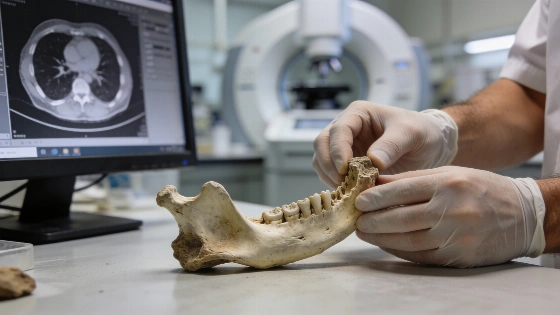
A new micro-CT study of the Qafzeh 25 remains from Israel reveals a partially healed jaw injury, offering rare evidence for trauma and possible interpersonal violence among early Homo sapiens in the Late Pleistocene
Researchers have conducted a detailed micro-computed tomography (micro-CT) analysis of the Qafzeh 25 fossil, a set of early Homo sapiens remains excavated from Qafzeh Cave in northern Israel. The study, led by a team at the Spanish National Research Centre for Human Evolution (CENIEH), focused on the upper and lower jaws of an individual dated to between 92,000 and 145,000 years ago, a period corresponding to the Middle Paleolithic.
The Qafzeh 25 remains were originally recovered from a well-documented archaeological context within the cave, which has yielded one of the largest assemblages of early modern human fossils in the Levant. The new analysis identified sharp-edged lesions on both the maxilla and mandible, consistent with trauma caused by a pointed or bladed object. Importantly, the bone around the injury showed signs of healing, indicating that the individual survived the event for some time before death.
Evidence for Trauma
The pattern and location of the jaw injury suggest a forceful impact, but the precise cause remains uncertain. While accidental injury cannot be ruled out, the researchers argue that the characteristics of the wound are more consistent with interpersonal violence than with a fall or animal attack. The study also documented previously unreported dental pathology, including caries in a lower premolar and enamel defects, which provide additional information about the individual's health and development.
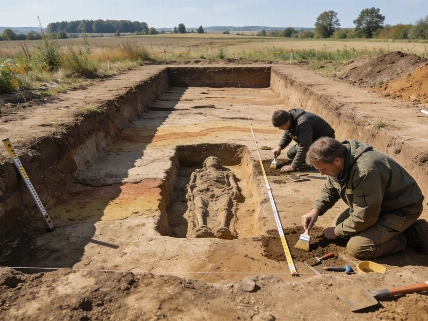
No evidence of carnivore gnawing or significant weathering was observed on the bones, and the remains were found in a position and condition consistent with deliberate burial. This context supports the interpretation that the body was intentionally interred soon after death, a practice that has been identified at Qafzeh Cave for other individuals as well.
Chronology and Context
The Qafzeh 25 individual is part of a population of early Homo sapiens who lived in the Levant during a key period of human evolution and dispersal. The remains have been dated using a combination of stratigraphic analysis and radiometric methods, with the most recent estimates placing them between 92,000 and 145,000 years before present. The cave's stratigraphy and associated artifacts, including Middle Paleolithic stone tools, provide a secure archaeological framework for interpreting the find.
Micro-CT imaging allowed the team to assess the internal structure of the bone and the extent of healing, offering a level of diagnostic detail not previously available for this specimen. The identification of trauma with evidence of survival is rare in the Pleistocene fossil record, making this case a significant data point for understanding the prevalence and nature of violence among early modern humans.
Interpretation and Limitations
While the lesion is consistent with sharp-force trauma, the available evidence does not establish the exact circumstances of the injury or the identity of the perpetrator. The possibility of an accidental wound remains, though the researchers favor an interpretation involving interpersonal conflict. The study highlights the challenges of distinguishing between different causes of skeletal trauma in ancient remains, especially when contextual clues are limited.
The deliberate burial of Qafzeh 25, combined with evidence for care during life and after death, contributes to ongoing debates about the emergence of complex social behaviors in early Homo sapiens. However, the interpretation of violence from a single case must be approached with caution, as broader patterns require larger comparative samples and careful consideration of taphonomic and preservation biases.
The Qafzeh 25 case adds to a small but growing body of evidence for trauma and possible violence in Pleistocene populations, but it does not by itself establish the frequency or social context of such events. Further research on other individuals from Qafzeh and comparable sites will be necessary to clarify the role of violence, care, and funerary practices in early human societies.
Diagnosing trauma in ancient skeletal remains relies on distinguishing between injuries that occurred during life (antemortem), at or around the time of death (perimortem), and after death (postmortem). Antemortem injuries often show signs of healing, such as new bone formation, while perimortem trauma may lack healing but display fracture patterns consistent with fresh bone. Postmortem damage, caused by taphonomic processes or excavation, typically affects dry bone and lacks biological response. Accurate diagnosis requires careful analysis of bone microstructure, context, and comparison with modern clinical and forensic cases. Incomplete preservation and limited contextual information can complicate interpretation, making it essential to consider alternative explanations and the limits of the available evidence.