Embodied AI says remote-operated shifts train its wheeled two-arm robot for factory work, with a claimed transition to autonomy in about a month; its 95 percent pilot result lacks published trial details
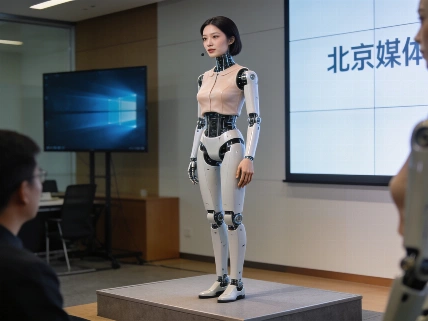
At Humanoid Europe in Munich on November 6, 2026, Lausanne-based Swiss startup Embodied AI unveiled AIR, a humanoid-style robot with a torso, head, two arms and a wheeled base. The company, spun out of EPFL, developed the hardware from research into a working robot in nine months.
AIR keeps its motors, gearboxes and other heavy components inside its torso, while tendons transmit movement to lightweight arms. The company says this layout reduces arm inertia and lets the arms give way on contact. The wheeled base is designed for flat factory floors, where the company says wheels offer greater stability than legs. AIR is aimed at repetitive manual work that changes too frequently to justify fixed industrial automation.
The tendon-driven design is intended to let the arms yield on contact as AIR works near factory employees. Embodied AI says the robot is designed with ISO/TS 15066:2016 in mind and plans to pursue CE marking in 2027. A 25-person team spun out of EPFL developed the mobile machine.
At first, a remote human operator controls AIR during factory shifts. The demonstrations are recorded and used to train the company's software for the assigned task. Embodied AI says AIR typically reaches autonomous operation after about a month of demonstrations.
The company reports an average task-success rate of 95 percent across paid manufacturing pilots involving manufacturers in consumer electronics and automotive-related sectors. It also says that, depending on the application, one unit could handle a workload equivalent to as many as three workers per shift. These are company-reported results. Embodied AI has not disclosed how many tasks were assessed, how long the trials ran or how it calculated the success rate.
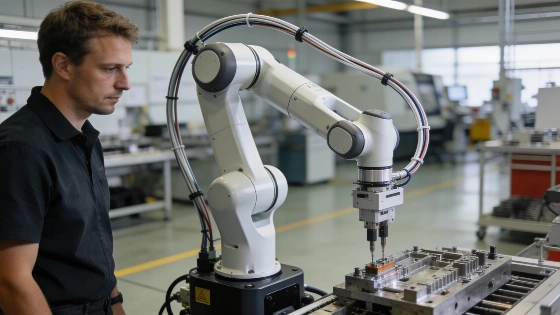
Coverage by EntechOnline distinguishes the customer production-line experience from deployment of the wheeled AIR platform: the line used a separate two-arm robot cell. The reported pilot results therefore concern the company's AI and teleoperation work, rather than necessarily representing long-term autonomous operation of AIR itself.
A separate physical-AI approach described in AWS's toolchain coverage links simulation, training and deployment. Embodied AI says AIR's task data instead comes from remote operation on factory shifts, with demonstrations recorded to train the system.
The disclosed arm weighs about 2 kilograms and can lift up to 5 kilograms, according to an investor description. No figures were provided for AIR's overall dimensions, weight, reach, battery capacity or maximum payload. Embodied AI says AIR is being tested with global manufacturers, has signed contracts with major original-equipment manufacturers and is preparing for scaled production. Orders were expected to open after the Munich unveiling.