AGIBOT's livestream followed six G2 humanoids through retail duties from November 2 to November 3. The footage offers a prolonged store trial while leaving continuous autonomous operation unverified, including how charging and human interventions were handled
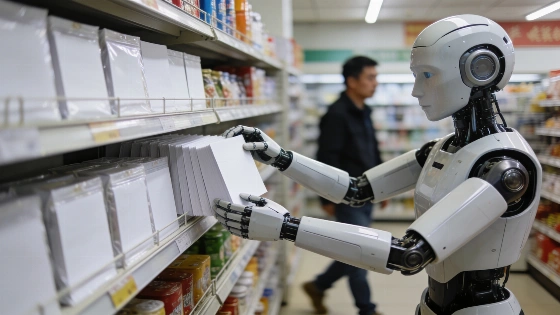
The assigned work ranged from greeting customers and stocking shelves to preparing coffee and hot food, organizing merchandise, and clearing tables or rubbish. AGIBOT scheduled six G2 humanoid robots for its "Robots Never Clock Out" convenience-store challenge from 10 a.m. on November 2 to 10 a.m. on November 3, 2026, Beijing time. The company described a shift spanning rush-hour crowds, late-night work and the morning breakfast period.
The 24-hour schedule describes the challenge and livestream, rather than establishing that each robot worked continuously through the full period. AGIBOT said the six G2s ran on its GO-3 base model and Genie Master agent. The customer-facing tasks combined mobile manipulation, food and beverage preparation, customer interaction and waste handling.
AGIBOT said the challenge was designed to test the machines under changing store conditions. The schedule covered busy periods, overnight duty and breakfast operations, bringing together work around people, merchandise, service counters and food-preparation equipment.
Before the event, AGIBOT reported that a single G2 running its GO-3 Preview model in a real store increased its task-success rate from 28.6% to 85.7% over five days. The company presented the figures as a pre-trial learning result; they describe that single robot's trial, not the performance of all six machines during the later challenge.
The extended footage offers a longer view of the robots in a public retail setting than a short staged demonstration. AGIBOT's event announcement framed the test around rush-hour crowds, late-night duty and the morning breakfast period. The livestream schedule and listed duties, however, are distinct from a measure of productive autonomous work.
A separate account of humanoid factory logistics trials described robots in an industrial setting; AGIBOT's challenge instead placed machines in a customer-facing shop. The settings involve different tasks, from warehouse handling to customer service and food preparation.
At its 2026 Innovation Day in Shanghai, AGIBOT introduced Worken, a proposed measure it calls "Effective Intelligent Work Hours." The framework combines the number of robots actively working, their autonomous working hours and output efficiency against a task-specific benchmark. Forbes reported that the company presented Worken as a way to count useful robot work rather than units merely manufactured or powered on.
The same Innovation Day included AGIBOT's G2 Max, a separate heavy-duty industrial robot intended for manufacturing and logistics. The company's reported specifications included 21 degrees of freedom, dual-arm handling capacity of up to 40 kilograms and adjustable working height from 0.1 to 2.5 meters. The G2 Max has a torso-like body on a wheeled base; those specifications describe the industrial model, not the legged G2 robots in the convenience-store challenge.
AGIBOT also presented its AHA3 hardware architecture and a preview of its next-generation GO-3 foundation model, and said it planned to make a robot operating system fully open source by the end of 2026. The company's Worken proposal places the store demonstration in a broader discussion of how to measure robot work, distinguishing scheduled operating time from active autonomous work and output measured against a task benchmark.