
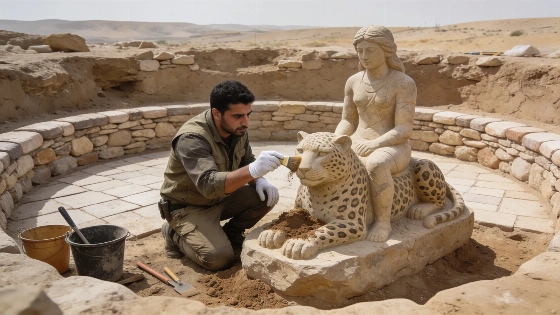
Archaeologists at Karahantepe in southeastern Türkiye have uncovered a rare Neolithic stone sculpture showing a human figure seated on a leopard, offering new evidence for symbolic art and social practices in early settled communities
A newly excavated stone sculpture from Karahantepe, a Neolithic site in southeastern Türkiye, is drawing attention for its unusual depiction of a human figure seated on the back of a leopard. The find, dated to approximately 11,000 years ago, adds to a growing body of evidence for complex symbolic expression among some of the earliest settled communities in Southwest Asia.
Excavation Context and Dating
The sculpture, measuring about 70 centimeters in length, was recovered during the 2026 field season at Karahantepe, located near Şanlıurfa. Archaeologists found the artifact in situ on a bench along the wall of a circular stone structure roughly three meters in diameter. The building's floor was paved with flat stones, and the sculpture's placement within this architectural context suggests it may have played a role in the activities or social practices that took place inside. The dating of the site and its features is based on stratigraphic association and comparative analysis with other Neolithic settlements in the region, including radiocarbon-dated contexts at nearby sites.
The Karahantepe discovery is part of a broader research initiative known as "Heritage to the Future," which aims to expand archaeological investigation and conservation across Türkiye. The region, known as Taş Tepeler or the "Stone Hills," includes more than a dozen Neolithic sites, with Karahantepe and Göbeklitepe among the most prominent. These sites are central to debates about the origins of monumental architecture and symbolic behavior in early farming societies.
Symbolism and Interpretation
The sculpture itself is carved from stone and presents a composite scene: a human figure positioned atop a leopard. While animal representations are common in Neolithic art from the region, direct combinations of human and animal imagery in a single sculptural composition are rare. The meaning of the scene remains uncertain, and researchers caution against definitive interpretations without further contextual evidence. It is possible that the sculpture reflects beliefs about the relationship between humans and wild animals, or that it played a role in ritual or communal activities within the structure where it was found.
Comparative finds from other Neolithic sites in the region, such as the monumental T-shaped pillars at Göbeklitepe, often feature carved animals and abstract symbols, but the direct pairing of a human figure with a leopard is distinctive. The discovery is expected to prompt new discussions about the symbolic world of early Neolithic communities and the ways in which art, architecture, and social practice were intertwined.
Regional Significance and Broader Context
Karahantepe lies approximately 30 kilometers from Göbeklitepe, a site that has transformed understanding of early Neolithic societies through its monumental enclosures and decorated stone pillars. Systematic excavations at Karahantepe since 2019 have revealed additional monumental buildings and a diverse array of human and animal representations, indicating that the symbolic and architectural traditions seen at Göbeklitepe were part of a wider cultural landscape.
The discovery of the human-leopard sculpture at Karahantepe highlights the diversity of symbolic expression in the region during the early Neolithic. It also underscores the importance of context: the sculpture's placement within a specific architectural setting may provide clues to its function and meaning. As with other recent finds, such as the evidence for monumental tomb construction in early farming communities discussed in this report on Neolithic tombs in Poland, the Karahantepe sculpture demonstrates the complexity and variability of early settled societies.
While the precise interpretation of the sculpture remains open, its recovery from a controlled archaeological context allows for careful analysis of its relationship to the surrounding architecture, associated artifacts, and broader settlement patterns. Ongoing research at Karahantepe and other Stone Hills sites is expected to refine understanding of the social, symbolic, and technological developments that accompanied the transition from mobile hunter-gatherer groups to more permanent, organized communities.
Understanding Symbolic Art in the Neolithic
Neolithic symbolic art is often interpreted through the lens of context, association, and comparison with other finds. The presence of animal imagery, composite figures, and monumental architecture suggests that early settled communities in Southwest Asia developed complex systems of meaning and social practice. However, the interpretation of such art is limited by the absence of written records and the challenges of reconstructing ancient belief systems from material remains alone. Archaeologists rely on careful excavation, documentation, and comparative analysis to build hypotheses about the roles these objects played in past societies, while remaining cautious about projecting modern assumptions onto ancient contexts.