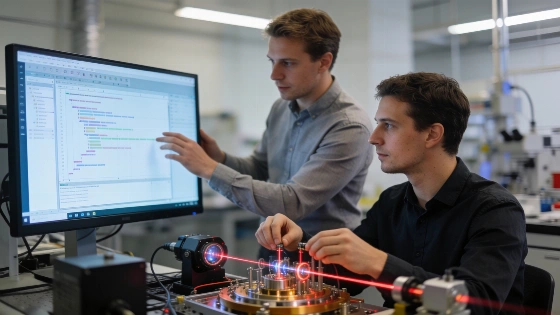
Zapata Quantum and QuEra Computing have announced a partnership to align quantum algorithm development with neutral-atom hardware, aiming to help enterprises and research centers prepare for future fault-tolerant quantum processors
Zapata Quantum and QuEra Computing have announced a strategic partnership intended to address the persistent gap between quantum hardware development and the readiness of quantum algorithms for practical enterprise use. The collaboration, part of the QuEra Quantum Alliance Program, brings together Zapata's Quantum Application Intelligence(TM) software framework and QuEra's neutral-atom quantum hardware roadmap. The stated goal is to enable enterprise, defense, and high-performance computing (HPC) users to design and validate quantum algorithms before large-scale, fault-tolerant quantum processors become available.
Neutral-Atom Hardware Roadmap
QuEra's hardware platform is based on neutral atoms, a leading approach for scaling up quantum processors. The company's roadmap includes the development of a fault-tolerant quantum processing unit (QPU) capable of executing one million quantum operations per second-a so-called "megaquop-class" device. QuEra aims to make this hardware accessible via Amazon Web Services (AWS) by 2028, but the system remains under development and has not yet demonstrated full fault tolerance or commercial operation. The partnership with Zapata is designed to align algorithm development with the evolving capabilities and constraints of this hardware platform.
Algorithm Design and Benchmarking
Zapata's Quantum Application Intelligence(TM) framework is intended to help users identify, design, and benchmark quantum algorithms for specific industrial and scientific applications, including materials design, optimization, and quantum chemistry. By integrating with QuEra's hardware roadmap, the partnership aims to prepare hybrid quantum-classical algorithms for execution on both near-term and future fault-tolerant neutral-atom devices. This approach is intended to allow users to test algorithmic viability and performance before large-scale quantum hardware is available, reducing the risk of software-hardware mismatch as systems scale.
Integration with Broader Quantum Ecosystem
The alliance complements Zapata's ongoing efforts to integrate quantum software with classical high-performance computing and artificial intelligence workflows. For example, Zapata has previously collaborated with NVIDIA to accelerate quantum algorithm synthesis using agentic AI models. This broader integration strategy reflects a trend across the quantum industry, where software and hardware developers are seeking to bridge the gap between current noisy intermediate-scale quantum (NISQ) devices and the anticipated arrival of fault-tolerant quantum computers. Similar efforts to connect quantum software with evolving hardware platforms have been reported elsewhere, such as in recent work on middleware for multi-processor quantum integration.
Technical and Engineering Challenges
Despite the partnership's ambitions, significant technical challenges remain. Achieving fault tolerance in neutral-atom quantum processors requires advances in qubit coherence, gate fidelity, error correction, and system integration. The "megaquop-class" target of one million quantum operations per second is a projected milestone rather than a demonstrated capability. Current neutral-atom devices typically operate with tens to hundreds of physical qubits, and scaling to the required logical qubit counts for practical error correction remains an open engineering problem. The effectiveness of Zapata's algorithm validation framework will depend on how closely it can model the real error rates, connectivity, and operational constraints of future hardware.
In quantum computing, the distinction between physical and logical qubits is central to understanding scalability and fault tolerance. A physical qubit is a single controllable quantum system, such as a trapped atom or ion, while a logical qubit encodes information redundantly across many physical qubits to detect and correct errors. Achieving fault-tolerant computation requires not only high-fidelity operations on physical qubits but also robust error-correction codes and real-time decoding. The number of physical qubits required per logical qubit can be substantial, and the overall system performance depends on the interplay between hardware quality, error rates, and algorithmic requirements. As quantum hardware and software co-design becomes more common, careful benchmarking and transparent reporting of both physical and logical performance will be essential for assessing progress toward practical quantum computing.