Astronomers have identified a third giant exoplanet in the Beta Pictoris system using the James Webb Space Telescope's spectroscopic capabilities, revealing a world previously concealed by the system's bright debris disk
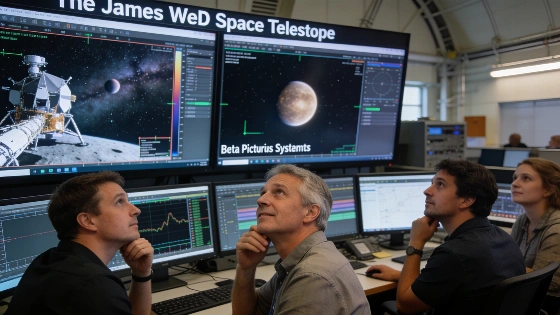
Astronomers have detected a previously unknown giant planet orbiting the young star Beta Pictoris, using the James Webb Space Telescope's (JWST) advanced spectroscopic instruments. The finding, published in the Astrophysical Journal Letters, marks the first time a directly imaged exoplanet in this system has been discovered primarily through its atmospheric chemical signature rather than by conventional imaging.
Discovery in a Well-Studied System
Beta Pictoris, located about 63 light-years from Earth, is a 23-million-year-old star surrounded by a prominent disk of dust and debris. The system has long served as a benchmark for studying planet formation and disk evolution, with two giant planets-Beta Pictoris b and Beta Pictoris c-previously identified through direct imaging. The new planet, designated Beta Pictoris d, was detected not as a bright point of light but through the unique spectral fingerprint of its atmosphere, which stood out against the background of scattered starlight and disk material.
The detection was made while researchers were using JWST's Near-Infrared Spectrograph (NIRSpec) Integral Field Unit to analyze the atmosphere of Beta Pictoris b. Instead, they found a distinct pattern of carbon monoxide absorption lines in a region where only dust-scattered light was expected. This spectral signature, resembling a barcode, is characteristic of giant planet atmospheres and allowed the team to isolate the planet's presence despite the glare of the debris disk.
Physical Properties and Orbit
Modeling based on the spectroscopic data suggests that Beta Pictoris d is at least twice the mass of Jupiter, making it the smallest of the three known giant planets in the system. Its estimated orbit lies at roughly 30 astronomical units (AU) from the star-comparable to Neptune's distance from the Sun-placing it at the widest separation among the system's confirmed planets but still within the inner edge of the debris disk.
Follow-up observations with JWST's Mid-Infrared Instrument (MIRI) detected additional atmospheric features, including water vapor and methane, further supporting the planet's identification. Independent confirmation came from a separate imaging study using the European Southern Observatory's Very Large Telescope and JWST's Near-Infrared Camera (NIRCam), which also identified Beta Pictoris d as a distinct object consistent with the spectroscopic detection.
Spectroscopy Overcomes Imaging Limits
Traditional direct imaging of exoplanets in systems like Beta Pictoris is complicated by the intense brightness and scattering effects of the surrounding debris disk, which can obscure or mimic planetary signals. The spectroscopic approach used here allowed researchers to bypass much of this interference by focusing on narrow molecular absorption features unique to planetary atmospheres. This method not only revealed the planet's existence but also provided immediate information about its atmospheric composition and motion.
Analysis of the spectral data enabled the team to measure the planet's radial velocity-its motion relative to the observer-and confirm that its speed and alignment matched an object orbiting Beta Pictoris, rather than a background star or brown dwarf. The presence of carbon monoxide, water vapor, and methane in the spectrum is consistent with expectations for a young, massive gas giant.
Implications for Planetary System Architecture
The discovery of Beta Pictoris d helps explain several features of the system's debris disk, including its sharply defined inner edge and other structural anomalies that had previously suggested the gravitational influence of an unseen planet. The result demonstrates that moderate-resolution spectroscopy can reveal planets in environments where direct imaging is limited by dust and scattered light.
Beta Pictoris is now only the second known system with at least three directly imaged giant exoplanets. The identification of Beta Pictoris d through its atmospheric signature rather than its brightness represents a methodological advance, suggesting that similar techniques could uncover additional planets in other complex or dusty systems.
The research team plans further analysis of JWST data to refine estimates of Beta Pictoris d's temperature, atmospheric composition, and orbital parameters. These measurements will contribute to a more detailed understanding of planet formation and migration in young planetary systems.
Beta Pictoris d's detection underscores the value of combining high-resolution spectroscopy with direct imaging and multi-instrument follow-up. As JWST continues its mission, astronomers expect to apply these methods to other systems where conventional imaging has reached its limits.
Spectroscopy is a technique that separates light into its component wavelengths, producing a spectrum that can reveal the chemical composition, temperature, and motion of astronomical objects. In exoplanet research, spectroscopy is used to identify molecules in planetary atmospheres by detecting characteristic absorption or emission lines. The method is especially powerful when direct imaging is hindered by bright starlight or surrounding dust, as it allows astronomers to isolate the unique spectral features of a planet even when it cannot be seen as a distinct point of light. By measuring shifts in these spectral lines, researchers can also determine the planet's velocity and orbital characteristics, providing a multidimensional view of distant worlds.