Tuesday Labs is asking for $200 to reserve Voxel, a planned bipedal home robot priced at about $20,000. Its chores depend on coordinated walking and object handling, but practical performance details remain limited ahead of production planned for 2028
Indoor chores force a machine to combine legged movement with object handling in rooms whose layouts change. New York-based Tuesday Labs introduced Voxel Series-1 on October 20, 2026, as a home robot designed to tidy rooms, find and fetch objects, and care for plants. The company's plans describe a specialized robot for a limited set of recurring household tasks, rather than a general-purpose domestic assistant.
Reservations are open to customers in the United States for a refundable $200 deposit. Tuesday Labs estimates the robot itself will cost about $20,000, before any applicable taxes and delivery fees. The company has described the 2028 U.S. delivery target as a projection, not a commitment; a reservation offers the opportunity to purchase a unit but does not guarantee delivery on that schedule. Reporting by Tech Times puts the planned first production run at 999 devices.
Tuesday Labs lists four intended functions: Home Reset, to return items to designated places; Find, to report where an object was last seen; Fetch, to locate and bring a requested item; and Tend, for recurring care such as watering plants. The company says Voxel will not handle cooking, laundry, or childcare at launch. Laundry and dishwashing have been described as possible future applications, rather than established capabilities.
A separate report on factory robot trials covered planned logistics tests in manufacturing; Voxel is intended for homes, where objects and room layouts can change from day to day.
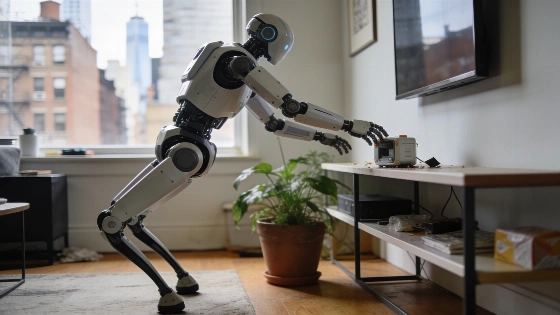
The proposed design combines two articulated arms with Z-shaped legs and a vision system. Each arm has seven degrees of freedom, meaning it can move through several independent directions, and a fully actuated wrist. Each gripper has one actuated degree of freedom for grasping and releasing objects. Backward-bending knees are intended to let the robot lower itself near furniture.
For sensing, Tuesday Labs describes two stereo RGB cameras and a separate wide-angle camera. The system is intended to monitor the surroundings and help locate objects. The camera arrangement and arm specifications describe the design; they do not by themselves establish how well the robot will recognize items that are partly hidden, moved, or surrounded by clutter. Humanoids Daily has also reported the robot's stated hardware details.
The measurable specifications include the $200 reservation deposit, an estimated robot price of about $20,000, two arms with seven degrees of freedom apiece, grippers with one actuated degree of freedom, and a three-camera vision arrangement. The first run is planned to include 999 units, with deliveries targeted for 2028. Tuesday Labs has not reported trial counts or task success rates for household use.
Tuesday Labs says Voxel's movements are designed in 3D animation software before machine-learning models are trained to reproduce them in the physical world. The company describes this approach as a way to preserve a planned gait while accounting for gravity, floor inclination, pushes, or trips. It has also said that its work on the robot's behavior draws partly on Pixar-inspired animation techniques.
A convincing movement pattern is different from dependable household performance. A robot must identify an object, reach it without disturbing nearby items, grasp it, and place it where intended. Tuesday Labs says the robot's vision and movement systems will need further refinement before production, while its ability to manipulate household objects around people also remains under development.
Robot perception is an estimate made from sensor data, not a complete understanding of a room. Cameras can help locate objects, while software must infer which item is being seen and how it relates to furniture or clutter. Manipulation adds physical uncertainty: an object may shift or fail to grip as expected. Voxel's stated camera and arm specifications describe design choices, while its planned 2028 deliveries remain a future target.