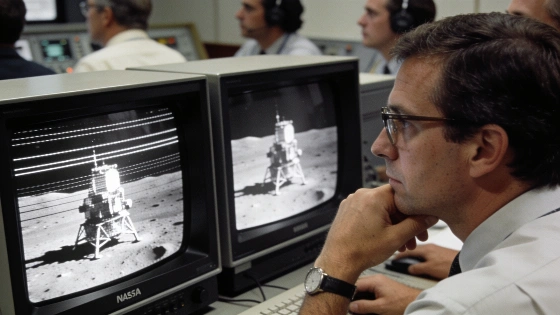
NASA's Viking 1 lander transmitted the first direct image from the Martian surface in July 1976, revealing the planet's rocky terrain and marking a milestone in robotic planetary science
On July 20, 1976, NASA's Viking 1 lander became the first spacecraft to successfully transmit a direct image from the surface of Mars. The event marked a turning point in planetary exploration, providing scientists with their initial close-up look at the Martian landscape and setting the stage for decades of robotic investigation across the solar system.
Descent and Landing Sequence
Viking 1's descent through Mars's thin atmosphere was a critical engineering challenge. The spacecraft relied on a combination of heat shield, parachute, and retrorockets to slow its approach, ultimately touching down safely in the Chryse Planitia region at 5:12 a.m. Pacific Daylight Time. Confirmation of the landing reached NASA's Jet Propulsion Laboratory after a delay caused by the vast distance between Earth and Mars, prompting immediate analysis of the lander's status and environment.
Forty minutes after touchdown, the lander's imaging system began transmitting its first data. The image, built line by line as the signal arrived, revealed angular rocks casting elongated shadows across fine-grained Martian dust. One of the lander's footpads appeared in the frame, providing a reference point for scale and confirming the spacecraft's position on stable ground.
Imaging Technology and Data Transmission
The Viking 1 lander was equipped with two facsimile cameras designed to operate in the harsh Martian environment. These cameras captured black-and-white images by scanning the surface with a photodiode array, converting reflected light into electronic signals. The data were then relayed to Earth via the Viking orbiter, which remained in Mars orbit to support communications and remote sensing.
Each image required significant time to transmit, with the first surface photograph taking approximately 40 minutes to assemble on mission control monitors. The resulting image provided direct visual evidence of Mars's surface composition and morphology, supporting geological interpretations that had previously relied on orbital imagery and Earth-based telescopic observations.
Scientific Impact and Mission Legacy
The Viking 1 mission was designed to search for signs of life and to characterize the Martian surface and atmosphere. Its successful landing and imaging paved the way for subsequent surface operations, including soil analysis and atmospheric measurements. Six weeks after Viking 1, its twin, Viking 2, landed in a different region, expanding the mission's scientific reach.
Viking's surface images revealed a landscape shaped by impact processes, wind erosion, and dust deposition, but found no definitive evidence of biological activity. The mission's data remain a reference point for Mars exploration, informing the design and objectives of later missions such as Mars Pathfinder, Spirit, Opportunity, Curiosity, and Perseverance. The technical and scientific lessons from Viking continue to influence planetary science and mission engineering.
Context in Robotic Space Exploration
The achievement of Viking 1's first surface image is often compared to other milestones in robotic exploration. For example, Japan's Hayabusa2 mission demonstrated the risks and rewards of close-proximity operations on small bodies, as detailed in this report on Hayabusa2's asteroid flyby. Both missions highlight the importance of direct surface data for understanding planetary environments and refining scientific models.
Viking's approach to data transmission, surface imaging, and environmental analysis established operational standards that remain relevant for current and future missions targeting Mars and other planetary bodies. The mission's legacy is evident in the continued search for habitable environments and the development of increasingly sophisticated robotic explorers.
To understand how a spacecraft like Viking 1 transmits images from another planet, it is important to consider the process of data acquisition and relay. Surface cameras convert light into electronic signals, which are then encoded and sent to an orbiter or directly to Earth, depending on mission architecture. The signals travel across interplanetary distances, introducing delays and requiring robust error correction. Each image is reconstructed line by line, with transmission times affected by bandwidth, signal strength, and the relative positions of Earth and the spacecraft. This method ensures that even with limited data rates, critical scientific information can be returned from distant worlds.