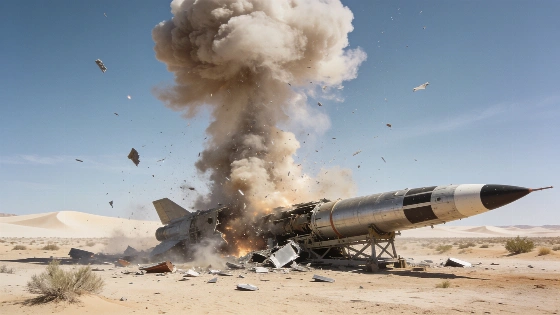
A V-2 rocket carrying the monkey Albert III exploded seconds after launch in 1949, exposing the dangers of early animal spaceflight and the technical limits of postwar rocketry.
On September 16, 1949, a V-2 rocket launched from White Sands Missile Range lasted only seconds before disaster struck. The rocket, carrying a long-tailed macaque named Albert III, exploded shortly after liftoff, destroying both the vehicle and its passenger. The failed flight highlighted the risks and uncertainties of early animal spaceflight, as well as the technical limits of American rocketry in the years after World War II. These tests at White Sands, overseen by the Aero-Medical Laboratory at Wright-Patterson Air Force Base, were part of the first efforts to understand how living creatures might survive spaceflight.
Project Blossom and Early Animal Flights
In the late 1940s, the U.S. Air Force began Project Blossom, a series of rocket launches using animals to study the effects of high-altitude flight and cosmic radiation. The program relied on surplus V-2 rockets and was managed by the Aero-Medical Laboratory. The main goal was to collect data that could help make future human spaceflight safer, years before anyone attempted to send people into space. Animals were anesthetized and fitted with biomedical sensors before launch, a method that later influenced NASA and other agencies.
Albert III was the third monkey chosen for these tests, after two earlier flights ended in fatal accidents-one from suffocation, the other from a parachute failure. Unlike the first two Alberts, who were rhesus monkeys, Albert III was a long-tailed macaque. Each animal was anesthetized and monitored for vital signs during flight. Using animals in these experiments reflected both the urgency and the uncertainty of early space medicine. Later, journals such as Nature published studies analyzing the physiological data from these missions, which became a foundation for space biomedicine.
Technical Failure and Flight Data
The V-2 carrying Albert III failed almost immediately. Records from the White Sands Missile Range Museum show the rocket's tail section exploded just 10.7 seconds after launch, followed by a second explosion a few seconds later. The rocket reached only about 3 miles (4.8 kilometers) in altitude before breaking apart. Investigators traced the cause to leaks in the alcohol fuel system, which led to a loss of thrust and structural failure. Such problems were common in early rocketry, as documented by NASA and the Max Planck Society in their historical reviews of postwar missile technology.
Despite the failure, engineers studied the flight data to improve rocket design and procedures. Of the seven Project Blossom launches, three ended in failure, showing the risks of adapting wartime missiles for biological research. The next flight, with Albert IV, also failed. It was not until 1951 that a monkey-Albert VI-survived a suborbital flight, this time on an Aerobee rocket. These gradual improvements were necessary steps toward the later success of human spaceflight, as seen in NASA's Mercury and Gemini programs.
Scientific and Ethical Implications
The loss of Albert III and other test animals raised questions about the scientific value and ethics of these missions. While the data helped researchers understand how acceleration, radiation, and atmospheric conditions affect living bodies, the high death rate showed the limits of both the technology and the experimental approach. Animal flights continued into the 1960s, but by the 1980s, NASA had stopped using animals for launch testing. Ethical debates about animal research in space have since appeared in journals like Science and in discussions at MIT and Harvard.
These early biological flights were part of a larger effort to turn military rockets into tools for science and exploration. The technical failures and ethical debates of the time shaped later protocols, including better launch vehicles and improved life-support systems. The experience from these missions led to the strict safety standards now used in crewed spaceflight. For more on how later missions tested spacecraft and crew safety, see this breakdown of NASA's 100th astronaut flight.
Aftermath and Lessons Learned
After the failed launch of Albert III, Project Blossom continued, making gradual improvements but still facing risks. Switching from V-2 rockets to newer vehicles like the Aerobee allowed for higher survival rates and more controlled experiments. Lessons from these missions shaped both rocket engineering and the ethical rules for animal research in space. The process of analyzing failures and redesigning systems, a standard practice in engineering, was key to progress in the field.
The story of Albert III is a reminder of the dangers and moral questions that came with the start of space exploration. Facing technical failure and changing protocols was necessary for progress, but the cost to animal subjects remains a point of reflection. Today's safety standards and mission designs owe much to the hard lessons learned from these early, often tragic, flights.
Rocket launches are complex, with every subsystem needing to work within tight limits. The V-2, first built as a missile, was adapted for science but kept many of its original risks. Fuel leaks, structural problems, and guidance issues were all factors. Failures like the one that destroyed Albert III's rocket gave engineers direct feedback on what needed to change, leading to better hardware and planning. Understanding these engineering challenges helps explain both the successes and failures of early spaceflight.