The US Army will conduct field trials of BLADE's Hunter WOLF unmanned ground vehicle with the 82nd Airborne Division, assessing its ability to support equipment transport and casualty evacuation in demanding operational scenarios
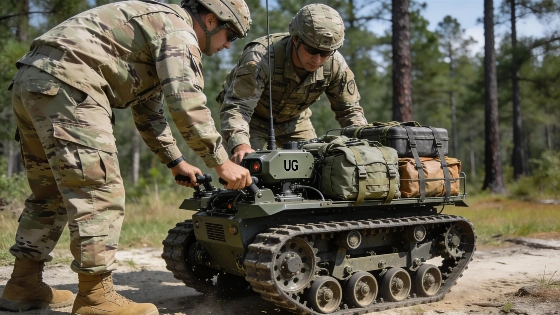
The US Army is preparing to evaluate BLADE's Hunter WOLF unmanned ground vehicle (UGV) in a field exercise with the 82nd Airborne Division at Fort Polk, Louisiana, on August 20. The trial will focus on the vehicle's capacity to assist with logistical support tasks, including transporting equipment and evacuating casualties, under the operational demands of a rapid-response infantry unit. The Hunter WOLF is designed to reduce the physical burden on dismounted soldiers by carrying up to 1,270 kilograms (2,800 pounds) of payload, offering an alternative to manual hauling of supplies and gear across challenging terrain.
The Hunter WOLF platform was developed to address the specific needs of light infantry formations, where conventional vehicles may be impractical or unavailable. Its compact form factor is intended to navigate environments that restrict larger vehicles, while remote operation allows it to function at a distance from personnel, potentially lowering the risk and workload for soldiers. During the upcoming evaluation, 82nd Airborne soldiers will operate the UGV in a range of mission scenarios, including tactical communications support, equipment transport, and casualty evacuation. The vehicle will be equipped with five Universal Battery Chargers, two AN/VRC-158 tactical radios, and a 15-kilowatt power system capable of delivering 120/240-volt AC output. Extended cargo rails will further increase its carrying capacity for mission-critical equipment.
Operational Demands
The 82nd Airborne Division is recognized for its rapid deployment capability, with the ability to mobilize worldwide within 18 hours. This operational profile places a premium on mobility, logistics, and adaptability. The Hunter WOLF will be tested in scenarios that reflect the division's emphasis on speed and maneuverability, providing an opportunity to assess whether the UGV can meaningfully support highly mobile infantry operations. According to BLADE, feedback from soldiers will inform further development and configuration of the platform, with a focus on reducing manual labor and exposure to hazardous conditions during support missions.
In previous Army evaluations, the Hunter WOLF was tested with the 3rd Brigade of the 10th Mountain Division and the 101st Airborne Division. Each trial has exposed the system to different operational environments and user requirements, allowing for iterative refinement of its capabilities. The Fort Polk exercise will add to this body of evidence, offering another data point on the UGV's performance in real-world conditions.
Technical and Human Factors
While the Hunter WOLF is marketed as an unmanned system, its operation remains subject to human supervision and control. The extent of its autonomy in navigation, obstacle avoidance, and task execution has not been independently verified, and the Army's evaluation will likely include assessment of operator workload, reliability, and failure recovery. The vehicle's ability to operate at a distance from soldiers may reduce direct physical strain, but it also introduces new requirements for training, communication, and situational awareness. The integration of power systems and tactical radios suggests a role not only in logistics but also in supporting mobile command and communications infrastructure.
Key technical specifications include a maximum payload of 1,270 kilograms, a 15-kilowatt onboard power system, and modular cargo rails. The system's ability to traverse difficult terrain and maintain operational effectiveness under field conditions will be central to its evaluation. However, no independent data on failure rates, battery endurance, or remote-control range has been released. The Army's field trial is expected to provide more detailed information on these operational parameters.
Deployment and Limitations
The Hunter WOLF remains in the evaluation phase and is not yet a standard-issue system within the Army. Its deployment with the 82nd Airborne Division is part of a broader series of trials intended to determine where robotic ground vehicles can provide practical value in military logistics and support roles. The Army's interest in such systems reflects a wider trend toward automating physically demanding and hazardous tasks, but the evidence for reliable, autonomous operation in complex environments remains limited. Human oversight, intervention, and training will continue to be necessary for the foreseeable future.
As with other military robotics initiatives, the integration of UGVs like the Hunter WOLF raises questions about safety, accountability, and the limits of automation in unpredictable operational settings. The Army's evaluation will help clarify the system's strengths and weaknesses, but broader adoption will depend on demonstrated reliability, ease of use, and the ability to operate safely alongside human personnel.
Understanding the distinction between automation and autonomy is essential in military robotics. Automated systems can perform predefined tasks with minimal human input, but true autonomy requires the ability to make context-sensitive decisions and adapt to unforeseen circumstances without direct supervision. Most current military UGVs, including the Hunter WOLF, rely on varying degrees of remote control or supervisory oversight. The effectiveness and safety of these systems depend not only on technical capability but also on the quality of human-machine interaction, operator training, and the robustness of fail-safe mechanisms in the field.