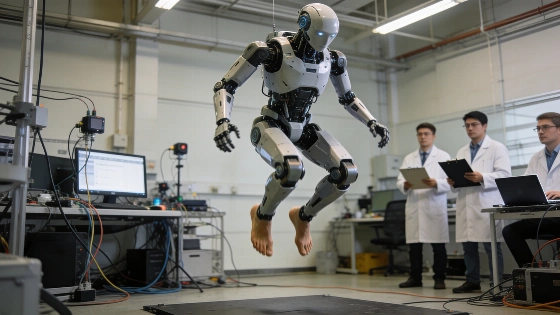
Unitree Robotics has released video evidence of a humanoid robot prototype performing a 2-meter standing jump and running at speeds exceeding elite human sprinters, but the results have not been independently verified
Chinese robotics developer Unitree Robotics has released a demonstration video of a new humanoid robot, codenamed "Superman," performing a standing vertical jump of approximately 2 meters and running at a reported top speed of 12.66 meters per second. If accurate, these figures would surpass the highest recorded human standing jump and the peak sprint speed achieved by Usain Bolt during his 2009 world-record 100-meter run. The robot's legs measure 0.85 meters in length, and the company states that the prototype was developed in just over three months. However, the performance claims are based solely on company-released video and have not been independently validated by external technical reviewers or published in peer-reviewed literature.
Unitree's demonstration highlights the company's focus on high-performance locomotion in humanoid robots, an area that has seen rapid progress but remains technically challenging. The video shows the robot executing a standing jump and landing upright, as well as running on a track at speeds that, if confirmed, would exceed those of any known human. The company has not disclosed the number of trials, the conditions under which the tests were conducted, or the extent of human supervision or intervention during the demonstrations. No information has been provided on the robot's sensing, actuation, or control algorithms beyond the basic hardware dimensions and reported performance metrics.
Performance Claims and Verification
According to Unitree, the "Superman" robot achieved a standing vertical jump of 2 meters and a running speed of 12.66 meters per second (approximately 45.6 kilometers per hour). For comparison, the current human standing vertical jump record is around 1.8 meters, and Usain Bolt's peak speed during his world-record sprint was measured at 12.42 meters per second. The company emphasizes that the robot's legs are shorter than those of an average adult human, suggesting a high power-to-weight ratio and efficient actuation. However, the demonstration does not include independent measurement, error bars, or repeatability data, and the figures are based on a single company-produced video. The lack of external validation means that the results should be interpreted as preliminary and subject to confirmation.
Unitree reports that the robot was developed in just over three months and that its hardware and software are still under active development. The company has not released technical documentation, source code, or detailed engineering analysis to support the performance claims. In April, Unitree's earlier H1 humanoid robot was reported to have reached a running speed of 10.1 meters per second in a separate demonstration, but the company acknowledged possible measurement errors and did not provide independent verification. As with the current "Superman" prototype, these results highlight the gap between laboratory demonstration and reliable, repeatable field performance.
Deployment, Scale, and Market Context
Unitree states that it has produced approximately 18,000 humanoid robots to date, though this figure includes multiple designs and excludes wheeled platforms. According to Smart Analytics Global, Unitree shipped about 5,900 humanoid robots in the first half of 2026, representing a 170 percent increase year-on-year and accounting for 31 percent of global shipments in this category. The company recently listed on China's STAR Market, becoming the first humanoid robotics firm to debut on the country's A-share market. Chinese vendors reportedly accounted for more than 97 percent of global humanoid robot shipments during the same period. Despite these production and shipment figures, the majority of humanoid robots remain in research, demonstration, or pilot deployment phases, with few systems achieving routine, unsupervised operation in real-world environments.
Industry analysts note that extreme locomotion demonstrations, such as high-speed running and vertical jumping, serve as stress tests for robot hardware, software, and control systems. These tests can reveal weaknesses in balance, actuation, and whole-body coordination, but do not guarantee that a robot will perform reliably in unstructured or hazardous environments. Mastery of dynamic movement is considered a prerequisite for future applications in disaster response, industrial inspection, or other high-risk settings, but further advances in reliability, stability, and adaptability are required before such robots can be deployed at scale. Related research on humanoid robots designed for collaborative tasks, such as the ergoCub system tested for reducing human strain during lifting, has focused on real-world ergonomics and safety in shared workspaces. For more on this approach, see the recent coverage of humanoid robots supporting human workers in lifting tasks.
Limits of Demonstration and Open Questions
While Unitree's video demonstration suggests rapid progress in humanoid robot athleticism, several critical questions remain. The company has not disclosed whether the robot operates autonomously, under remote control, or with human supervision during high-speed or high-jump maneuvers. No information is available on the robot's ability to recover from falls, handle unexpected obstacles, or operate safely around people. The demonstration does not address battery life, energy consumption, or the durability of mechanical components under repeated stress. Without systematic evaluation, it is unclear how the robot would perform outside controlled conditions or over extended periods.
Performance records in robotics are often achieved under highly specific laboratory conditions and may not translate to practical deployment. The absence of independent verification, detailed methodology, and repeatability data limits the ability to assess the true significance of the reported achievements. As humanoid robots move from demonstration to potential real-world use, issues of safety, reliability, and meaningful human control will become increasingly central to both engineering and regulatory evaluation.
Understanding the distinction between automation and autonomy is essential in robotics. Automation refers to the execution of predefined tasks by a machine, often under human supervision or control. Autonomy, by contrast, implies the ability of a system to make decisions and adapt to changing environments without direct human intervention. Many robots described as autonomous in marketing materials are, in practice, highly automated but still require human oversight, especially in unstructured or unpredictable settings. The degree of autonomy achieved by a robot depends on its sensing, perception, control algorithms, and ability to handle failure or uncertainty. In the context of humanoid robots, the gap between impressive laboratory demonstrations and reliable, unsupervised operation in the real world remains substantial.