Unitree Robotics has released footage of its G1 humanoid robot sparring with a human using the UnifoLM-X2-1.0 AI model, highlighting advances in predictive perception and autonomous motion planning for dynamic physical tasks
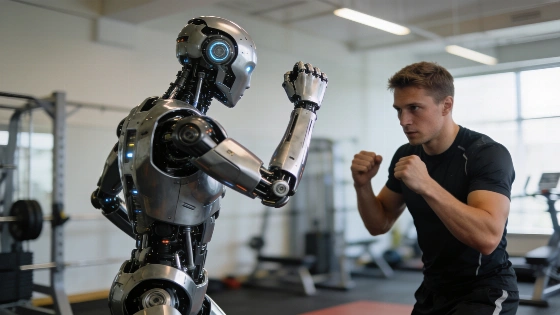
Unitree Robotics has released a demonstration of its G1 humanoid robot engaging in autonomous sparring with a human opponent, powered by the company's UnifoLM-X2-1.0 AI model. The footage shows the robot responding to an approaching human, adjusting its stance, and executing evasive and offensive maneuvers without direct human control. This marks a shift from previous demonstrations that relied on teleoperation or scripted routines, raising the stakes for what can be claimed as autonomous physical interaction in robotics.
The G1's performance is driven by UnifoLM-X2-1.0, a foundation model designed to predict environmental changes and plan actions in real time. Rather than translating operator commands from a headset or controller, the system processes sensor data, anticipates the opponent's next moves, and generates corresponding motor commands. In the demonstration, the robot avoids strikes and delivers its own, with visual overlays illustrating the model's predictive planning. According to Unitree, this approach is intended to reduce the latency between perception, decision, and action-a persistent bottleneck in physical AI systems.
Technical details from the demonstration suggest that the G1's autonomy is not yet fully onboard. Console logs visible in the video, including commands such as OBS/replan and env.step, indicate that sensor data may be transmitted to an external computer running the UnifoLM-X2-1.0 model, which then returns movement instructions to the robot. This architecture allows for more computationally intensive planning but highlights the ongoing challenge of integrating advanced AI models directly onto mobile robotic platforms. The company has not disclosed the processing hardware used or the round-trip latency between sensing and actuation.
Unitree positions this demonstration as a testbed for deploying predictive AI in high-speed, contact-rich environments. The G1's ability to maintain balance, anticipate human movement, and execute closed-loop responses is presented as a step toward more capable autonomous robots for industrial and service applications. However, the demonstration remains a curated scenario, with no published data on success rates, failure cases, or the number of human interventions required during development. The company has not released independent benchmark results or peer-reviewed technical documentation for UnifoLM-X2-1.0 at this stage.
For context, the field of humanoid robotics has seen a surge in research prototypes and commercial platforms aiming to reduce reliance on remote control. Projects such as the Berkeley Humanoid Lite, which was reported earlier, have focused on hardware accessibility and modularity, while Unitree's latest effort targets the software bottleneck of real-time autonomous decision-making. The G1's demonstration is notable for its attempt to integrate predictive world modeling with physical execution, but it remains to be seen how the system performs outside controlled environments or with more complex tasks.
Unitree's claim that UnifoLM-X2-1.0 "breaks through world-action foundation models' bottlenecks" is ambitious, but the absence of independent evaluation or systematic testing data limits the strength of the evidence. The demonstration does not establish that the G1 can operate safely or reliably in unstructured settings, nor does it address the risks of unpredictable contact or system failure. Until the company provides transparent performance metrics and allows for third-party assessment, the advance should be viewed as a promising but preliminary step in the long-standing challenge of embodied AI autonomy.
Foundation models like UnifoLM-X2-1.0 are large-scale neural networks trained to predict future states of the world based on multimodal sensor input. In robotics, these models aim to bridge the gap between perception and action by generating motion plans that account for both the robot's own dynamics and the anticipated behavior of other agents. The effectiveness of such models depends on the quality of training data, the fidelity of simulation environments, and the ability to generalize to real-world variability. Integrating these models onto physical robots introduces additional constraints, including limited onboard computing, communication delays, and the need for robust safety mechanisms in unpredictable environments.