Surface codes could protect logical qubits from physical errors, yet their patent claims may face an abstractness challenge unless they are tied to a specific quantum computing system and measurable implementation.
A surface code may make a quantum computer more resilient to physical errors, but that protection alone may not secure patent eligibility. The central risk is legal as much as technical: a claim built around redundant information and error correction could be treated as an abstract idea unless it explains how a particular quantum computing system performs the work.
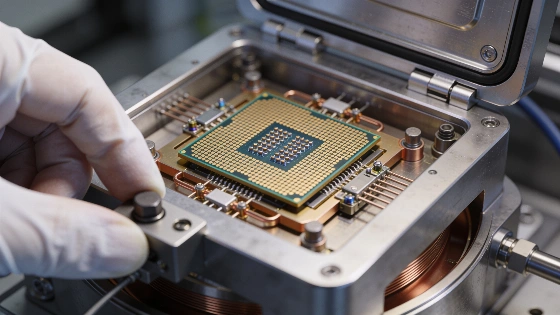
Surface codes encode one logical qubit across many physical data qubits arranged on a two-dimensional lattice. The information is nonlocal and topologically protected rather than stored in one component, so an error affecting an individual physical qubit need not destroy the encoded state. In practice, the code depends on repeatedly measuring local consistency relations and using the resulting syndrome record to infer faults without directly measuring the logical value.
Ancilla, or measurement, qubits sit between the data qubits and interact with neighboring sites. Their role is to measure stabilizers, which reveal error syndromes without directly collapsing the logical state. A classical decoder can then infer where errors occurred and determine which corrective operations should be applied. The distinction between syndrome extraction and direct logical readout is central: the former diagnoses consistency violations, while the latter would expose the encoded quantum information itself.
The proposed system therefore has a concrete operating sequence: configure data qubits on a two-dimensional lattice, interleave measurement qubits, perform stabilizer measurements periodically, derive syndromes from the results, and apply corrections to the data qubits. Those steps describe a quantum error-correction architecture, not an error-free computer or a complete fault-tolerant processor. They also identify potential claim limitations involving qubit connectivity, pulse schedules, measurement cadence, decoder inputs, and feedback operations.
Surface codes remain a leading fault-tolerance approach because their local stabilizer checks can be repeated across a planar arrangement and because increasing code distance can, under suitable noise conditions, suppress logical errors. A recent Nature-linked hardware report described work showing that surface-code methods can improve error correction when mapped onto IBM's non-grid heavy-hex architecture. That development matters to the patent analysis because it demonstrates that the relevant invention may concern adaptation to real device connectivity rather than an idealized square lattice alone.
The patent problem begins with the abstraction doctrine. Redundant bits have long been used in communications and classical computing to detect and correct errors, so an examiner or court could characterize a broad surface-code claim as an abstract scheme for error correction using redundancy. The quantum setting does not automatically remove that risk if the claim recites only a desired result, such as preserving a logical qubit or reducing errors.
That argument becomes stronger when the claim says only "a quantum computing system" without identifying the hardware that carries out the stabilizer measurements and corrective operations. Patent practitioners generally view claims tied to a concrete hardware stack as more defensible than black-box claims because specific components and operations connect the alleged invention to a technological implementation. Hardware language helps connect an invention to a practical machine, although it is not a guarantee. The input analysis points to Symantec as a counterexample in which mechanical hardware elements did not prevent a finding of patent ineligibility.
The second stage of the Mayo/Alice framework presents another obstacle. On the description supplied here, the claim appears to rely on error-correction concepts that predate quantum computing. Without additional inventive elements, the specification may struggle to show that the abstract idea has been transformed into eligible subject matter. A claim that specifies how a superconducting, trapped-ion, or other identified processor performs a defined sequence is therefore materially different from one that merely instructs a generic machine to correct quantum errors.
The stronger response is not that a logical qubit is inherently patentable. It is that the surface-code implementation improves the functioning of the quantum computer that performs it. Patent eligibility analysis generally gives weight to an improvement in a computer's operation or in another technical field, and the relevant guidance is identified in MPEP § 2106.04(d)(1) of the U.S. Patent and Trademark Office's November 2024 edition.
That distinction matters. A logical qubit considered in isolation can be described as an abstraction rather than a device capable of being improved. A system that specifies the lattice, the ancilla arrangement, the stabilizer-measurement cycle, the syndrome-processing path, and the corrective operations gives the argument a physical target. The claim is no longer merely about the desired protected state; it is about how a quantum computer is configured and operated to maintain one. The same distinction between an abstract result and a reproducible apparatus is important across laboratory environments, whether research is associated with MIT, CERN, or another quantum-computing program.
The technical context also connects this legal question to active work on quantum error correction. A surface-code testing report illustrates why architecture matters: the geometry and connectivity of a processor affect how stabilizers are measured and how errors are inferred. That comparison does not establish patentability here, but it reinforces the importance of specifying the machine rather than claiming an outcome in the abstract. The recent heavy-hex work, discussed in connection with Nature, likewise shows why a useful claim may need to address nonideal couplers, routing constraints, or altered measurement schedules.
Current research also tests whether topological codes can tolerate realistic coherent noise rather than only simple independent stochastic errors. A recent preprint reported a positive threshold for coherent Z-rotation errors in quantum LDPC codes with a bounded number of logical qubits, explicitly including surface code and other topological codes. The result supports continued investigation of practical fault tolerance, but it does not by itself establish a working commercial processor, a universal logical gate set, or patent validity. Because the reported work is preliminary, its threshold result should be treated as research evidence rather than a demonstrated engineering guarantee.
The description contains no physical-qubit count, code distance, logical error rate, gate fidelity, readout fidelity, operating temperature, decoder latency, or number of correction cycles. It also does not report a hardware demonstration, a useful algorithm executed on a logical qubit, or a result showing that logical performance improves as the code grows. Those omissions prevent any assessment of whether the architecture works below an error threshold or can scale beyond a conceptual design.
The distinction is decisive for both engineering and law. Detecting syndromes is not the same as completing real-time correction, and one protected memory operation is not a full fault-tolerant computation. The proposal identifies the ingredients of a surface-code system, but it does not by itself establish reproducibility, manufacturability, practical utility, or a quantum advantage over classical computing. A statement that a qubit can be kept alive with a surface code expresses confidence in the approach, but it is not a substitute for reported device metrics.
For a patentee, the most credible eligibility position is therefore narrow and technically grounded: the claimed configuration improves the operation of a quantum computing system by maintaining encoded information despite physical errors. That argument is stronger when the specification ties each abstract step to named components and measurable interactions. It is weaker when "logical qubit" is left as the entire invention. The specification should distinguish the code's mathematical structure from the hardware and control procedures that make the structure operative.
Surface-code protection should be treated as a specific machine implementation rather than a legal shortcut around abstractness. The concept has real technical structure, but the patent case depends on showing how that structure changes the operation of an identified quantum computer. In this setting, hardware specificity is not decorative detail; it is the bridge between a familiar error-correction principle and a potentially eligible technological improvement. Publications in Nature can establish technical context, but only the patent record's claims and disclosure determine the legal scope of protection.
A physical qubit is an individual controllable quantum system, while a logical qubit distributes information across multiple physical qubits. Stabilizer measurements do not read the encoded value directly; they produce syndrome information about consistency relations among neighboring qubits. A decoder interprets those results, and corrective operations address the inferred faults. Because the description gives no measured logical error rate or hardware result, the surface code described here remains an implementation concept with a patent argument attached rather than a demonstrated fault-tolerant device.