S-Transistors, a Finnish deep-tech spin-off, has secured €2.6 million to develop wafer-scale superconducting transistor circuits for quantum processor control at millikelvin temperatures, aiming to address wiring and thermal challenges in large-scale quantum computing
Efforts to scale quantum computers beyond laboratory prototypes face persistent engineering barriers, particularly in the control and readout of thousands of qubits at cryogenic temperatures. S-Transistors, a spin-off from the VTT Technical Research Centre of Finland, has announced €2.6 million ($3 million USD) in pre-seed funding to develop wafer-scale superconducting transistor circuits designed for quantum processor control at millikelvin (mK) temperatures. The funding round, led by Lifeline Ventures with additional angel investment, will support the construction of a pilot manufacturing line, a dedicated cryogenic laboratory, and the prototyping of integrated control hardware.
Physical Wiring and Thermal Constraints
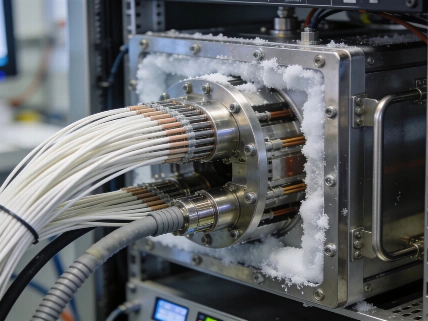
Current quantum processors-whether based on superconducting or silicon spin qubits-require hundreds to thousands of individual coaxial cables to connect room-temperature electronics to the quantum chip inside a dilution refrigerator. Each cable introduces thermal load, increasing the difficulty of maintaining the sub-100 mK environment required for qubit operation. As quantum processors grow in size, the physical space and cooling power needed for these cables become a major bottleneck, limiting practical system scaling.
Superconducting Transistor Integration
S-Transistors is developing integrated circuits based on superconducting transistors that operate with near-zero electrical resistance and minimal power dissipation at millikelvin temperatures. Unlike conventional silicon CMOS transistors, which can function at low temperatures but generate excess heat and noise, superconducting devices can switch signals with negligible thermal impact. The company's initial commercial product is a wafer-scale cryogenic multiplexer, intended to route multiple qubit control signals internally within the cryostat and reduce the number of required external cables.
The multiplexer is designed to be compatible with existing dilution refrigerators and quantum processor architectures. S-Transistors plans to deliver early prototypes to partners within the first year of operation. The longer-term vision is a "quantum motherboard"-a unified, wafer-scale control plane that integrates classical electronics directly adjacent to the quantum processor, minimizing both wiring complexity and thermal disturbance.
Engineering and Fabrication Roadmap
The pre-seed capital will be allocated to establishing a pilot semiconductor manufacturing line and an in-house cryogenic laboratory, enabling the company to fabricate and test superconducting transistor circuits at scale. The team, led by CEO Dr. Heorhii Bohuslavskyi and CTO Dr. Andrey Generalov, aims to demonstrate reliable device operation at millikelvin temperatures, with a focus on low power dissipation and compatibility with quantum processor requirements. While the company's fabrication technology is patent-pending, independent benchmarking and peer-reviewed performance data have not yet been released.
Beyond quantum computing, S-Transistors suggests that its superconducting transistor platform could find applications in high-performance computing, deep-space electronics, AI acceleration hardware, and sensitive particle detectors. However, the primary technical challenge remains the integration of scalable, low-noise control electronics within the extreme thermal constraints of quantum cryogenic environments. Related advances in cryogenic device engineering, such as the development of wide superconducting nanowire single-photon detectors, have also targeted the wiring and noise limitations of quantum hardware-see, for example, recent work on scaling superconducting nanowire detectors for quantum photonic devices.
Remaining Challenges and Industry Context
While the integration of superconducting control electronics at millikelvin temperatures is a promising approach to overcoming wiring and thermal bottlenecks, several engineering hurdles remain. Device yield, fabrication reproducibility, long-term stability, and compatibility with diverse quantum processor platforms must be demonstrated in practice. The absence of published performance metrics or independent replication means that the scalability and reliability of the proposed architecture are not yet established. As quantum hardware developers continue to push toward larger and more complex systems, the need for robust, low-noise cryogenic control infrastructure will remain a central challenge for the field.
Superconducting quantum devices operate at temperatures close to absolute zero, typically below 20 millikelvin, to suppress thermal noise and preserve quantum coherence. At these temperatures, even small amounts of heat from control electronics or wiring can degrade qubit performance or destabilize the cryogenic environment. Superconducting transistors, which switch signals without electrical resistance, offer a route to integrating classical control functions directly inside the cryostat. However, achieving reliable, scalable operation at these extreme conditions requires advances in materials, fabrication, and system engineering that are still under active development.