NVIDIA researchers have introduced SONIC, a large-scale control framework that allows humanoid robots to execute a wide range of whole-body movements using inputs from teleoperation, video, text, and music, with evidence from both simulation and real-world tests
NVIDIA researchers have developed SONIC, a large-scale control framework designed to enable humanoid robots to perform a broad spectrum of whole-body movements. Unlike conventional controllers that are typically engineered for specific tasks, SONIC is trained to generalize across a wide variety of actions, including running, jumping, grasping, and transitioning smoothly between behaviors. The system accepts multimodal inputs-such as teleoperation, video, text, and music-and translates them into coordinated robot motion. SONIC was evaluated in both simulation and on a physical humanoid robot, with results indicating robust performance across diverse tasks.
Training Data and Model Scale
SONIC's approach is grounded in large-scale motion tracking, using over 100 million motion frames derived from approximately 700 hours of human motion-capture data. The largest SONIC model contains 42 million parameters and was trained using up to 128 GPUs, consuming around 21,000 GPU hours. This scale allowed the researchers to demonstrate improved tracking accuracy and generalization as the dataset, model size, and computational resources increased. The system's architecture includes a universal token space, which enables different input modalities-such as robot motion, human motion, and hybrid commands-to be encoded into a shared representation. Specialized encoders process each input type before converting them into quantized tokens, which are then decoded by a common robot control policy.
SONIC's universal token interface supports integration with a range of input sources, including VR teleoperation, video-based control, natural-language instructions, and music-driven motion generation. This design allows the same policy to handle varied commands, facilitating transitions between input types without retraining the underlying model. The framework also incorporates a real-time kinematic motion planner, which generates short motion segments between keyframes and can continuously replan based on new commands. This enables interactive changes in direction, speed, and movement style, providing a flexible control layer for high-level intent.
Evaluation and Real-World Deployment
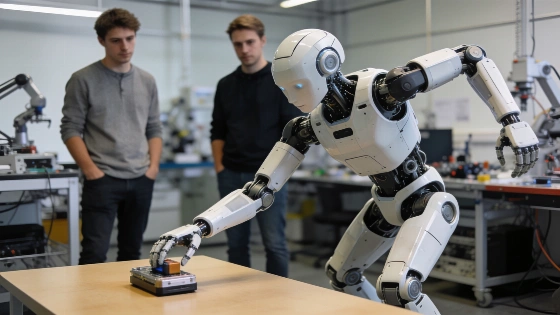
In testing, SONIC was deployed on a Unitree G1 humanoid robot and evaluated on 123 real-world motion sequences. The system achieved a 99.2% success rate in these physical trials, compared to 100% in simulation, indicating a relatively small gap between simulated and real-world performance. SONIC was also connected to a vision-language-action model via its universal token interface, enabling the robot to execute whole-body tasks such as object pickup, opening a trash can with a foot pedal, and coordinated hand-foot actions to move a soda can into a bin. Across five such tasks, the system achieved an average success rate of 75% in the physical environment.
For multimodal control, SONIC can process human motion extracted from video (including live webcam streams), interpret text prompts specifying actions, and generate dance movements from music. The system is capable of transitioning between these input modalities, supporting interactive and flexible robot control. The researchers report that SONIC's shared action representation could simplify the integration of higher-level AI systems, allowing them to control the entire humanoid body rather than treating locomotion and manipulation as separate problems.
Context and Limitations
SONIC's development addresses a longstanding limitation in humanoid robotics: the need for separate controllers and training objectives for each new behavior. By treating motion tracking as a scalable learning problem and leveraging dense frame-by-frame supervision from human motion data, SONIC provides a consistent training signal across a diverse set of behaviors. However, the system's performance remains dependent on the quality and diversity of its training data, and its generalization to entirely novel or safety-critical tasks has not been independently verified. Human oversight remains essential, particularly in unstructured or unpredictable environments.
SONIC's approach can be compared to other recent efforts in humanoid robot control, such as the development of robots designed for adaptive collaboration in shared tasks. For example, research on robots like ergoCub, which focuses on reducing human strain during lifting, highlights the growing emphasis on flexible, general-purpose control frameworks in the field. Readers interested in related advances can find further details in this coverage of adaptive humanoid robot collaboration.
SONIC remains a research system, and its deployment outside controlled laboratory settings will require further validation, safety assurance, and regulatory review. The framework's reliance on large-scale computing resources and extensive motion-capture data may also limit its accessibility for smaller research groups or commercial developers.
In robot learning, the distinction between simulation and real-world deployment is critical. Simulation allows researchers to train and test models at scale without the risks and costs of physical hardware, but it cannot fully capture the complexities of real environments-such as sensor noise, mechanical wear, or unexpected obstacles. The gap between simulated and real-world performance, known as the sim-to-real gap, remains a central challenge in robotics. Effective transfer from simulation to reality requires careful calibration, robust perception, and ongoing human oversight to ensure safety and reliability in practical applications.