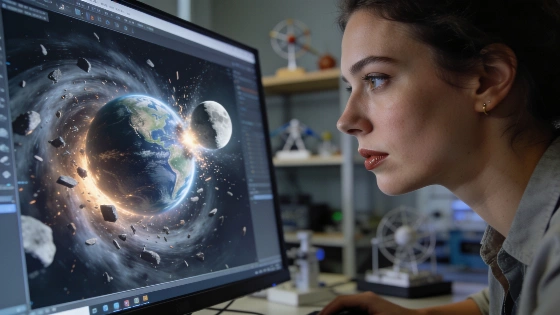
New computer models suggest the Moon could have assembled rapidly from debris after a collision between early Earth and a Mars-sized body, with the timing and temperature of the impact playing a critical role
The Moon's origin story may be far more abrupt than previously thought. According to new high-resolution simulations, the satellite could have coalesced in just a few hours following a catastrophic collision between the young Earth and a Mars-sized protoplanet known as Theia. This scenario challenges the long-standing view that the Moon formed slowly from a lingering disk of debris, instead pointing to a rapid assembly shaped by the thermal state of the colliding worlds.
Impact Modeling and Material Strength
The latest research, led by Adeene Denton at the Southwest Research Institute, used advanced computational models to simulate the Moon-forming impact with unprecedented detail. Unlike earlier studies, these simulations incorporated the internal temperatures and material strengths of both Earth and Theia at the time of collision. The models reveal that the temperature profile of the impactors-specifically, how hot or cool their interiors remained after planetary formation-directly influenced the violence of the collision and the fate of the resulting debris.
Warmer protoplanets, still retaining heat from their own formation, are mechanically weaker and deform more easily during impacts. This difference in material strength alters how debris is distributed around the Earth and how quickly it can accrete into a satellite. The simulations show that if Theia was still hot-meaning the impact occurred less than 60 million years after the Solar System's birth-the collision would have obliterated Theia and produced a massive, short-lived disk of debris. In this scenario, the Moon could have formed in as little as five hours.
Timing and Thermal State
The timing of the impact is critical. If the collision happened later, when Theia had cooled and its mantle was stronger, the debris disk would have persisted longer, allowing the Moon to accrete more gradually. In this case, more of Theia's material would have survived to merge with Earth, and the Moon's assembly would have stretched over a longer period. The models suggest that the Moon's composition-dominated by Theia's mantle with a smaller contribution from Earth-depends on these initial conditions, though the precise match to the Moon's observed isotopic ratios remains unresolved.
These findings build on two decades of impact modeling, including foundational work by planetary scientist Robin Canup. The new simulations, published in The Astrophysical Journal Letters, add a crucial layer of realism by accounting for the evolving geologic properties of early planetary bodies. The results also echo the rapid-formation scenario depicted in NASA-led models from 2022, but with greater attention to the physical state of the impactors.
Consequences for Lunar Science
The implications extend beyond lunar history. If the Moon formed in hours rather than millennia, the window for observing moon-forming disks around rocky exoplanets would be vanishingly brief. This would make direct detection of such disks with current telescopes extremely unlikely, in contrast to the longer-lived disks seen around gas giants. The research also highlights persistent puzzles: despite the Moon's overall similarity to Earth's mantle, subtle differences in isotopic composition remain unexplained by current models, including those that account for temperature and material strength.
For context, the Moon-forming impact is estimated to have occurred within the first 60 to 150 million years of Solar System history, with the precise timing still debated. The simulations suggest that the Moon's rapid assembly is only possible if the impact happened early, while both Earth and Theia retained significant internal heat. This focus on the physical state of planetary bodies at the time of collision marks a shift from earlier models that treated impactors as uniform, cold spheres.
Modeling Uncertainty and Broader Context
While the new simulations offer a compelling mechanism for rapid lunar formation, they do not resolve all outstanding questions. The isotopic similarities and differences between Earth and the Moon remain a challenge for any impact scenario. The results also depend on assumptions about the initial temperatures and cooling rates of early planets, which are difficult to constrain directly. As with other recent advances in planetary science, such as the role of magnetic fields in shaping the early Solar System reported earlier, the findings underscore the complexity of reconstructing ancient events from limited physical evidence.
Numerical simulations are a cornerstone of planetary science, especially when direct observation is impossible. In impact modeling, researchers use high-performance computing to solve equations governing the behavior of rock, metal, and vapor under extreme conditions. These models must account for temperature, pressure, material strength, and the physics of fragmentation and accretion. The reliability of the results depends on the accuracy of the input parameters-such as the thermal state of the impactors-and the physical assumptions built into the code. As computational power and physical understanding improve, simulations can test a wider range of scenarios, but they remain models, not direct evidence. The challenge is to connect these virtual collisions to the physical properties of the Moon and Earth as measured today.