Infleqtion, Honeywell Aerospace and UC Santa Barbara have built a silicon-nitride optical-cavity prototype intended to reduce the size of laser-stabilization hardware, although its field performance and quantitative advantage over bulk optics have not yet been reported.
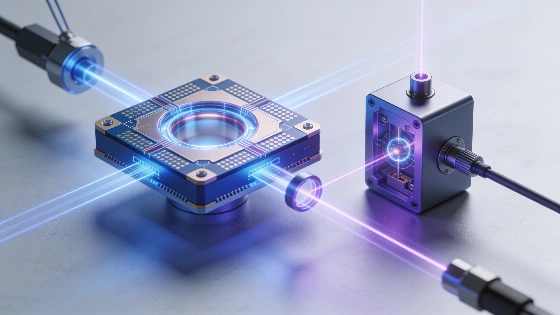
A piece of optics that can occupy a substantial laboratory assembly has been integrated onto a silicon-nitride chip. On October 6, 2026, Infleqtion announced that its collaboration with Honeywell Aerospace and the University of California, Santa Barbara (UCSB) had produced an integrated optical-cavity prototype for neutral-atom quantum processors, quantum sensors and optical atomic clocks. The company presents the work as a route toward more compact, potentially handheld quantum instruments.
The announcement is documented in an Infleqtion technical release, but it does not constitute a peer-reviewed performance study. No sample count, statistical analysis, confidence interval or independent replication is reported, so the result should be read as a fabrication and integration milestone rather than a validated system benchmark.
Neutral-atom systems depend on spectrally precise lasers to cool and trap atoms, manipulate internal states and perform quantum gates. The required optical frequencies can drift because of temperature changes, mechanical disturbance, electronics and intrinsic laser noise. An optical cavity provides a frequency reference: light circulates in a resonant structure, and feedback electronics use the resonance to correct laser fluctuations.
In many laboratory systems, that reference is assembled from bulk optical components, including mirrors, mounts, spacers, isolators, lenses and vibration-control hardware. Such arrangements can deliver excellent performance, but they occupy space and require careful alignment. The new device changes the physical packaging of the reference rather than introducing a new quantum algorithm or demonstrating a new qubit architecture.
Infleqtion engineers and Professor Daniel J. Blumenthal's Optical Communications and Photonic Integration, or OCAQπ, Group at UCSB jointly designed the prototype. Honeywell Aerospace fabricated it on its own photonic manufacturing line using silicon-nitride, or Si₃N₄, integration processes. Honeywell says it has developed the relevant silicon-nitride photonic-integration processes for approximately a decade, linking the demonstration to an existing foundry capability rather than to laboratory-only fabrication.
Silicon nitride is used here as an integrated photonic material, not as a qubit medium. Its role is to guide and confine light in a resonant structure that can act as a stable reference for laser-frequency control. A wafer-compatible process may eventually allow repeated fabrication and tighter integration with waveguides, couplers and control electronics, although fabrication compatibility alone does not establish high yield or uniform performance.
Blumenthal's research profile at UCSB covers integrated lasers and photonic components for optical atomic clocks, atom interferometers, and experiments involving neutral atoms and trapped ions. That background is relevant because the same frequency-control problem appears across several precision-quantum platforms. Similar photonic-integration questions also feature in research communities associated with MIT and in peer-reviewed literature published by Nature, where miniaturization must be evaluated together with noise, thermal stability and packaging.
The work also builds on photonic intellectual property developed by SiNoptiq, a UCSB spin-off founded by Blumenthal and acquired by Infleqtion in 2024. The acquisition connects university-developed technology with Infleqtion's neutral-atom hardware program, but it does not by itself establish production yield, long-term operating stability or commercial readiness.
The available official materials do not disclose the chip or cavity dimensions, optical quality factor, resonance linewidth, propagation loss, thermal coefficient, achieved frequency stability, packaging results or field-test data. They also provide no clock-accuracy measurement, sensor-sensitivity result, atom number, gate fidelity or processor benchmark. Consequently, a quantitative advantage over conventional bulk-glass cavities cannot yet be confirmed.
This limitation is important in precision photonics. A smaller resonator is useful only if it preserves the frequency reference quality needed by the surrounding instrument. Relevant tests would normally include environmental sensitivity, vibration response, temperature cycling, coupling efficiency, long-term drift and performance after packaging. The announcement does not report those measurements, nor does it provide p-values, confidence intervals or a comparison group.
The practical attraction is straightforward: every external optical component adds alignment, packaging and environmental-control demands. A cavity integrated with photonic circuitry could reduce the volume of the optical subsystem and simplify assembly in equipment intended for deployment outside a laboratory. The proposed application set includes atomic timing devices, quantum-enhanced inertial navigation, compact sensors and neutral-atom quantum computers.
Miniaturization, however, does not remove the underlying engineering requirements. A useful instrument would still need a narrow-linewidth laser, efficient coupling into the chip, stable mechanical and thermal packaging, control electronics and calibration that survives temperature changes and vibration. The cavity would also have to maintain the required reference quality when connected to the rest of the instrument rather than operated as an isolated prototype.
These constraints resemble those faced by other precision technologies, from navigation instruments to space-qualified timing systems. NASA and CERN, for example, routinely treat packaging, environmental qualification and system-level calibration as separate engineering questions from the performance of an individual optical component. The same distinction applies here: integration is a prerequisite for a compact system, not proof that the final system has been achieved.
The broader quantum industry is moving on several fronts at once. Some groups are expanding research networks and processor scale, while others are compressing the optical and electronic subsystems that make quantum control possible. The Infleqtion-Honeywell-UCSB prototype belongs to the second effort: it addresses the physical footprint and manufacturability of laser stabilization.
The announcement gives no evidence that complete system-level tests have been completed. It does not report independent replication or a controlled comparison with the bulk-glass cavities used in relevant laboratory systems. A foundry process can make repeated fabrication possible in principle, but wafer processing alone does not guarantee cavity uniformity, usable yield, economical packaging or stable operation under field conditions.
The most defensible conclusion is therefore narrow but significant. Infleqtion, Honeywell Aerospace and UCSB have demonstrated a silicon-nitride integrated-cavity prototype and connected it to a manufacturing pathway that Honeywell says has been developed over roughly ten years. The result supports continued engineering toward smaller quantum hardware, while the central performance questions-dimensions, losses, linewidth, stability, environmental robustness and deployment-remain open for future measurements.