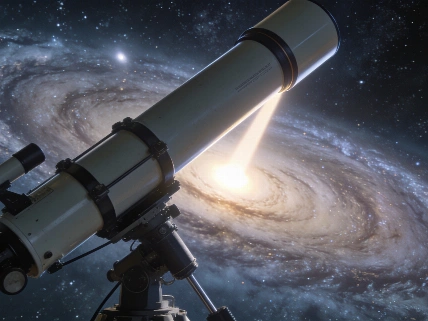
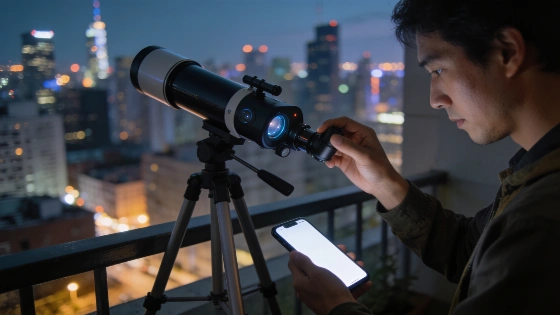
The Seestar S30 Pro integrates a high-resolution sensor, dual cameras, and automated image processing in a compact, smartphone-controlled telescope, enabling deep-sky imaging even from light-polluted locations
Automated telescopes have transformed how amateur astronomers and astrophotographers observe the night sky, especially in urban environments where light pollution limits traditional stargazing. The Seestar S30 Pro, a compact smart telescope, aims to further lower the barrier to deep-sky imaging by combining advanced optics, dual cameras, and real-time image processing in a portable, app-controlled device. Its design reflects a shift from manual operation to digital observation, allowing users to capture faint galaxies and nebulae with minimal setup and technical expertise.
Instrument Design and Capabilities
The Seestar S30 Pro departs from the appearance of conventional telescopes, resembling a large camera lens more than a traditional optical tube. Weighing 1.65 kilograms and measuring 210 x 140 x 80 millimeters, it is designed for portability, fitting easily into a backpack or as carry-on luggage. The instrument features a quadruplet apochromatic refractor with a 30-millimeter aperture and a 160-millimeter focal length, yielding a focal ratio of f/5.3. Its primary telephoto camera uses a Sony IMX585 sensor with 8.3 megapixels, while a secondary wide-angle camera employs a Sony IMX586 sensor for sky alignment and wide-field imaging.
All functions, including slewing, focusing, and image capture, are managed through a dedicated smartphone app. The device operates offline by creating its own WiFi network, ensuring field usability without internet access. The minimal physical interface-limited to a power button and USB-C port-reflects its emphasis on automation. The S30 Pro includes 128 GB of internal storage and a 6000 mAh battery, supporting up to six hours of operation. Users can mount the telescope on any standard tripod, and a padded shoulder bag is provided for transport.
Imaging Performance and Processing
Upon activation, the Seestar S30 Pro automatically plate-solves the visible stars to determine its orientation, then slews to the selected target. It captures a series of short exposures, typically around 10 seconds each, which are stacked in real time to enhance signal-to-noise ratio and reveal faint structures. The system employs intelligent frame rejection to discard images affected by tracking errors or environmental disturbances. Over time, the stacking process gradually resolves faint nebulae and galaxies, with detail improving as more exposures are integrated.
During testing under suburban Bortle 6 skies and darker Bortle 2 conditions, the S30 Pro produced clear images of objects such as the Orion Nebula (M42), Bode's Galaxy (M81), the Cigar Galaxy (M82), the Whirlpool Galaxy (M51), and the Great Globular Cluster in Hercules (M13). The optics maintained sharp star images across the field, and built-in filters helped mitigate the effects of light pollution. The new equatorial (EQ) mode, enabled by an optional tripod head, allows exposures up to 60 seconds, further improving detail on faint targets. However, planetary imaging remains limited by the instrument's small aperture and focal length, with planets appearing small and lacking fine surface detail. The Moon, by contrast, is well resolved.
Automation, App Features, and User Experience
The Seestar app serves as both controller and processing platform, offering a planetarium-style interface for target selection and real-time monitoring of imaging sessions. Users can schedule multiple targets for overnight observation using Plan mode, though exposure and gain settings are fixed per session. The telescope can operate unattended, capturing and stacking images while the user is away. For those interested in further processing, the S30 Pro supports FITS file export for use with external software, while its built-in Deep Sky Stack and AI Denoise features provide quick, automated results.
While the system is optimized for ease of use, it does not offer full manual control over exposure parameters, which may limit appeal for advanced users seeking granular adjustments. The internal storage may also require regular management for those capturing large numbers of high-resolution frames. Despite these constraints, the S30 Pro's automation and portability make it a practical option for beginners and experienced observers seeking a convenient, grab-and-go imaging solution.
Comparisons and Market Context
The Seestar S30 Pro represents an incremental advance over the original Seestar S30, primarily through its higher-resolution sensor, expanded imaging modes, and support for equatorial tracking. For those seeking a more affordable entry point, the standard Seestar S30 offers similar automation with lower (2 MP) resolution. Competing devices such as the DwarfLab Dwarf Mini prioritize portability but are limited by smaller sensors, while premium options like the Unistellar Odyssey provide larger apertures and access to citizen science campaigns at a higher price point.
For readers interested in the broader context of automated astronomical instruments, the evolution of smart telescopes parallels developments in planetary exploration, where automation and remote operation have become essential. For example, the challenges of instrument control and data processing in urban astrophotography echo those faced by missions such as NASA's Viking 1, which required careful interpretation of remote data under uncertain conditions-a topic explored in this analysis of Viking 1's life-detection experiments on Mars.
Overall, the Seestar S30 Pro is best understood as an automated imaging system that makes deep-sky astrophotography accessible to a wider audience, particularly in environments where traditional telescopes are limited by light pollution and setup complexity.
Image stacking is central to the Seestar S30 Pro's approach to deep-sky imaging. By capturing multiple short exposures and combining them, the system increases the effective signal-to-noise ratio, allowing faint astronomical objects to emerge from background noise. This method is especially valuable in light-polluted environments, where single long exposures would be overwhelmed by skyglow. Automated stacking, combined with intelligent frame rejection and built-in filtering, enables the telescope to reveal details that would otherwise be invisible to the naked eye or through a conventional eyepiece. Understanding the principles of image stacking helps explain why compact, automated telescopes like the S30 Pro can achieve results once reserved for larger, manually operated instruments under dark skies.