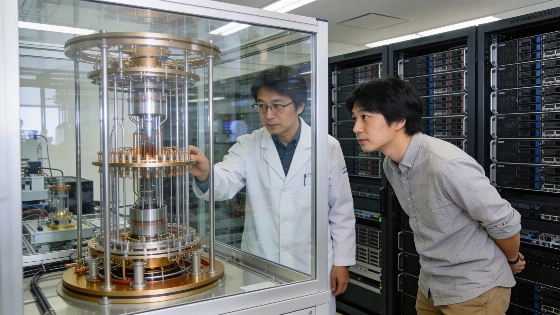
Japan's RIKEN Center for Computational Science has launched ROQUO, a hybrid quantum-classical supercomputer integrating Quantinuum's trapped-ion Reimei system with NVIDIA Blackwell GPUs, aiming to benchmark quantum circuit synthesis and quantum chemistry workloads
Japan's RIKEN Center for Computational Science (R-CCS) has begun operating ROQUO, a hybrid supercomputing platform designed to integrate quantum and classical resources for scientific computing. ROQUO directly connects Quantinuum's trapped-ion Reimei quantum processor, installed on-site in Kobe, with a cluster of NVIDIA Blackwell GPUs and links to the Fugaku supercomputer. The system was constructed under the Japanese government's JHPC-quantum project and is positioned as a testbed for hybrid quantum-classical workflows, with a focus on scientific and industrial applications that require both quantum and high-performance classical computation.
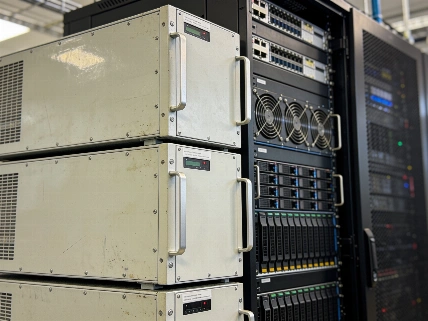
ROQUO's architecture combines 540 NVIDIA Blackwell GPUs distributed across 135 GB200 NVL4 compute nodes, delivering a measured 19.80 petaflops (PFLOPS) of double-precision (FP64) performance on the High Performance LINPACK benchmark. The quantum backend includes Quantinuum's Reimei trapped-ion system and access to IBM Quantum System Two (ibm_kobe). The system uses NVIDIA Quantum-X800 InfiniBand for high-bandwidth interconnect and a software-based SQC Interface (CUDA-Q) to manage data exchange between classical and quantum resources. This configuration is intended to support real-time quantum error correction and low-latency circuit execution, which are essential for practical hybrid algorithms.
Hybrid Circuit Synthesis and Error Correction
One of ROQUO's initial research tracks is the automated synthesis and optimization of quantum circuits using evolutionary AI frameworks. Researchers from RIKEN, Quantinuum, and NVIDIA are employing the CUDA-Q platform to generate native quantum circuits tailored for the Reimei trapped-ion processor. The evolutionary approach aims to identify circuit structures that are both hardware-efficient and robust against noise, with the goal of improving execution fidelity on current-generation quantum hardware. The system's low-latency interconnect is designed to minimize synchronization delays between classical and quantum components, a critical factor for hybrid algorithms that require frequent feedback between subsystems.
Quantum error correction and calibration are also central to ROQUO's early experiments. NVIDIA's open Ising AI models are being used to assist with automated calibration of the Reimei QPU, state preparation, and real-time error decoding. These efforts are intended to address the persistent challenge of noise and decoherence in trapped-ion systems, which currently limit the depth and reliability of quantum circuits. While the system supports real-time error decoding, full fault-tolerant operation remains out of reach for current hardware, and logical qubits have not been reported as operational in this deployment.
Quantum Chemistry Benchmarks and Industrial Applications
ROQUO's hybrid infrastructure is being used by a consortium of corporate and academic partners-including Mitsubishi Chemical, Mizuho Bank, Keio University, AIST, and the University of Toronto-to benchmark quantum chemistry workloads. Early demonstrations have focused on molecular spectral analysis, where the hybrid system achieved a reported 13.4-fold speedup over CPU-only baselines for selected tasks. These benchmarks target applications in semiconductor manufacturing, such as evaluating extreme ultraviolet (EUV) photoresist compounds, and in materials design for energy storage. However, the quantum component remains limited by the scale and fidelity of current trapped-ion hardware, and the classical postprocessing required for verification and analysis still dominates total workflow time for most practical problems.
ROQUO's integration of on-premises quantum hardware with high-performance classical resources is intended to accelerate the development and testing of "AI for Science" frameworks. By providing a platform for tightly coupled quantum-classical computation, the system allows researchers to explore the limits of current quantum devices in realistic scientific workflows. The deployment also serves as a demonstration of international collaboration, with the U.S.-Japan Genesis Mission partnership supporting the operational framework and hardware integration.
System Performance and Remaining Challenges
ROQUO's measured performance includes 19.80 PFLOPS FP64 on the LINPACK benchmark for its classical subsystem, with 540 NVIDIA Blackwell GPUs across 135 compute nodes. The quantum backend is based on Quantinuum's Reimei trapped-ion processor, but the number of operational physical qubits, gate fidelities, and coherence times have not been disclosed in this announcement. The system's hybrid architecture is designed to support low-latency data exchange and real-time feedback, but the overall utility of the quantum component remains constrained by hardware noise, calibration drift, and the absence of error-corrected logical qubits. No independent replication or peer-reviewed benchmarking of the full hybrid workflow has been reported to date.
While the initial results demonstrate accelerated quantum chemistry workflows for selected molecular problems, the practical advantage of the quantum component is still limited to tasks that can be efficiently mapped to current trapped-ion hardware. The majority of industrially relevant chemistry and materials problems remain beyond the reach of today's quantum processors, and classical simulation continues to provide the primary computational power for large-scale applications. The ROQUO system, however, provides a valuable platform for testing hybrid algorithms, benchmarking quantum-classical integration, and identifying the engineering steps required for future fault-tolerant quantum computing.
To understand the significance of ROQUO's architecture, it is important to distinguish between physical and logical qubits. Physical qubits are the actual quantum systems-such as trapped ions or superconducting circuits-that can be individually controlled and measured. Logical qubits, in contrast, encode information across multiple physical qubits using error-correcting codes to detect and correct errors. Achieving reliable logical qubits requires high-fidelity gates, long coherence times, and real-time error correction, all of which remain major engineering challenges. Current hybrid systems like ROQUO operate with physical qubits and employ error mitigation and calibration strategies, but have not yet demonstrated the sustained logical qubit performance needed for practical fault-tolerant quantum computing.