Minerva's Roger pairs remote human control with onboard balance and navigation software for hazardous work. The company has raised about $10 million and plans paid pilots in fall 2026, but independent performance data are not yet public.
A human operator remains in control when Minerva Humanoids' walking robot Roger enters a hazardous environment. The San Francisco startup says the machine combines remote control with onboard software for balance, navigation and recovery from falls, allowing specialists to work through the robot rather than approach dangerous equipment themselves. Minerva was founded in 2025 by people with backgrounds at MIT, Tesla Optimus and Boston Dynamics; its stated focus is specialized hazardous-work robotics, not a general-purpose autonomous humanoid.
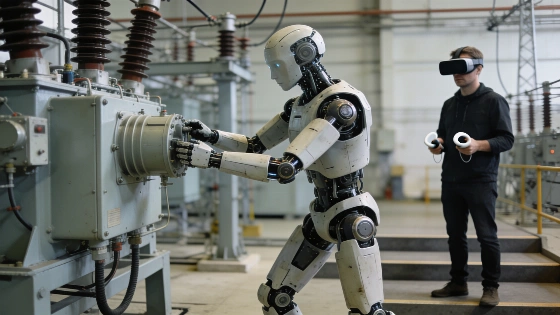
That distinction matters: Roger is not an independently working humanoid. An operator uses a VR headset to view the robot's cameras and direct its movements, including two-handed tasks. Minerva says its control system, called Minerva Intelligence, manages functions that would be difficult to handle continuously by remote command alone. The company describes low-latency control loops, but has not published latency measurements. In teleoperation generally, delays and incomplete visual feedback can complicate precise control, which is why the operator's view, communication reliability and onboard assistance all matter.
According to the company's published description, Minerva Intelligence can run without a continuous cloud connection and handles balance, navigation and recovery after a fall. If communication or power is lost, the robot is supposed to stop and make a controlled fall away from critical objects. These are design claims, not a substitute for published testing: no failure statistics or independent validation of this fallback behavior are available in the material reviewed. The distinction between remote control and onboard assistance is a familiar one in robotics, including work pursued across research programs at MIT and NASA, but Roger's performance must be assessed on its own evidence.
The intended work includes explosive ordnance disposal (EOD), hazardous-material response, offshore oil and gas operations and high-voltage energy sites. Minerva's case is that tracked disposal robots with a single manipulator arm can leave some two-handed or dexterous tasks unfinished, requiring a technician to approach. Roger is designed to extend remote handling while keeping a trained specialist responsible for decisions.
That is a concrete safety aim, not yet evidence that the robot reduces risk in routine operations. Minerva has not disclosed Roger's payload, battery life, operating speed or manipulation accuracy, and the material provided does not report systematic trial results or failure rates. The company says operators can learn full-body control within minutes; without published evaluation details, that remains a company claim rather than an independently assessed training outcome. The available information also does not include a peer-reviewed study in journals such as Nature or Science reporting task-level results.
Minerva says it moved from concept to a working walking prototype in five months, including hardware design, manufacture and assembly. It emerged from stealth on October 6, 2026, and announced approximately $10 million in pre-seed funding in October. General Catalyst led the round, with Long Journey Ventures and Credo Ventures as co-leads. The company says the funds will support further hardware and control-system development ahead of energy and EOD deployments planned later in 2026, and has said it intends to begin paid pilot projects in fall 2026.
Reports say Roger was tested at the NATO Explosive Ordnance Disposal Centre of Excellence in Slovakia and underwent field checks at two international airports. However, independent protocols, success criteria and failure statistics have not been published, so these reports do not establish operational reliability or service deployment. Research partnerships with the Mohamed bin Zayed University of Artificial Intelligence and the University of Waterloo are examining energy-related humanoid capabilities and perception under smoke, darkness and sensor failures.
The company's ambition sits within a wider move to test humanoids in practical work, including factory humanoid trials. But a robot's ability to walk is only one part of industrial usefulness: reliable manipulation, communications, recovery from faults and performance across varied sites all matter. Minerva has not yet supplied public measurements for those capabilities. Robotics research and programs at NASA's robotics program also illustrate the breadth of specialized robotic systems; the relevant benchmark for Roger, however, is whether it performs specific hazardous tasks safely and consistently.
Teleoperation means a person controls a machine from a separate location, rather than the machine deciding and carrying out a task on its own. Shared control adds software assistance, such as stabilizing balance or supporting navigation, while the operator directs the work. That assistance can reduce the number of commands a person must issue, but it does not remove the need for situational awareness, dependable communications or a clear way to intervene. Minerva's account of the system and its safeguards is available in its published company profile; independently measured performance remains unavailable.
Roger's strongest claim is therefore not that humanoids can replace specialists, but that a human may be able to perform more delicate work from a safer position. The five-month build and reported early demonstrations justify attention; they do not establish field reliability. Until Minerva publishes task-level performance and safety evidence from its pilots, Roger should be judged as a promising teleoperated prototype-not a proven solution for hazardous operations.