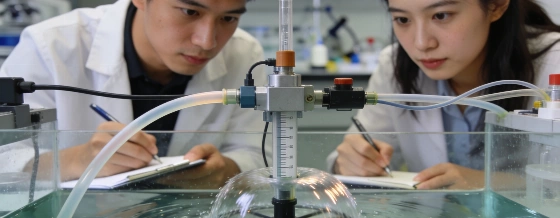
Researchers at New York University have built custom rotary sprinklers to investigate the reverse sprinkler problem, measuring how angular momentum and device geometry affect rotation when water is drawn in rather than expelled
Experiments at New York University have provided new evidence on the long-standing reverse sprinkler problem, a fluid dynamics puzzle that has challenged physicists since it was popularized by Richard Feynman. The research team constructed a series of rotary sprinklers with varied geometries and submerged them in water to directly measure the torque and rotation rate as fluid was either expelled or drawn into the device. Their findings, published in the Proceedings of the National Academy of Sciences, indicate that the reverse sprinkler's motion is governed by angular momentum imparted at the device's center as water is sucked in, rather than by the overall angular momentum of the incoming flow or the geometry of the sprinkler arms alone.
Standard rotary sprinklers operate by ejecting water at an angle, generating torque that causes the device to spin and distribute water over a wide area. The reverse scenario-where a submerged sprinkler draws water inward-has produced conflicting theoretical predictions and experimental results for decades. Some models have focused on the total angular momentum of the system, while others have considered the torque exerted at the nozzles or the buildup of angular momentum at the core. The NYU team sought to disentangle these competing explanations by designing sprinklers with specific arm shapes, including spiral and S-shaped configurations, to isolate the effects of geometry and flow path on rotation.
In controlled laboratory tests, the researchers measured the torque and rotation rate for each sprinkler design under both forward (expelling) and reverse (sucking) flow conditions. They found that, regardless of arm geometry, the torque in the forward mode was directly proportional to the angular momentum flux of the outgoing water. In the reverse mode, however, the key factor was the subtle asymmetry at the center of the device, where water converges as it is drawn in. This central angular momentum injection, rather than the overall flow pattern, determined the direction and magnitude of rotation. The measured torque in reverse was consistently lower than in the forward case, resulting in much slower rotation rates.
The study's experimental approach required precise control of flow rates and careful measurement of rotational dynamics. Devices were submerged in a water tank, and flow was regulated to ensure consistent conditions across trials. The team compared devices with arms that forced water to travel 360 degrees before exiting to those with arms that doubled back, but these geometric differences did not account for the observed behavior in reverse mode. Instead, the experiments demonstrated that the angular momentum imparted at the device's core was the unifying principle behind both forward and reverse rotation.
Mechanical engineering experts not involved in the study have noted that while the experiments are well executed, the theoretical models referenced are highly simplified and do not capture the full complexity of fluid flow in open systems. Computational fluid dynamics simulations, which are standard in engineering practice, could provide further insight but are not expected to reveal fundamentally new physics in this context. The NYU team is now developing new simulation tools to model open-system fluid dynamics with inflow and outflow, aiming to test their experimental findings against advanced computational models.
While the reverse sprinkler problem is unlikely to yield a practical device, the research highlights the value of carefully controlled experiments in resolving subtle questions in classical physics. The methods developed for this study may also inform future investigations of angular momentum transfer in more complex systems. The challenge of connecting laboratory measurements with real-world applications is a recurring theme in experimental physics, as seen in efforts to bridge simulation and experiment in aerodynamic testing for vehicles, such as those described in recent research integrating AI with fluid dynamics models.
Understanding the reverse sprinkler effect requires careful distinction between the angular momentum carried by the fluid and the torque experienced by the device. In the forward mode, water jets carry angular momentum away, producing a reaction torque that spins the sprinkler. In the reverse mode, water converges from all directions, and only asymmetries at the device's center inject angular momentum, resulting in weaker and slower rotation. This distinction illustrates how irreversibility in fluid dynamics, governed by the Navier-Stokes equations, leads to different outcomes when flow direction is reversed, even in seemingly symmetric systems.