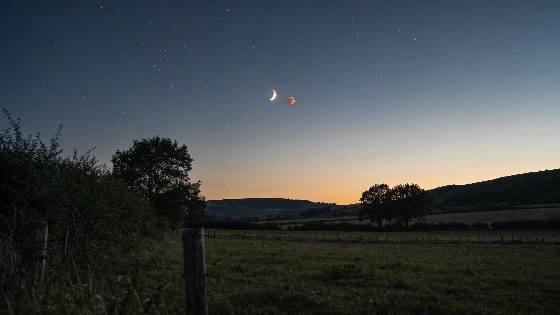
Observers in the Northern Hemisphere will see the crescent Moon pass close to Mars in the constellation Taurus before sunrise on August 9, offering a preview of the winter starscape and a rare opportunity for binocular viewing.
In the early hours of August 9, skywatchers across the Northern Hemisphere will have the chance to observe a close approach between the crescent Moon and Mars, set against the backdrop of the constellation Taurus. This alignment, visible before dawn, offers a rare opportunity to view both objects within the same binocular field and to preview the stars that will dominate the winter sky.
Predawn Alignment and Visibility
The 17% illuminated crescent Moon will rise approximately four hours before sunrise, appearing above the eastern horizon shortly after 2 a.m. local time for observers in New York. Mars, distinguished by its steady reddish glow, will be positioned less than 5 degrees to the lower right of the Moon. This proximity allows both objects to be seen together through standard 10x50 binoculars, providing enhanced detail of the lunar surface and the planet's characteristic color.
As the night progresses, the Moon and Mars will appear to move together across the sky, with Mars gradually pulling ahead as dawn approaches. The surrounding stars of Taurus, including the prominent V-shaped Hyades cluster, will frame the scene, while Orion rises to the right and Gemini appears below, offering a glimpse of the constellations that will become more prominent in the coming months.
Observational Details and Instrumentation
For those interested in a closer look, entry-level binoculars such as 10x50 models are sufficient to resolve features on the Moon's surface, including major craters and the dark basaltic plains known as lunar maria. The event also provides an opportunity to observe earthshine-a faint illumination of the Moon's night side caused by sunlight reflected from Earth's surface and atmosphere. This subtle glow can reveal the outline of the Moon's unlit hemisphere, especially when the lunar phase is a thin crescent.
While the Moon and Mars are the primary focus, the surrounding starscape adds context to the observation. The Bull of Taurus sits above the pair, while Orion and Gemini occupy positions to the right and below, respectively. These constellations, now low in the predawn sky, will rise higher as the seasons change.
Upcoming Lunar and Solar Events
This conjunction marks one of the final opportunities to observe the Moon before it enters its new phase on August 12. During the new Moon, the lunar disk will pass between Earth and the Sun, resulting in a total solar eclipse visible from parts of Greenland, Iceland, and Spain. For readers interested in the broader context of solar eclipses, the UK is also preparing for a significant partial eclipse on August 12, with up to 98% of the Sun obscured in some regions-a topic explored in detail in our article on the upcoming UK solar eclipse event.
During the August 9 observation, the Moon's proximity to the Sun in the sky will make it increasingly difficult to observe in the days that follow, as it transitions toward the new phase and the eclipse. Observers are encouraged to take advantage of this window for lunar and planetary viewing before the Moon becomes lost in the Sun's glare.
Limits and Observational Challenges
Atmospheric conditions, local horizon obstructions, and light pollution can all affect visibility during the predawn hours. Observers should seek out locations with a clear eastern horizon and minimal artificial lighting for the best experience. While binoculars enhance the view, the event remains accessible to the unaided eye under favorable conditions.
It is important to note that the apparent closeness of the Moon and Mars is a line-of-sight effect; the two bodies are separated by tens of millions of kilometers in space. The alignment offers no physical interaction but provides a striking visual conjunction for ground-based observers.
For those planning to photograph the event, stable mounting and careful exposure settings are recommended to capture both the bright crescent and the fainter earthshine. The contrast between the illuminated and unlit portions of the Moon can be challenging to record in a single image.
Understanding the concept of earthshine is essential for interpreting the subtle features visible during crescent phases. Earthshine occurs when sunlight reflects off Earth's surface and clouds, illuminating the Moon's night side. This phenomenon is most noticeable when the Moon is a thin crescent, as the contrast between the sunlit and earthlit regions is greatest. Observing earthshine provides insight into the interplay between planetary bodies and the transfer of light within the Earth-Moon system, and it serves as a reminder of the dynamic relationships that shape our view of the night sky.