Researchers are integrating artificial intelligence with computational fluid dynamics and wind-tunnel data to refine the aerodynamic performance of passenger vehicles, aiming to bridge the gap between simulation and real-world results
Efforts to improve the aerodynamic efficiency of passenger cars are increasingly turning to artificial intelligence (AI) as a tool for bridging the gap between simulation and physical testing. According to a report from Physics World, engineers are now combining large-scale physics-based models with AI algorithms to optimize vehicle design, aiming to reduce drag and improve energy efficiency in mass-produced automobiles.
Combining AI With Aerodynamic Testing
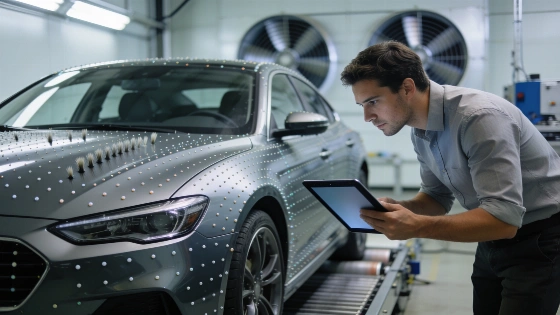
Traditionally, aerodynamic development has relied on computational fluid dynamics (CFD) simulations and wind-tunnel experiments. While CFD provides detailed predictions of airflow around a vehicle, its accuracy is limited by the quality of the underlying physical models and the computational resources available. Wind-tunnel testing, on the other hand, offers direct measurement but is costly and time-consuming, making it impractical for rapid iteration across many design variants.
Recent advances involve the use of AI-driven “large physics models” that are trained on extensive datasets combining CFD results, wind-tunnel measurements, and real-world driving data. These models can identify subtle patterns and discrepancies between simulated and measured performance, enabling engineers to refine both their simulations and physical prototypes more efficiently. The approach is particularly valuable for passenger vehicles, where small improvements in drag coefficient can translate into significant gains in fuel economy or electric range at scale.
High-Quality Data Remains a Central Challenge
One of the central challenges in deploying AI for aerodynamic optimization is the need for high-quality, representative training data. Models that are trained on limited or biased datasets may fail to generalize to new vehicle shapes or operating conditions. To address this, engineers are integrating data from multiple sources and carefully validating model predictions against experimental results. This iterative process helps ensure that AI-driven recommendations are physically meaningful and robust across a range of real-world scenarios.
In practical terms, the integration of AI with physics-based modeling allows for faster exploration of the design space. Engineers can simulate thousands of design variations, using AI to prioritize those most likely to yield aerodynamic improvements before committing to expensive wind-tunnel or on-road tests. This workflow not only accelerates development but also supports the creation of vehicles that meet increasingly stringent efficiency standards without compromising safety or manufacturability.
Faster Design Exploration Comes With Limitations
While the use of AI in aerodynamic engineering is advancing rapidly, several limitations remain. The accuracy of AI-driven predictions depends on the diversity and quality of the training data, and the models must be continually updated as new vehicle architectures and materials are introduced. Additionally, the interpretability of complex AI models can be limited, making it essential for engineers to maintain a clear understanding of the underlying physics to avoid overfitting or misapplication of the technology.
For physicists and engineers interested in this multidisciplinary field, the growing intersection of AI, computational modeling, and experimental testing offers a range of career opportunities. Expertise in fluid dynamics, data science, and experimental validation is increasingly valuable as the automotive industry seeks to balance performance, efficiency, and regulatory compliance in next-generation vehicle designs.
In a typical aerodynamic optimization project, engineers may analyze hundreds of CFD simulations and dozens of wind-tunnel tests, generating terabytes of data. For example, a single vehicle design iteration might involve CFD runs at multiple yaw angles and speeds, with each simulation producing detailed pressure and velocity fields across the car's surface. Wind-tunnel measurements provide ground truth for drag and lift coefficients, while on-road tests capture the influence of real-world turbulence and environmental variability. The integration of these datasets enables AI models to predict aerodynamic performance with increasing accuracy, but the process requires careful calibration and ongoing validation to ensure reliability.
How Computational Fluid Dynamics Supports the Process
Understanding the role of computational fluid dynamics is essential in this context. CFD uses numerical methods to solve the equations governing fluid flow, allowing engineers to predict how air moves around complex shapes. However, CFD results are sensitive to mesh resolution, turbulence modeling, and boundary conditions, which can introduce systematic errors. By combining CFD with experimental data and AI-driven analysis, engineers can identify and correct these errors, leading to more accurate and efficient vehicle designs.