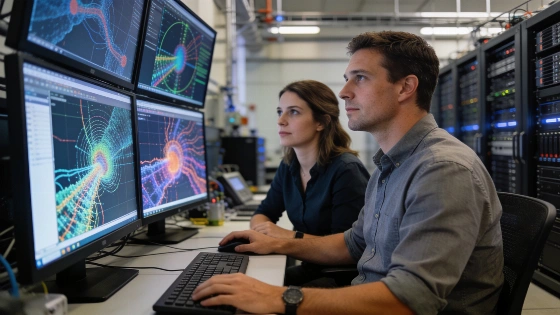
Rescale has secured US Department of Energy funding to embed agentic AI into advanced simulation codes, aiming to make national laboratory-developed modeling tools more accessible to manufacturers and engineering teams
Rescale, a US-based digital engineering platform, has been awarded funding under the Department of Energy's Genesis Mission to develop agentic AI capabilities for advanced simulation tools. The initiative, known as the Agentic HPC Pipeline Initiative (AHPI), will see Rescale collaborate with Lawrence Berkeley National Laboratory, Lawrence Livermore National Laboratory, and Oak Ridge National Laboratory. The project's stated goal is to lower the technical barriers that have historically limited industry access to high-performance simulation codes developed at US national labs.
Genesis Mission Backs the Agentic HPC Initiative
The Genesis Mission, established by executive order in November 2025, is a multi-year federal program designed to accelerate scientific discovery by integrating artificial intelligence, supercomputing, quantum systems, and advanced scientific instruments into a unified research platform. The Department of Energy's first Genesis Mission funding round, announced earlier this year, allocated $293 million to projects in advanced manufacturing, biotechnology, nuclear energy, and quantum science. According to the department, more than 8,000 applications were submitted, making it the largest funding call in its history. Rescale's AHPI was selected for Phase I funding to address a persistent challenge: many simulation tools developed at national laboratories require specialized expertise and infrastructure, limiting their adoption by US manufacturers.
AI Agents to Support Advanced Simulation Tools
Under the AHPI, Rescale will work with the three national laboratories to integrate agentic AI into simulation codes including WarpX, LiDO, and Adamantine. These codes, developed by the respective labs, are used for modeling complex physical phenomena in fields such as materials science and energy systems. The project aims to embed AI agents within the Rescale platform to assist engineers in selecting appropriate simulation tools, configuring inputs, monitoring computational runs, and analyzing results. According to company statements, the intended outcome is to reduce the time and expertise required to use these simulations by a factor of five or more, though independent verification of this claim is not yet available.
Rescale's approach builds on its existing partnership with Oak Ridge National Laboratory's Manufacturing Demonstration Facility. A key feature of the AHPI is the retention of agentic workflows, surrogate models, and code environments on the Rescale platform after the formal end of DOE-industry collaborations. This is intended to allow ongoing access and collaboration between laboratories and manufacturers, addressing a common limitation in previous public-private research partnerships where access to tools often ended with project funding.
A Broader Push to Expand US Scientific Computing
The Genesis Mission has been compared by department officials to historic US science efforts such as the Manhattan Project and the Apollo program, with the stated ambition of doubling national research productivity within a decade. The scale of the program is reflected in the number of participating institutions—17 national laboratories and approximately 40,000 scientists and engineers. The integration of agentic AI into simulation workflows is one of several efforts to make advanced computing resources more usable by industry, complementing large-scale infrastructure investments such as the recently announced hyperscale AI data center campus in Georgia.
Reliability and Human Oversight Remain Critical
While the AHPI is at an early stage, its focus on agentic AI—software agents capable of autonomously managing complex simulation tasks—reflects a broader trend in scientific computing. However, the effectiveness of these agents in reducing the need for specialized human expertise, and their reliability in high-stakes engineering contexts, will require systematic evaluation. The project's success will depend on the transparency of its technical documentation, the reproducibility of its results, and the extent to which it can demonstrate measurable improvements in industrial R&D workflows.
Agentic AI refers to software systems that can autonomously plan, execute, and adapt sequences of actions to achieve defined goals, often by interacting with external tools or environments. In the context of scientific simulation, agentic AI may automate the selection of simulation codes, parameter tuning, job scheduling, and result interpretation. While this can reduce manual workload and lower the expertise threshold for using advanced tools, it also introduces new challenges in verification, error recovery, and human oversight. Ensuring that agentic AI systems remain transparent, auditable, and subject to meaningful human control is a central concern in their deployment for critical engineering and scientific applications.