Archaeologists excavating the medieval site of Sondur on Sandoy, Faroe Islands, have uncovered a rare runestone and Christian artifacts, offering new evidence for religious activity and material culture in the North Atlantic during the Middle Ages
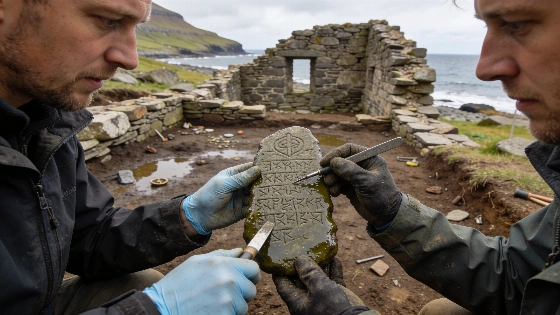
Archaeological excavations at the site of Sondur on Sandoy, one of the Faroe Islands, have revealed a rare runestone embedded in the floor of a medieval building. The find is notable for its scarcity in the Faroese context, where runic inscriptions are seldom recovered, and adds to a growing body of evidence for Christian activity in the region during the Middle Ages.
Excavation Context and Material Evidence
The runestone was discovered during the most recent field season, positioned within the floor of a structure exposed by ongoing excavation. The building itself is aligned on an east-west axis, with an entrance at the western end-a layout consistent with medieval chapels and prayer houses documented elsewhere in the Faroe Islands. In addition to the runestone, archaeologists recovered fragments of a small statuette depicting the Virgin Mary holding the Christ Child, as well as a lamp likely used for burning oil or candles. These finds collectively support the interpretation that the building functioned as a Christian prayer house or chapel.
Comparable architectural features have been identified at other medieval sites in the archipelago, including Bønhúsberg on Mykines, Bønhústoft in Leirvík, and Bakki at Velbastaður. The Sondur excavation is being conducted by the National Museum of the Faroe Islands in partnership with Aarhus University and the Moesgaard Museum, with fieldwork scheduled to continue through August.
Preservation, Analysis, and Interpretation
The runestone was preserved in waterlogged conditions for centuries, which has aided in the survival of its surface but necessitated immediate conservation. The artifact has been transferred to the National Museum of the Faroe Islands for stabilization and further study. Preliminary examination suggests that portions of the runic inscription may already be legible, but a specialist in runic epigraphy is expected to conduct a detailed analysis later this month. The inscription's content, language, and dating remain to be fully established, and may provide new insight into the use of runic writing and the development of Christianity in the Faroe Islands during the medieval period.
While the runestone is the most prominent find, the associated Christian artifacts and the building's orientation reinforce the interpretation of the site as a locus of religious practice. However, the precise function of the structure and the full significance of the runic text await further analysis. The rarity of runestones in the Faroe Islands makes this discovery particularly significant for understanding the spread of Christian material culture in the North Atlantic.
Numerical and Comparative Context
Runic inscriptions are exceptionally rare in the Faroe Islands, with only a handful documented to date. The Sondur excavation has yielded not only the runestone but also at least two additional Christian artifacts-a statuette fragment and a lamp-within a single building context. The structure's east-west alignment and western entrance mirror those of other medieval prayer houses in the region, providing comparative architectural evidence. The ongoing project is expected to continue through the end of August, with further finds and analysis anticipated as excavation progresses. For comparison, other recent discoveries of ritual or religious sites, such as the Etruscan well containing bronze offerings and skeletons at Kainua, highlight the diversity of religious practices and material culture across medieval and ancient Europe (see reporting on Etruscan ritual wells).
Uncertainty and Future Research
The interpretation of the Sondur building as a prayer house is supported by its architectural features and associated finds, but remains provisional pending further analysis of the runestone and additional excavation. The legibility and content of the runic inscription will be critical for refining the chronology and understanding the cultural context of the site. Conservation work is ongoing, and the results of epigraphic study are expected to clarify the inscription's language, date, and possible dedication. As with many medieval sites in the North Atlantic, preservation conditions and limited comparative material present challenges for interpretation, and alternative explanations for the building's function cannot be excluded until more evidence is available.
Understanding the significance of runestones in the Faroe Islands requires attention to archaeological provenance. Provenance refers to the documented origin and context of an artifact, including its recovery location, stratigraphic association, and relationship to other finds. Secure provenance allows archaeologists to interpret objects within their historical and cultural setting, while uncertain or disturbed contexts can limit the reliability of conclusions. In the case of the Sondur runestone, its in situ discovery within a medieval building floor provides strong contextual evidence, but further analysis of the inscription and associated materials will be necessary to establish its full historical significance.