
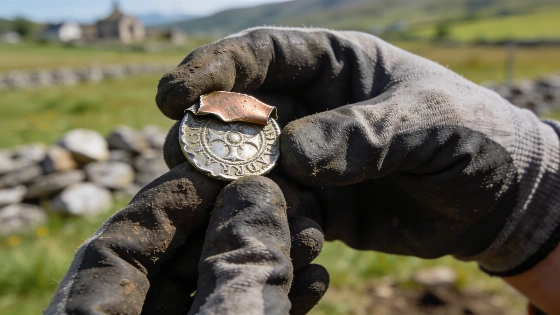
Archaeologists have identified a silver coin discovered near Utstein Monastery in southwest Norway as a rare issue from the reign of Magnus Barefoot, using numismatic analysis and X-ray imaging to reveal unique design features and possible reuse as jewelry
A silver coin recovered by a metal detectorist in a plowed field near Utstein Monastery, southwest Norway, has been identified as a rare medieval issue dating to the reign of Magnus Barefoot (Magnus Berrføtt), who ruled Norway from 1093 to 1103 CE. According to a report from Live Science, the find represents the first example of its specific type to be documented within Norway, despite the ruler's coins being known from around 100 previously recovered specimens.
A Medieval Coin Modified Into Jewelry
The coin was found outside a controlled archaeological excavation, but its location near a major medieval monastic site provides some contextual information. Researchers from the University of Stavanger Museum of Archaeology conducted a detailed analysis, noting that the coin's outer edge had been deliberately folded around a copper plate. Two rounded notches on the edge suggest that a chain or loop may once have been attached, indicating the object was likely worn as jewelry for an extended period after its original use as currency.
Rare Griffin and Cross Designs
X-ray imaging revealed a griffin motif concealed beneath the copper plate, while the visible side of the coin displays a cross-over-cross design. This combination of motifs is extremely rare: only four two-sided coins with both the griffin and cross-over-cross designs are known. Three were recovered together in a single hoard in Denmark, and the fourth was previously found in the Faroe Islands. The Norwegian find is therefore significant for expanding the known distribution of this coinage type and providing evidence for its circulation or reuse in the region.
Numismatic analysis suggests the coin was minted during the late Viking Age, a period marked by political consolidation and the gradual transition from Viking to medieval forms of rule in Scandinavia. The coin's modification and prolonged use as an ornament highlight the complex afterlives of medieval currency, which could be repurposed as personal adornment or status symbols long after their original economic function had ended. However, because the coin was not recovered from a secure archaeological layer, its precise deposition date and the circumstances of its loss remain uncertain.
Why the Norwegian Find Is Significant
Approximately 100 coins attributed to Magnus Barefoot have been documented to date, but only a handful display the rare combination of griffin and cross-over-cross motifs. The Norwegian example is unique in its context and in the evidence for secondary modification. The find underscores the importance of systematic recording and analysis of metal-detected material, especially when objects are recovered outside formal excavations. Without stratigraphic association or direct dating, interpretation must rely on typological comparison and material analysis, which can limit the certainty of historical conclusions.
What Medieval Coins Can Reveal
Numismatic evidence plays a central role in dating and interpreting medieval Scandinavian sites and finds. Coins can often be dated to within a few decades based on inscriptions, iconography, and metallurgical composition. However, when coins are found outside controlled excavations, their value for reconstructing precise historical events is reduced. The study of coin reuse and modification, including transformation into jewelry, provides insight into changing patterns of value, identity, and material culture in the medieval North.