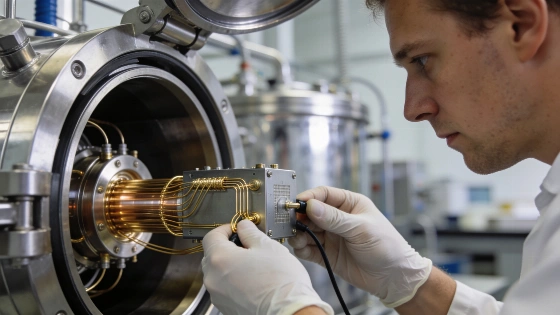
Qubic will deliver nine kinetic inductance traveling wave parametric amplifiers and control software under a CA$1.5 million federal contract, aiming to cut cryogenic power use in quantum measurement setups.
The Canadian government has committed up to CA$1.5 million (US$1.08 million) to deploy Qubic's cryogenic amplifiers in operational quantum environments. The contract, awarded through the Innovative Solutions Canada Testing Stream, calls for Qubic to supply nine kinetic inductance traveling wave parametric amplifiers (KI-TWPAs) and control software for sub-Kelvin integration and field testing by spring 2027. The project is part of a broader push, seen at research centers like MIT and CERN, to improve the scalability and reliability of quantum hardware outside the lab.
Device architecture and thermal constraints
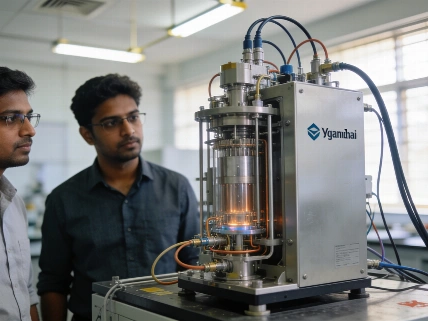
Qubic's KI-TWPA design moves away from the Josephson-junction-based amplifiers common in today's quantum hardware. Instead of using magnetic-field-sensitive components, the device relies on the nonlinear inductance of the superconducting transmission line. This is meant to make the amplifier less sensitive to magnetic fields and reduce its thermal load on dilution refrigerators-a key issue for scaling quantum processors and sensors. According to Qubic, the hardware dissipates less than 0.1 milliwatts of heat, while conventional cryogenic amplifiers can use up to half of a refrigerator's cooling power in some setups. Peer-reviewed studies in Nature have highlighted similar challenges, pointing to the need for device-level innovation in quantum system integration.
Each amplifier will ship with mounting hardware and evaluation software, with the first units expected in late 2026. The contract requires real-world operational testing, not just lab demonstrations, and sets milestones for integration and performance checks under sub-Kelvin conditions. The devices are intended for multiplexed qubit readout and high-sensitivity radio-frequency (RF) sensing-both essential for practical quantum computing and measurement. These dual-use features reflect trends at places like Stanford and the Max Planck Society, where quantum hardware is being tested for both computing and advanced sensing.
Funding, partnerships, and commercial context
This contract follows a CA$3.5 million (US$2.5 million) seed round led by Two Small Fish Ventures in June 2026, bringing Qubic's total raised capital and non-dilutive grant funding to nearly CA$10 million. Qubic, a spin-off from the Institut Quantique and the Institute for Quantum Computing, has also signed a commercial integration agreement with Quantum Machines to add its low-noise amplifiers to hybrid quantum control stacks. These moves are part of a wider effort to bridge the gap between lab prototypes and scalable, reliable quantum systems-a challenge also noted by NASA in its quantum technology planning.
Government procurement of quantum hardware is still rare, with most contracts focused on software, simulation, or research. The direct purchase and field testing of cryogenic amplifiers marks a shift toward seeing if new device types can meet the reliability and integration needs of operational quantum platforms. As reported earlier, similar field tests in the US have focused on quantum-resistant cryptography, but hardware-level procurement for quantum measurement is still limited.
Technical evidence and open questions
Qubic's architecture aims for lower thermal dissipation and magnetic-field resilience, but independent performance data are still scarce. The contract requires nine amplifiers, but does not specify if all must meet the same benchmarks or if some variation is allowed. The company says the devices operate near the quantum noise limit, but has not yet released detailed data on gain, bandwidth, noise temperature, or stability under real-world wiring and vibration. Peer-reviewed work from groups at Harvard and in Science has stressed the need for transparent benchmarking and reproducibility in quantum device testing.
Integrating these amplifiers into sub-Kelvin environments brings further engineering challenges, including thermal anchoring, electromagnetic compatibility, and long-term stability. The evaluation milestones set for spring 2027 will be the first chance to see if the devices can perform consistently outside controlled lab settings. Until then, the practical impact of the KI-TWPA approach remains uncertain for both quantum computing and sensing.
Engineering limits and commercial readiness
Qubic's contract highlights the ongoing gap between promising device physics and working quantum infrastructure. While the company's approach addresses known issues in cryogenic power use and magnetic-field sensitivity, the lack of independent performance data means claims of scalability and reliability are still unproven. The Canadian contract's field test is a necessary step, but not a guarantee, toward wider adoption. For now, the quantum hardware sector is cautious, with each new device architecture needing to prove itself in real-world integration and reproducibility.
In quantum measurement and control, the difference between lab demonstration and operational reliability is crucial. The KI-TWPA's success will depend not just on its design, but on its ability to deliver low-noise amplification under the full range of conditions found in working quantum systems. Until those results are public, the field is waiting for evidence rather than celebrating progress.
Cryogenic amplifiers are essential for reading out quantum states in superconducting and spin-based quantum processors. These devices must work at millikelvin temperatures, where even small amounts of heat can degrade qubit coherence and measurement accuracy. The challenge is to amplify weak quantum signals without adding noise or overloading the limited cooling power of dilution refrigerators. Device designs that minimize heat and resist magnetic interference are key for scaling quantum hardware beyond the lab. Moving from demonstration to deployment depends on reproducibility, integration, and independent verification of performance in real-world conditions.