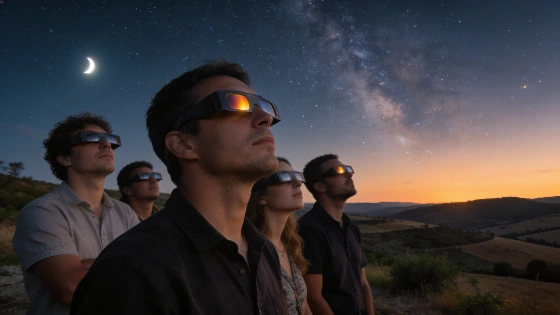
On 12 August 2026, a total solar eclipse will cross parts of Greenland, Iceland, and Spain, coinciding with the Perseid meteor shower and a prominent Venus. Observers in North America and Europe will experience rare overlapping astronomical events
On 12 August 2026, a rare convergence of astronomical events will be visible across parts of the Northern Hemisphere. A total solar eclipse will sweep across a narrow corridor spanning eastern Greenland, western Iceland, and northern Spain, while a deep partial eclipse will be observable from much of Europe, northwest Africa, and parts of North America. The timing of the eclipse coincides with the annual peak of the Perseid meteor shower and a prominent evening appearance of Venus, offering a unique opportunity for both amateur and professional observers to witness multiple phenomena in a single night.
Iceland and Greenland: Path of Totality
The path of totality for the 2026 solar eclipse is approximately 290 kilometers wide, crossing remote regions of eastern Greenland and western Iceland before reaching northern Spain. In Greenland, the maximum duration of totality is expected to be about 2 minutes 17 seconds, with the eclipse occurring at 16:36 local time (WGST) and the Sun positioned roughly 25 degrees above the west-southwest horizon. In Iceland, totality will begin between 17:43 and 17:50 GMT, lasting up to 2 minutes 13 seconds in the far west. The Sun will be about 25.5 degrees above the horizon at maximum eclipse. Due to the high latitude and extended twilight, true darkness will not occur, limiting visibility of the Perseids and aurora. Venus will not be visible from these northern locations after sunset.
Spain: Low Sun, Total Eclipse, and Meteor Showers
In Spain, the eclipse will be most dramatic in the northwest, with totality beginning between 20:26 and 20:33 CEST. The maximum duration in Spain is about 1 minute 50 seconds at Playa de la Escaladina in Galicia, where the Sun will be just 11 degrees above the horizon. In the Balearic Islands, totality will last around 1 minute 36 seconds with the Sun only a few degrees above the horizon. The Sun will set at 21:16 in Madrid, and the darkest part of the night-when the Perseid meteor shower is most active-will occur around 02:00 CEST. Under rural Spanish skies, observers may see 30 to 50 meteors per hour, with the new moon ensuring minimal interference from moonlight. Light pollution will affect meteor visibility near cities, but the eclipse itself is unaffected by local lighting conditions.
United Kingdom and Western Europe: Deep Partial Eclipse and Venus
Although the path of totality does not cross the United Kingdom, observers there will witness a deep partial eclipse, with 90% to 96% of the Sun obscured depending on location. The maximum eclipse will occur shortly after 19:00 BST, with the Sun low in the west-northwest. The Isles of Scilly and Land's End in Cornwall will see the deepest coverage, approaching 96%. The partial eclipse will create noticeable dimming and a drop in temperature, but not the complete darkness of totality. After sunset, Venus will be prominent in the western sky, appearing near its brightest and showing a half-lit phase through telescopes. The Perseid meteor shower will reach its peak in the early hours of 13 August.
Western Europe and North America: Eclipsed Sunsets and Meteor Activity
Across western Europe, including regions such as Corsica, the Ligurian coast, Venice, and the Alps, the eclipse will coincide with sunset, producing rare crescent-shaped solar silhouettes as the Sun dips below the horizon. In North America, a partial eclipse will be visible from Alaska to New England, affecting 26 U.S. states and all Canadian provinces. The deepest eclipse in the U.S. will occur in Alaska, with Fairbanks experiencing about 37% coverage at 08:21 AKDT. In Canada, Iqaluit will see 61% obscuration at 13:24 EDT, and St. John's, Newfoundland, will see over 50% at 15:35 NDT. Observers are reminded that eclipse glasses are essential for safe viewing, even during partial phases. After sunset, Venus and the Perseids will be visible, with the meteor shower peaking overnight.
The 2026 eclipse is notable for its overlap with the Perseid meteor shower and Venus's evening prominence. The eclipse occurs at new moon, ensuring dark skies for meteor observation in regions where true night falls. The combination of a solar eclipse, a major meteor shower, and a bright planetary apparition is rare, and the event's timing offers a unique opportunity for coordinated observations across continents.
Solar eclipses occur when the Moon passes directly between Earth and the Sun, casting a shadow on Earth's surface. The path of totality is the narrow region where the Sun is completely obscured, while observers outside this path see only a partial eclipse. The duration and appearance of totality depend on the observer's location relative to the centerline of the shadow. Meteor showers, such as the Perseids, are caused by Earth passing through debris left by comets, producing visible streaks as particles burn up in the atmosphere. Venus's dichotomy-when it appears half-lit-occurs as its position relative to Earth and the Sun changes, making it especially bright in the evening sky. Safe solar observation requires certified eclipse glasses or indirect viewing methods to prevent eye damage.