A commercial portable X-ray device was operated aboard an orbital spacecraft, producing diagnostic-quality radiographs comparable to those acquired on Earth and highlighting the potential for in-flight medical imaging beyond ultrasound
Researchers have reported the first diagnostic-quality X-ray images acquired during orbital spaceflight, using a commercially available portable digital radiography system. The experiment, conducted aboard the Dragon spacecraft during the Fram2 mission in early April 2025, demonstrates that radiographic imaging can be performed in microgravity with image quality comparable to ground-based standards. This result establishes a technical baseline for expanding medical imaging capabilities in crewed space missions, where current options are limited to ultrasound.
Traditional X-ray systems are typically too large, heavy, and power-intensive for spaceflight, and their operation is sensitive to motion and requires shielding. The team addressed these constraints by selecting an FDA-cleared, battery-powered portable X-ray generator (Impact Wireless; MinXray) paired with a flat-panel detector. Prior to launch, three crew members received four hours of training on the system and acquired baseline radiographs of their hand, forearm, abdomen, pelvis, chest, and a quality-control phantom. The same imaging protocol was repeated in orbit, with additional images of a smartwatch to assess non-destructive testing capability.
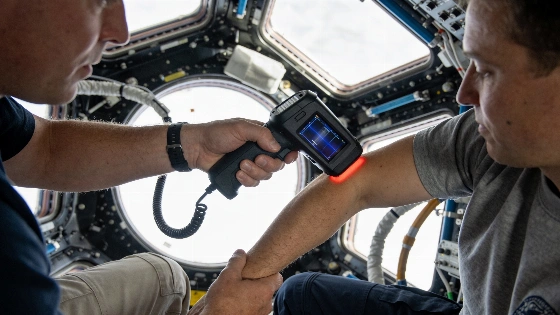
During the 3.5-day polar orbital mission, crew members operated the handheld X-ray device to capture anatomical images, while the phantom and smartwatch were secured to the detector. The crew reported that the imaging workflow was straightforward to follow under microgravity conditions. Upon return, the X-ray generator showed minor re-entry damage, but its internal components and output remained unaffected. The detector passed postflight inspection and quality control tests.
Image Quality and Diagnostic Assessment
Seven in-flight X-ray images were evaluated by three independent radiologists, who compared them to preflight and postflight images acquired using the same protocol. The reviewers found no significant differences in overall image quality, contrast resolution, or spatial resolution between spaceflight and ground-based radiographs. For central-body images (chest, abdomen, pelvis), positioning was less precise in orbit, but all images achieved good or near-excellent diagnostic quality on a five-point Likert scale. Phantom images captured in space resolved low-contrast targets down to 2 mm and high-contrast meshes up to 80 lines per inch. The smartwatch radiograph revealed internal components at submillimeter scale.
The experiment provides quantitative evidence that portable digital radiography can deliver diagnostic-quality images in microgravity, with minimal operator training. The system's performance was robust to the mechanical and environmental stresses of launch, orbital operation, and re-entry. According to a report from Physics World, the study demonstrates that nonmedical crew members can reliably operate the device after brief instruction, supporting its potential for future missions where medical expertise may be limited.
Engineering Constraints and Future Applications
While the portable X-ray system functioned as intended, several engineering and operational challenges remain. The device's mass, power requirements, and radiation shielding must be balanced against spacecraft constraints. Image positioning accuracy was reduced in microgravity, particularly for central-body regions, suggesting that further protocol refinement or stabilization aids may be needed. The study did not address long-term reliability, repeated use, or integration with other medical systems.
Beyond crew health, the ability to perform radiographic imaging in orbit could support non-medical diagnostics, such as inspecting electronics, spacesuits, or other mission-critical hardware without disassembly. The demonstration establishes a foundation for future research on radiation safety, workflow optimization, and the integration of digital radiography into spaceflight medical protocols. The results have not yet been independently reproduced in other missions or with alternative hardware.
In the context of space medicine, this experiment marks a step toward diversifying in-flight diagnostic tools. Ultrasound remains the only widely used imaging modality in orbit, but it is operator-dependent and limited by acoustic access. Digital radiography offers rapid acquisition, lower operator dependence, and higher spatial resolution for many conditions relevant to spaceflight, including trauma, dental issues, and pulmonary complications. The evidence from this mission suggests that portable X-ray systems could become a practical addition to the medical toolkit for long-duration missions, provided that engineering and operational constraints are addressed.
Understanding the distinction between diagnostic-quality imaging and clinical utility is essential. While the images acquired in this study met radiological standards for contrast and resolution, the broader impact on crew health outcomes will depend on integration with medical protocols, radiation management, and the ability to interpret findings in the context of limited in-flight resources. Further research is needed to validate these systems across a wider range of anatomical targets, mission durations, and crew skill levels.
Radiographic imaging relies on the differential absorption of X-rays by tissues of varying density, producing contrast that enables the visualization of bones, organs, and foreign objects. In microgravity, maintaining stable positioning of both the subject and the detector is more challenging than on Earth, which can affect image quality. Portable digital radiography systems use flat-panel detectors to capture and digitize X-ray signals, allowing rapid image acquisition and review. Diagnostic quality is typically assessed by radiologists based on spatial resolution, contrast, and the visibility of clinically relevant features. Achieving consistent diagnostic quality in space requires careful attention to device calibration, operator training, and workflow adaptation to the unique constraints of the orbital environment.