NASA's Perseverance rover has recorded a rare occultation event, imaging Earth as it briefly disappeared behind Mars' innermost moon Phobos using its Mastcam-Z camera system
NASA's Perseverance rover has documented a rare astronomical alignment from the surface of Mars, capturing a sequence of images as Earth vanished behind the Martian moon Phobos. The event, known as an occultation, was observed on July 2, 2026, and required precise planning to record from the rover's vantage point in Jezero Crater.
Imaging an Occultation
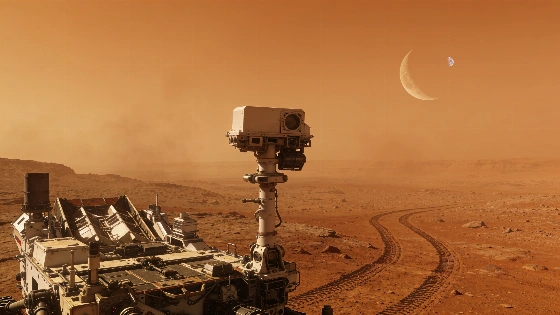
The occultation was recorded using Perseverance's Mastcam-Z instrument, a dual-camera system designed for high-resolution color imaging and stereoscopic views. Over the course of the event, Mastcam-Z acquired nine separate images, later combined into a composite that shows Earth-visible as a faint dot-passing behind the irregular crescent of Phobos in the dusty Martian sky. Such alignments are uncommon, as Phobos orbits Mars three times daily while Earth remains visible for extended periods, but the two rarely overlap from a single surface location.
Phobos is the larger and closer of Mars' two moons, with an average orbital distance of about 6,000 kilometers from the Martian surface. Its rapid orbit and irregular shape make precise predictions of occultations challenging, requiring careful modeling of both the moon's path and the rover's position. The successful capture of this event demonstrates the capabilities of Perseverance's imaging systems and the value of long-term surface operations for observing dynamic solar system phenomena.
Scientific Context and Mission Operations
The images were taken on the 1,907th Martian day (sol) of Perseverance's mission, which began with its landing in February 2021. Mastcam-Z's ability to resolve distant objects in the sky allows for the study of both Martian atmospheric conditions and the orbits of Mars' moons. Occultations involving Phobos or Deimos provide opportunities to refine orbital models and test predictions of their motion, which remain uncertain due to the moons' irregular shapes and possible origins as captured asteroids or remnants of ancient impacts.
Beyond this occultation, Perseverance has previously recorded other transient events, including Phobos transiting the Sun-a phenomenon sometimes described as a Martian solar eclipse. These observations contribute to a broader dataset that helps scientists understand the evolution and stability of Mars' moons, as well as the planet's atmospheric scattering and dust content. The ability to capture such fleeting alignments is a testament to the mission's operational flexibility and the planning required to coordinate surface activities with celestial mechanics.
Measurement Details and Observational Challenges
The occultation sequence was acquired on July 2, 2026, using Mastcam-Z's zoom and color imaging capabilities. Each exposure was timed to track the apparent motion of Phobos as it crossed the sky, with Earth's position calculated in advance to maximize the chance of overlap. The resulting composite image shows Earth as a pale dot, briefly obscured by the crescent-shaped silhouette of Phobos against the Martian sky. The event lasted only a few seconds, underscoring the need for precise timing and instrument readiness.
Capturing such an alignment is complicated by the thin Martian atmosphere, which scatters sunlight and can obscure faint objects. The brightness of Phobos and the faintness of Earth from Mars-where Earth appears as a star-like point-require careful exposure settings and image processing to distinguish both bodies. These technical challenges are similar to those faced in other planetary imaging campaigns, such as efforts to track distant spacecraft or natural satellites from the ground or orbit. For comparison, astronomers using the Chandra X-ray Observatory have also documented dynamic interactions in space, such as a black hole jet disrupting gas in a distant galaxy, highlighting the diversity of transient events accessible to modern instruments.
Implications for Mars Science
Observations of occultations and transits by Mars' moons provide more than striking images-they offer data for refining models of orbital evolution and surface processes. Phobos, in particular, is gradually spiraling inward due to tidal interactions with Mars and is expected to break apart or impact the planet within tens of millions of years. Tracking its precise motion helps constrain these timescales and informs future mission planning, including potential sample-return efforts.
Events like the Earth-Phobos occultation also serve as calibration opportunities for rover instruments, allowing teams to test pointing accuracy, exposure control, and image processing pipelines under challenging conditions. As Perseverance continues its extended mission, such observations will remain valuable for both planetary science and the ongoing development of surface exploration techniques.
Occultations occur when one celestial body passes in front of another from a specific viewpoint, temporarily blocking its light. On Mars, occultations involving Phobos or Deimos are used to refine orbital parameters and study the moons' shapes and surface features. For surface-based observers, these events require precise timing and instrument alignment, as the apparent motion of the moons is rapid and the targets are often faint. The successful imaging of Earth passing behind Phobos demonstrates the interplay between mission planning, instrument capability, and the dynamic nature of the Martian sky.