
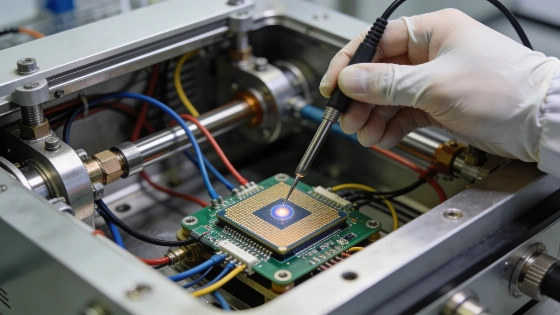
A proposed hardware method for implementing the Pauli Z gate in quantum dot-based quantum computers highlights the unresolved legal barriers to patenting quantum operations that rely on established physical laws.
Patenting hardware-level quantum computing operations often runs into a familiar legal problem: where to draw the line between inventive engineering and simply applying known physical laws. The Pauli Z gate-a basic quantum logic operation-implemented on a quantum dot platform is now a test case for how far patent protection can go when the underlying physics is already well understood. Major research institutions, including MIT and Stanford, are watching this debate closely as they push forward with quantum hardware development.
Quantum dot hardware and the Z gate
The Pauli Z gate is a single-qubit operation that flips the phase of a quantum state. It is a standard part of quantum algorithms and error correction. In quantum dot systems, the Z gate is performed by rotating an electron's spin by π radians around the z-axis. This involves preparing the electron spin in a known state, applying a perpendicular magnetic field for a time set by the Larmor frequency, and then measuring the resulting quantum state. These steps are well documented in quantum information textbooks and in journals such as Nature Nanotechnology.
While the method is technically specific, it does not introduce new physics or an unexpected engineering approach. The hardware uses established semiconductor techniques to trap and control single electrons, and the quantum operation follows directly from the known effect of magnetic fields on electron spin. This approach matches what is taught at places like Harvard and the Max Planck Society, where the focus is on using well-understood quantum effects in devices.
Legal barriers and natural law
In the United States, patent eligibility is shaped by the Mayo/Alice framework, which excludes inventions that only apply natural laws without an additional inventive concept. The American Axle case reinforced this by denying a patent for a method that used a physical law in a routine way. For the Pauli Z gate, patent examiners or courts may argue that the described method is simply the known effect of a magnetic field on electron spin, without the inventive step needed for eligibility. This reasoning is common in legal scholarship and is central to ongoing discussions at the U.S. Patent and Trademark Office.
Supporters of eligibility often point to the specific hardware context-such as using a quantum dot, preparing the initial state, or the type of semiconductor substrate. But courts have been skeptical of claims that just limit a natural law to a particular technology without a new mechanism. There is concern that granting such a patent could block all practical uses of Z-rotations in quantum dots, giving one party control over a basic quantum operation. This issue has come up in policy discussions at CERN and in editorials in Science.
Hardware details and patent survival
Some argue that including detailed hardware features-like the structure of the quantum well, the method for trapping electrons, or how the device integrates with semiconductor substrates-could make a patent claim stronger. Still, the legal standard is unclear. More hardware detail may be seen as background rather than a real inventive contribution. The outcome often depends on how narrowly the claim is written and whether it can be distinguished from simply applying physical law.
These issues are not unique to quantum computing. Similar questions about eligibility have come up in other fields where the line between natural law and engineering is blurry. As reported earlier, even new quantum software frameworks must deal with the difference between abstract ideas and patentable inventions.
Patent law and quantum innovation
The debate over patenting quantum hardware methods has real consequences. Without clear eligibility standards, companies and researchers face uncertainty about protecting their work. This can slow investment and collaboration, especially when the underlying physics is already public knowledge. The current legal environment puts pressure on inventors to show a true technological advance beyond just applying established quantum mechanics.
For quantum computing to grow as an industry, the patent system needs to balance rewarding engineering innovation with keeping basic operations open. Until courts or lawmakers clarify the rules, inventors in quantum hardware will keep working in a legal gray area, with eligibility depending on the details of claim language and how "inventive concept" is interpreted. The debate is closely followed by journal editors at Science and policy analysts at NASA, who see the broader impact on technology transfer and commercialization.
In quantum computing, a qubit is the basic unit of quantum information, often realized as the spin of an electron in a quantum dot. The Pauli Z gate changes the phase of the qubit's state without affecting its chance of being measured as zero or one. Implementing this gate in hardware requires precise control of the qubit's environment, but the mechanism is set by well-known physical laws. Patent law continues to draw a line between inventions that use these laws in a routine way and those that offer a new engineering solution-a distinction that remains central to the future of quantum device innovation.