Pasqal Holding SAS, a developer of neutral-atom quantum processors, has received SEC approval for its planned business combination with Bleichroeder Acquisition Corp. II, setting the stage for a shareholder vote and potential Nasdaq debut
Pasqal Holding SAS, a French company specializing in neutral-atom quantum computing, has announced that its joint Form F-4 Registration Statement with Bleichroeder Acquisition Corp. II was declared effective by the U.S. Securities and Exchange Commission (SEC) on August 5, 2026. This regulatory milestone enables the next step in Pasqal's proposed business combination with the special purpose acquisition company (SPAC), with a shareholder vote scheduled for August 25, 2026. If approved, the merged entity will operate as Pasqal Holding SA and intends to list on the Nasdaq stock exchange under the ticker symbol PSQL.
Neutral-Atom Quantum Hardware
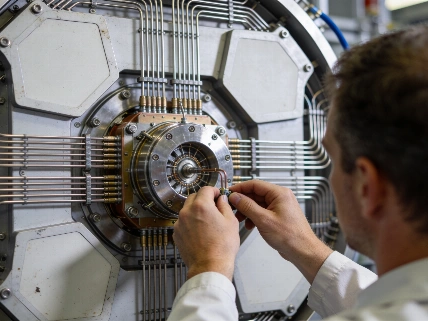
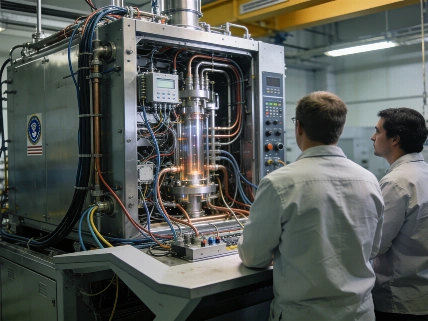
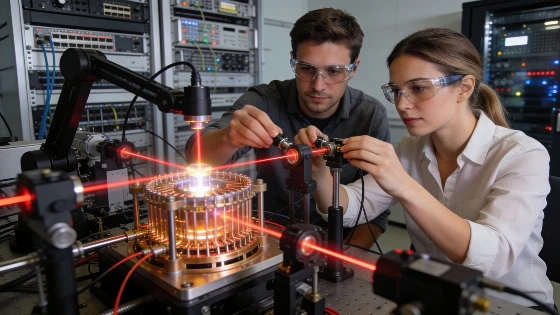
Founded in 2019 by Nobel laureate Alain Aspect and collaborators, Pasqal develops quantum processors based on arrays of neutral atoms. These systems use optical tweezers-highly focused laser beams-to trap and manipulate individual atoms, enabling the implementation of quantum gates and analog quantum simulations. Unlike superconducting or trapped-ion platforms, neutral-atom devices can be operated in standard data center environments, potentially simplifying integration with existing high-performance computing infrastructure.
System Scale and Technical Benchmarks
According to company disclosures, Pasqal has raised over $300 million in private funding and has deployed system architectures exceeding 1,000 physical qubits. The company's roadmap targets more than 10,000 physical qubits and 200 logical qubits with fault-tolerant error correction, though these higher-level milestones remain in development. Recent deployments include a 140-qubit neutral-atom quantum processing unit (QPU) at CINECA in Italy, where the system was integrated with the Leonardo supercomputer for hybrid quantum-classical workflows. Pasqal also reports collaborative work with Los Alamos National Laboratory to demonstrate quantum advantage in materials simulation tasks, though the precise computational benchmarks and classical baselines for these claims have not been independently verified.
Commercial Integration and Partnerships
Pasqal's recent commercial activity includes partnerships with MegazoneCloud in South Korea, algorithm development collaborations with Crédit Agricole CIB, industrial modeling projects with Saudi Aramco, and work with True Nexus on protein gelation modeling for sustainable food design. These projects reflect growing interest in applying quantum simulation to materials science, finance, and industrial chemistry, but the practical utility of current quantum hardware remains limited by noise, error rates, and the absence of large-scale fault-tolerant logical qubits. Integration with high-performance computing centers, such as the CINECA deployment, provides a testbed for evaluating hybrid workflows and benchmarking quantum processors against classical supercomputers.
Regulatory and Engineering Challenges
The SEC's approval of the registration statement is a procedural step rather than a technical validation of Pasqal's quantum hardware. The upcoming shareholder vote will determine whether the business combination proceeds, but the transition from laboratory-scale quantum processors to commercially useful systems remains a significant engineering challenge. Key obstacles include scaling up the number of high-fidelity qubits, implementing robust quantum error correction, and demonstrating reproducible quantum advantage on tasks that are intractable for classical computers. While Pasqal's roadmap is ambitious, the gap between current device performance and practical fault-tolerant quantum computing is substantial, and independent benchmarking will be essential for evaluating progress.
Understanding the distinction between physical and logical qubits is central to interpreting claims about quantum processor scale. A physical qubit is a single controllable quantum system, such as an atom or superconducting circuit, that can be manipulated and measured. However, physical qubits are prone to errors from environmental noise, imperfect control, and decoherence. Logical qubits encode information redundantly across many physical qubits using quantum error-correcting codes, allowing errors to be detected and corrected. Achieving a useful number of logical qubits with low logical error rates is a major engineering milestone, and current systems typically operate far below this threshold. Roadmaps that project thousands of logical qubits require substantial advances in device fidelity, error correction, and system integration beyond what has been demonstrated in today's hardware.