NVIDIA's COMPASS system combines pretrained navigation models, reinforcement learning, and AI agents to adapt robot movement across machines and environments, aiming to reduce retraining time while keeping human oversight in the loop
When a robot faces a new environment or hardware update, retraining its navigation system can stall progress for weeks. NVIDIA's COMPASS framework claims to cut through this bottleneck, offering a method to adapt navigation policies across different robots and settings without starting from scratch each time. The system's core promise: less manual labor, more repeatable adaptation, and a workflow that keeps human developers in control of critical decisions.
COMPASS-short for Cross-Embodiment Mobility Policy via Residual RL and Skill Synthesis-does not attempt to replace human oversight with automation. Instead, it integrates a pretrained navigation model (NVIDIA's X-Mobility policy) with reinforcement learning to create a specialist policy for each new robot and environment. The process is orchestrated by AI coding agents that automate routine development steps, from checking software dependencies to preparing simulation assets and running initial tests. Developers remain responsible for approving environments, validating test results, and deciding when a trained model is ready for deployment.
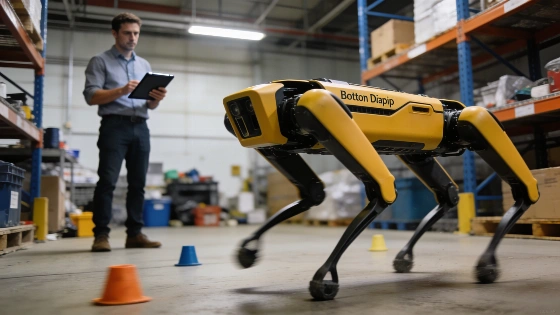
In a demonstration using the Boston Dynamics Spot quadruped robot, researchers began with a simulated warehouse environment before moving to more complex or realistic spaces. COMPASS supports both synthetic environments-such as those from NVIDIA's SAGE-10K dataset, which includes 10,000 generated indoor scenes-and reconstructions of real-world locations using NVIDIA Omniverse NuRec. This flexibility allows developers to test navigation policies in settings that closely resemble the robot's intended operating domain, a step that is often missing from generic simulation-based training.
Training starts with a smoke test to confirm that the robot, environment, sensors, and control systems are correctly integrated. Once this check passes, reinforcement learning is used to fine-tune the navigation policy for the specific robot and environment. The system saves checkpoints throughout training, enabling developers to compare different policy versions and select the most reliable one based on concrete performance metrics: goal-reaching rate, fall frequency, and route completion time. Both the original pretrained policy and the adapted specialist are evaluated under identical conditions to measure improvement.
COMPASS is not the first attempt to streamline robot learning across platforms. Previous research, such as the reported earlier six-legged robot that learned adaptive walking from insect data, has also targeted cross-domain adaptation. However, COMPASS distinguishes itself by automating much of the development pipeline and explicitly requiring human approval at key stages, rather than relying on fully automated retraining or black-box optimization.
Once a navigation policy is approved, it can be integrated into the robot's runtime system. The policy uses camera images, odometry, and navigation goals to generate movement commands. For robots lacking built-in localization, NVIDIA's cuVSLAM can provide visual odometry. The workflow is designed to be repeatable and auditable, with human developers retaining authority over deployment and safety-critical decisions.
Measured results from the COMPASS workflow focus on practical metrics. In the Spot robot demonstration, researchers tracked the percentage of successful goal completions, the number of falls per trial, and the time required to navigate test routes. These figures provide a concrete basis for comparing adapted policies to their pretrained baselines, though the results remain limited to the tested environments and hardware. The system's reliance on simulation and synthetic environments means that real-world performance may still diverge, especially in unmodeled or dynamic settings.
COMPASS's approach-combining pretrained models, reinforcement learning, and automated agent-driven workflows-reflects a pragmatic shift in robotics research. Rather than promising full autonomy or eliminating human oversight, the framework acknowledges the persistent need for human judgment in safety, deployment, and evaluation. The real advance here is not in the sophistication of the learning algorithm, but in the systematization of adaptation and the explicit retention of human authority. For robotics teams facing the grind of repeated retraining, COMPASS offers a more structured, auditable, and developer-centered path forward, but it does not erase the need for careful validation in the environments where robots will actually operate.
Reinforcement learning is a machine-learning technique in which an agent learns to make decisions by receiving feedback in the form of rewards or penalties. In robotics, this often involves training in simulated environments before transferring policies to physical machines. The gap between simulation and reality-known as the sim-to-real gap-remains a central challenge, as models that perform well in controlled settings may fail in unpredictable real-world conditions. Human oversight and staged evaluation are critical to managing these risks, especially when robots are deployed in environments with safety or operational constraints.