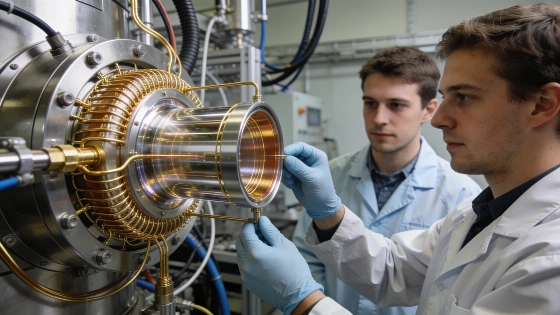
Nord Quantique has advanced quantum error correction using bosonic codes in superconducting cavities, aiming to reduce overhead and improve logical qubit performance in hardware operating at cryogenic temperatures
Nord Quantique, a quantum hardware developer based in Quebec, has reported new progress in quantum error correction using bosonic codes implemented with microwave photons in superconducting cavities. The company's approach aims to encode logical qubits within individual cavities, reducing the physical overhead typically required by conventional quantum error correction schemes. This strategy is designed to address one of the central engineering challenges in quantum computing: the need to suppress errors without scaling up to thousands of physical qubits per logical qubit.
Bosonic Codes in Superconducting Cavities
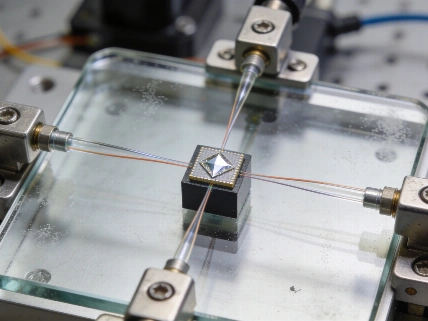
The physical system at the core of Nord Quantique's platform consists of superconducting microwave resonators operated at cryogenic temperatures. By trapping and manipulating microwave photons within these cavities, the company implements bosonic error-correcting codes such as the Gottesman-Kitaev-Preskill (GKP) code and the Tesseract code. These codes are designed to detect and correct both bit-flip and phase-flip errors within a single cavity, potentially enabling a one-to-one mapping between cavities and error-corrected logical qubits. This contrasts with surface-code-based approaches, which typically require hundreds or thousands of physical qubits per logical qubit.
In 2024, Nord Quantique demonstrated a quantum memory based on this architecture. Since then, the company has reported improvements in quantum error correction gain, now exceeding a factor of two compared to the uncorrected baseline, with both X and Z error correction performed and without relying on post-selection. The latest hardware includes a four-qubit system capable of gate operations, scheduled to enter operation within the year. The company's roadmap targets logical error rates between 10-7 and 10-9 by 2032, with the goal of integrating over 2,000 logical qubits within a 10-square-meter cryogenic footprint.
Engineering and Infrastructure
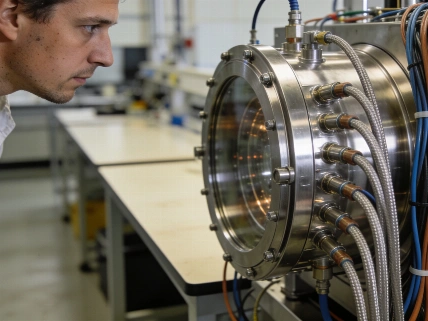
Nord Quantique's development has been shaped by its location in Sherbrooke, Quebec, where it leverages existing fabrication facilities, dilution refrigerators, and benchmarking infrastructure. Rather than building new facilities from scratch, the company rents access to equipment and infrastructure established through more than a billion dollars of prior investment in the region's quantum ecosystem. This capital-efficient approach is intended to accelerate hardware development and reduce the cost of scaling up quantum processors.
The company's focus on bosonic codes is motivated by the scaling challenges faced by transmon-based superconducting qubit architectures, where wiring, control, and crosstalk become increasingly difficult as device counts grow. By encoding redundancy within the cavity itself, Nord Quantique aims to minimize the number of physical components required for each logical qubit, potentially simplifying control and readout while reducing the overall system complexity.
Benchmarking and Roadmap
Recent benchmarking results indicate that Nord Quantique's error correction gain has more than doubled since its 2024 memory demonstration, moving from a factor of approximately 1.1 to over 2. This improvement was achieved with full correction of both bit-flip and phase-flip errors and without post-selection, suggesting that the error correction operates in real time on the hardware. The company's four-qubit system is expected to provide further evidence of multi-qubit gate operations and logical performance in the coming year.
Nord Quantique's roadmap projects logical error rates as low as 10-9 by 2032, but achieving these targets will require advances in code design, hardware stability, and system integration. The company is also exploring high-rate codes and partnerships for commercial system deployment. The broader quantum computing field continues to debate the most practical path to scalable, fault-tolerant quantum computers, with alternative approaches such as trapped-ion and neutral-atom systems also under active development. For context, efforts to integrate multiple quantum processors and simulators, as seen in recent middleware integration projects, highlight the diversity of strategies being pursued to overcome hardware and software bottlenecks.
Limitations and Open Questions
While the reported error correction gain represents a meaningful step, several engineering and scientific challenges remain. The physical implementation of bosonic codes requires precise control of microwave photon states, high-fidelity gates, and stable cryogenic operation. Crosstalk, photon loss, and calibration drift can all degrade performance, and the scalability of the approach beyond a handful of cavities has yet to be demonstrated in hardware. The company's targets for logical error rates and system size remain projections, and independent verification of multi-qubit logical performance will be essential for establishing the platform's viability for large-scale quantum computation.
As with all quantum hardware announcements, the distinction between laboratory demonstration and practical, deployable technology is critical. The field will be watching for peer-reviewed publications, independent benchmarking, and reproducible results as Nord Quantique and other developers advance toward fault-tolerant quantum computing.
Quantum error correction is a set of techniques that protect quantum information from errors caused by decoherence, noise, and imperfect control. In most hardware platforms, a logical qubit is encoded across many physical qubits, with error-correcting codes detecting and correcting errors in real time. Bosonic codes, such as the GKP code, use continuous-variable states of a single mode-like a microwave cavity-to encode redundancy, potentially reducing the number of physical components needed. Achieving low logical error rates is essential for running long quantum algorithms, but implementing error correction in hardware remains a major engineering challenge. The effectiveness of any error-correction scheme depends on the underlying physical error rates, the code's ability to detect and correct errors, and the stability of the hardware over time.